Band 5.5 IELTS Writing Task 1 Model Answer
Overall Band Score: 5.5 · IELTS Momentum Workout · 2026-11-24
IELTS Writing Task 1 question
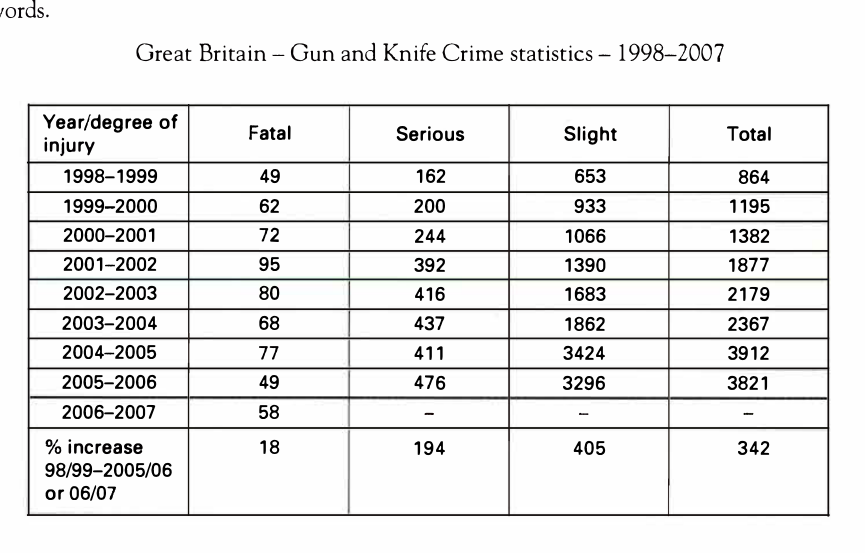
The table shows the number of fatal, serious and slight injuries resulting from gun and knife crime in Great Britain from 1998 to 2007 and the percentage increase for each degree of injury over the period.
Summarise the information by selecting and reporting the main features, and make comparisons where relevant.
Great Britain - Gun and Knife Crime statistics - 1998-2007
Student answer (Band 5.5)
The table illustrates the ratio of three types of injuries caused by gun and knife crime in Great Britain from 1998 to 2007.The numbers rose for each degree of injury over the years.
Overall, all categories of injury had been rising every year except fatal injury mentioned in the table for Great Britain. As whole, the major dramatic increase expresses in the number of slight injuries. The serious injury is shown as second major injury that was reaching the consistent upward slop till 2007. Meanwhile, the only ijury is fata injury that rose slowly.
Firstly, Fatal injuries were constantly increasing till 2002 to 95 from 49 in the year 2000 but account for sudden decline in the year from 2002 to 2004. After 2004 only for one year in 2005 this ijury rose to 77 from 68.
Addditionally, serious injury remained increased till 2007 with significant percentages as to 476 injuries in year 2006 and reamin ewual in 2007.Likewise serious ijury, slight injuries follows same upward trend rose to 3821 injuries from 864 injuries in 2002.
AI examiner evaluation
| Criterion | Band |
|---|---|
| Task Achievement / Task Response | 5.5 |
| Coherence and Cohesion | 5.5 |
| Lexical Resource | 5.0 |
| Grammatical Range and Accuracy | 5.0 |
| Overall | 5.5 |
Task Achievement / Task Response: Band 5.5
You identify the subject and provide an overview that slight injuries rose most markedly, which is a relevant main feature. However, the overview is not consistently accurate: fatal injuries did not rise every year, and serious injuries did not continue upward to 2007 because the table gives no serious-injury figure for that year. Several details are also misreported. The fatal figure of 95 was reached in 2001–02, not “till 2002” from 2000, and slight injuries rose to 3,296 in 2005–06, not 3,821; 3,821 is the total. The response also omits the overall total trend and the percentage increases. Select key figures carefully and distinguish the final available year for each category.
Coherence and Cohesion: Band 5.5
The response has a basic paragraph structure, moving from an introduction and overview to details about fatal injuries and then the other categories. This gives the reader some organisation, and words such as “Overall,” “Firstly” and “Additionally” signal stages in the report. However, progression is weakened by unclear or contradictory statements, including “all categories … had been rising every year except fatal injury” and the claim that serious injuries remained increased till 2007. The final paragraph also combines serious and slight injuries without clearly separating their figures, and the reference to 3,821 is confusing. Use one paragraph for the overview and separate detail paragraphs by category or trend, with clear links between each figure and its year.
Lexical Resource: Band 5.0
You use some task-related vocabulary, including “fatal injuries,” “serious injury,” “slight injuries,” “dramatic increase” and “upward trend,” so the topic is generally recognisable. However, the range is limited and several word choices or collocations are inaccurate or awkward, such as “the ratio of three types,” “increase expresses in the number,” and “remained increased.” Spelling errors—including “ijury,” “fata,” “slop,” and “Addditionally”—are noticeable and sometimes make the text harder to read. Aim for precise reporting language and check spelling carefully; for example, describe the number of cases rather than a ratio, and use verbs such as “rose,” “reached” and “fell” accurately.
Grammatical Range and Accuracy: Band 5.0
You attempt both simple and longer sentences, and the response is usually understandable, but grammatical control is inconsistent. Errors occur in sentence boundaries and punctuation, as in “from 1998 to 2007.The numbers,” and in verb forms and sentence construction: “all categories … had been rising,” “the serious injury … was reaching,” and “fatal injuries were constantly increasing till 2002 to 95.” Articles, agreement and prepositions also need attention, as in “As whole” and “in year 2006.” These recurring problems sometimes make relationships between time periods and figures unclear. Practise building accurate sentences with a clear subject, verb and time reference, then check articles, tense consistency and punctuation.
See this exact question answered at other band scores. The same prompt compared across bands.
Browse more IELTS Writing model answers or get your own writing scored by the same AI examiner.