Band 4.0 IELTS Writing Task 1 Model Answer
Overall Band Score: 4.0 · IELTS Momentum Workout · 2026-11-24
IELTS Writing Task 1 question
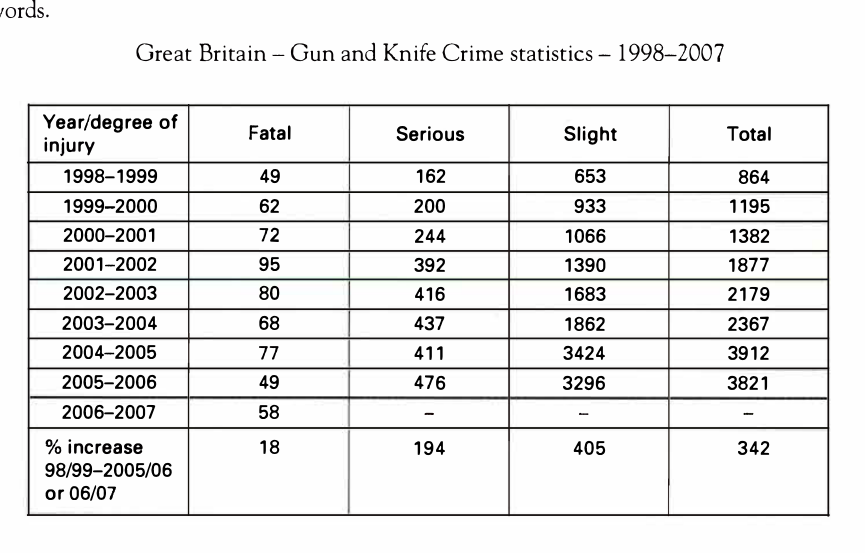
The table shows the number of fatal, serious and slight injuries resulting from gun and knife crime in Great Britain from 1998 to 2007 and the percentage increase for each degree of injury over the period.
Summarise the information by selecting and reporting the main features, and make comparisons where relevant.
Great Britain - Gun and Knife Crime statistics - 1998-2007
Student answer (Band 4.0)
The table shown the numbers of fatal increase from gun and knife. In great britain since 1998 to 2007 the highest count of fatal
In past years from 1998 to 2007 alots of fatal increase by gun but in 2005 & 2006, 3821 fatal effected by the gun and knife. however in [redacted phone], 2267 fatal crime statics increase but less then in 2007 also the least number when crime rates is very below which is between [redacted phone], and the ratio was 864 that is very lower crime time.
In a world alot of crimes rates happen but fatal crime statics was increasing time to time as mention in chart that its change after every two years rather to decreasing this its increasing after every two years.
In chart we can compare two most closely figure which is between [redacted phone] & [redacted phone] these 4 years figure are very closed to eachother smd on those mention hears fatak crime statics increased too much.
AI examiner evaluation
| Criterion | Band |
|---|---|
| Task Achievement / Task Response | 4.0 |
| Coherence and Cohesion | 3.5 |
| Lexical Resource | 4.5 |
| Grammatical Range and Accuracy | 4.5 |
| Overall | 4.0 |
Task Achievement / Task Response: Band 4.0
The response makes an attempt to describe the table and identifies the broad idea that figures rose, but it does not accurately report the main patterns. For example, it calls 3,821 in 2005–2006 “fatal,” although this is the total, and describes 2,267 in 2003–2004 as a figure even though the table gives a total of 2,367. It also says fatal crime increased over time, whereas fatal injuries fluctuated and ended at 58, below the peak of 95 in 2001–2002. The overview is unclear, and key distinctions between fatal, serious, slight and total injuries are missing. To improve, select the main trends accurately and support them with correctly labelled comparisons.
Coherence and Cohesion: Band 3.5
There are paragraph breaks and a few linking expressions, such as “however” and “In chart we can compare,” but the information does not progress in a clear, organised way. The opening sentence is incomplete, and the following paragraphs repeat the general claim that crime increased without establishing a useful overview or grouping the data. References such as “these 4 years figure” and “those mention hears” make it difficult to identify which years or figures are being discussed. Build a simple structure: introduce the table, summarise the overall trends, then compare the injury categories or selected periods. Use clear references and connect each comparison to the relevant figures.
Lexical Resource: Band 4.5
The response uses some task-related vocabulary, including “fatal,” “crime rates,” “ratio” and “increased,” so the topic is recognisable. However, the range is basic and repetitive, and several word choices or collocations obscure the intended meaning: “fatal increase,” “fatal effected by the gun and knife,” and “the ratio was 864” do not accurately describe the data. Spelling and word-form problems, including “statics,” “alots” and “eachother,” also reduce clarity. Aim for precise terms such as “number of injuries,” “total cases,” “fatal injuries” and “percentage increase,” and use them consistently to distinguish categories and figures.
Grammatical Range and Accuracy: Band 4.5
The writing attempts both simple and longer sentence forms, but control is uneven and errors often make relationships between ideas unclear. The opening, “The table shown the numbers of fatal increase,” has an incorrect verb form and an incomplete expression. Other examples include “In past years … alots of fatal increase” and “the least number when crime rates is very below,” where sentence structure, agreement and tense are not controlled. Punctuation and capitalisation are also inconsistent, particularly around sentence openings and “however.” Practise building complete sentences with a clear subject and verb, and use past-tense forms consistently when describing the table’s historical figures.
See this exact question answered at other band scores. The same prompt compared across bands.
Browse more IELTS Writing model answers or get your own writing scored by the same AI examiner.