Band 5.5 IELTS Writing Task 1 Model Answer
Overall Band Score: 5.5 · IELTS Momentum Workout · 2026-11-25
IELTS Writing Task 1 question
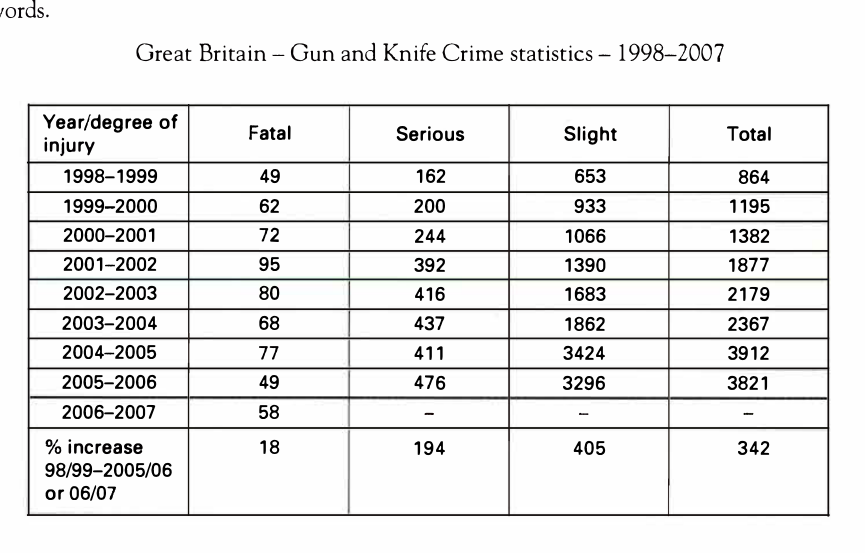
The table shows the number of fatal, serious and slight injuries resulting from gun and knife crime in Great Britain from 1998 to 2007 and the percentage increase for each degree of injury over the period.
Summarise the information by selecting and reporting the main features, and make comparisons where relevant.
Great Britain - Gun and Knife Crime statistics - 1998-2007
Student answer (Band 5.5)
The chart illustrates, the amount of serious damages caused by gun and knife in britian between 1988 and 2007. The number of injuries increased with the time.
Overall, the injuries in late 90's are less and it increased with the time and get to a higher ratio in early 2000. slight injuries are increased more than serious injuries. While there is no big difference in fatal harms.
In late 90's the slight injuries were 653 which increased to 1862 in early 2000. In the last 2 years in 2006 it's increased alot and reached to 3296. Serious damages are less in camaprison of slight harms. Its start from 162 before 2000 and reach to 476 in 2006. fetal injuries are flactuated and very less from the start. it started from 49 in 1999 and then a little increased in 2002 to 95, and than again reduce to 49 in 2006. overall injuries go from 864 to 3821 between 1988 to 2007.
AI examiner evaluation
| Criterion | Band |
|---|---|
| Task Achievement / Task Response | 5.5 |
| Coherence and Cohesion | 5.5 |
| Lexical Resource | 5.0 |
| Grammatical Range and Accuracy | 5.0 |
| Overall | 5.5 |
Task Achievement / Task Response: Band 5.5
You identify the broad pattern that injuries rose and correctly highlight the much larger increase in slight injuries than in fatal cases. Several figures are also accurate, including slight injuries rising from 653 to 1,862 and then reaching 3,296 in 2005–06, and serious injuries increasing from 162 to 476. However, the opening misidentifies the table as showing only serious damage and gives the period as 1988–2007 rather than 1998–2007. The overview is imprecise: the overall total peaks at 3,912 in 2004–05 before falling, and the table does not provide serious, slight or total figures for 2006–07. A clearer overview and more careful reporting of the dates and available data would make the summary more complete and accurate.
Coherence and Cohesion: Band 5.5
The response has a basic paragraph structure, moving from an introduction and overview to details about each injury category. This helps the reader follow the main topics. However, progression within the paragraphs is sometimes unclear, and several links are repetitive or awkward, such as “increased with the time” and “While there is no big difference in fatal harms.” The final sentence returns to the total without explaining its relationship to the earlier figures, while the account of slight injuries jumps between years. Use a more deliberate sequence—for example, overview, then comparisons of the categories, followed by the total—and connect each figure to the trend it demonstrates. Clearer referencing and fewer repeated transitions would improve cohesion.
Lexical Resource: Band 5.0
You use some relevant vocabulary, including “increased,” “fluctuated,” and “in comparison,” and the reader can generally understand which injury categories you mean. However, the range is limited and several choices are inaccurate or unnatural for describing statistical data. “Serious damages” and “fatal harms” are not suitable labels for the table’s injury categories, while “higher ratio” does not clearly describe a higher number. Spelling errors such as “britian,” “camaprison,” and “flactuated,” together with informal “alot,” are noticeable and reduce precision. Choose standard terms such as “injuries,” “figures,” and “cases,” and use verbs like “rose,” “fell,” and “fluctuated” accurately to describe changes.
Grammatical Range and Accuracy: Band 5.0
The response communicates its main points using mostly short, simple sentences, with a few attempts to combine ideas, such as “slight injuries are increased more than serious injuries.” However, grammatical errors occur frequently and sometimes make relationships between figures unclear. Examples include “The chart illustrates, the amount,” where the comma is misplaced, “it increased with the time,” which has an incorrect verb form and article, and “Its start from 162,” which lacks the correct subject–verb construction. Tense and sentence formation also vary inconsistently in “it started from 49 … and then a little increased.” Practise accurate past-tense reporting and build controlled comparisons, for example, “Slight injuries rose from 653 to 1,862, whereas serious injuries increased from 162 to 437 by 2003–04.”
See this exact question answered at other band scores. The same prompt compared across bands.
Browse more IELTS Writing model answers or get your own writing scored by the same AI examiner.