Band 5.5 IELTS Writing Task 1 Model Answer
Overall Band Score: 5.5 · IELTS Momentum Workout · 2026-11-25
IELTS Writing Task 1 question
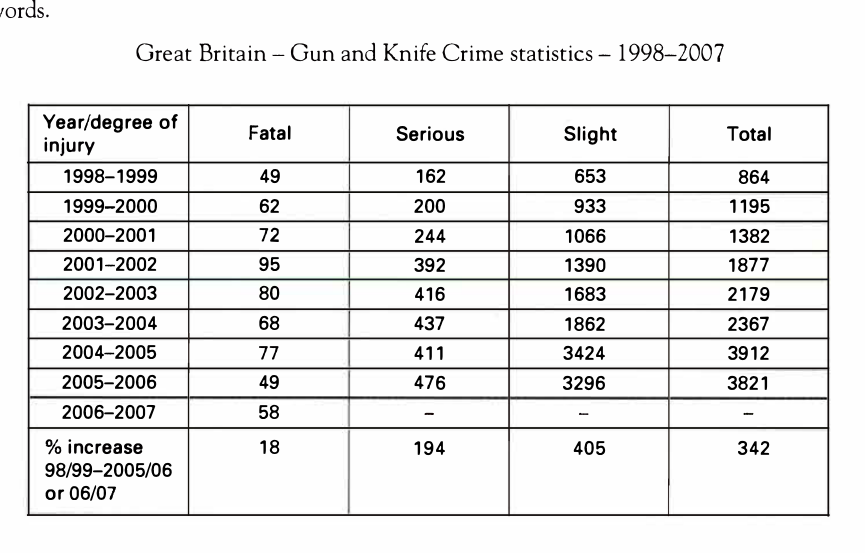
The table shows the number of fatal, serious and slight injuries resulting from gun and knife crime in Great Britain from 1998 to 2007 and the percentage increase for each degree of injury over the period.
Summarise the information by selecting and reporting the main features, and make comparisons where relevant.
Great Britain - Gun and Knife Crime statistics - 1998-2007
Student answer (Band 5.5)
The table shows the total number of three main injuries in Great British results from shoot or knife offence at the time of about 9 years (1998 to 2007) and ratio of incraesed or decreased for each injury with the passage of time.
Overall the table illustrate that 18% increased in fatal, 194% increased in serious and 405% increased in slight injuries where the total number of increased is 342 injuries.
From 1998 to 2000, the fatal moved from 49 to 62, serious from 162 to to 200, slight incresed from 653 to 933 and overall increased from 864 to 1195. in the deuration of 2000 to 2002, the fatal rises from 72 to 95, serious increased from 344 to 392, slight increased from 1066 to 1390.
From 2002 to 2004, the fatal decline from 80 to 68, serious moved from 416 to 432, slight increased from 1683 to 1862 and total rises from 2179 to 2367. From 2004 to 2007, the fatal decreased from 77 to 49 then increased to 58, the serious increased from 411 to 476, slight decline from 3424 to 3296 amd total number is decrased from 3912 to 3821.
AI examiner evaluation
| Criterion | Band |
|---|---|
| Task Achievement / Task Response | 5.5 |
| Coherence and Cohesion | 6.0 |
| Lexical Resource | 5.0 |
| Grammatical Range and Accuracy | 5.0 |
| Overall | 5.5 |
Task Achievement / Task Response: Band 5.5
You identify the table’s subject and report several relevant figures, including the overall rise in injuries and the broad increase in slight injuries. However, the overview is not fully accurate: the percentages are increases, not “increased in” counts, and the total rose by 342% rather than “342 injuries.” Some details are also misreported: serious injuries were 244 in 2000–01, not 344, and 432 in 2003–04, not 437; the table gives no serious, slight or total figures for 2006–07. The response describes selected periods but does not clearly summarise the dominant pattern across the whole table. A more precise overview and careful checking of figures would make the key features clearer and more complete.
Coherence and Cohesion: Band 6.0
The response has a recognisable structure: an introduction, an overview, and paragraphs that group the figures into time periods. This gives the reader a generally coherent route through the data. The time markers “From 1998 to 2000,” “From 2002 to 2004,” and “From 2004 to 2007” help signal progression. However, the final period is confusing because the table has no injury totals after 2005–06, yet the paragraph refers to 2006–07. Some sentences also combine several figures without clear punctuation, and the repeated “increased” and “moved” make the links mechanical. Use clearer sentence boundaries and connect comparisons explicitly, while keeping each period’s figures accurate.
Lexical Resource: Band 5.0
You use some relevant data-reporting vocabulary, including “decline,” “increased,” and “total,” so the reader can understand the general subject. However, the range is limited and several word choices or collocations are inaccurate or awkward. “Ratio of increased or decreased” does not express percentage change naturally, while “fatal moved” and “the serious increased” are imprecise. There are also noticeable spelling errors, such as “incraesed,” “incresed,” “deuration,” and “decrased,” which reduce the polish of the report. Aim for accurate, varied terms such as “rose,” “fell,” “accounted for,” and “percentage increase,” and check spelling before submitting.
Grammatical Range and Accuracy: Band 5.0
The response attempts both simple statements and longer sentences that compare several years, but the range of structures is limited and errors recur. For example, “the table illustrate” has incorrect subject–verb agreement, and “the fatal moved from 49 to 62” uses an unclear grammatical construction. In “serious from 162 to to 200,” the repeated preposition disrupts the sentence, while “the serious increased” lacks a clear noun phrase. Tense and sentence-boundary control are also inconsistent, as in the lower-case “in the deuration” after a full stop. Build comparisons with clear subjects and verbs—for example, “Fatal injuries rose from 49 to 62”—and proofread agreement, articles, and punctuation.
See this exact question answered at other band scores. The same prompt compared across bands.
Browse more IELTS Writing model answers or get your own writing scored by the same AI examiner.