Band 5.5 IELTS Writing Task 1 Model Answer
Overall Band Score: 5.5 · IELTS Momentum Workout · 2026-11-26
IELTS Writing Task 1 question
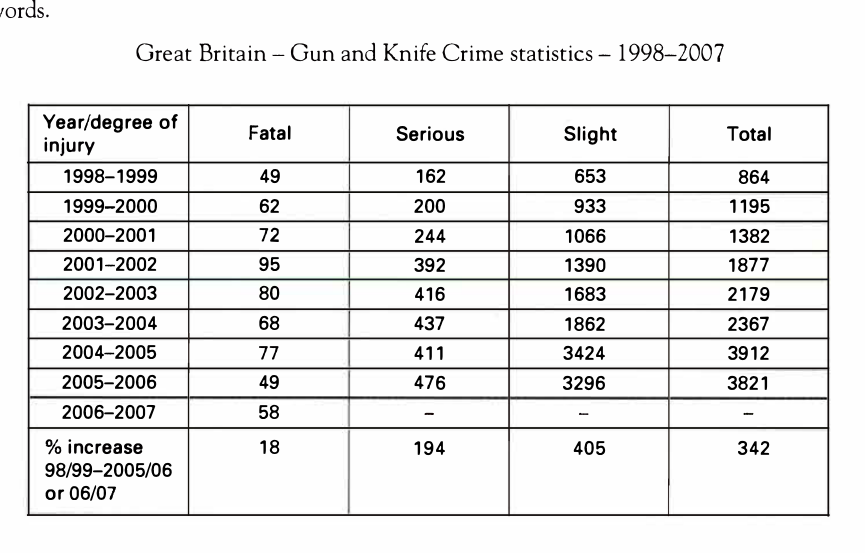
The table shows the number of fatal, serious and slight injuries resulting from gun and knife crime in Great Britain from 1998 to 2007 and the percentage increase for each degree of injury over the period.
Summarise the information by selecting and reporting the main features, and make comparisons where relevant.
Great Britain - Gun and Knife Crime statistics - 1998-2007
Student answer (Band 5.5)
This table shows the number of crimes done in Great Britain from 1998 to 2007 by Gun and Knife.It also shows the seriouness of injuries during these years.
Overall,maximum number of fatal injuries was recorded betweem [redacted phone].Similarly serious injuries were happened in 2005-6 while number of slight injuries was at its peak in 2004-5.
By seeing table in more detail we came to know that cases of fatal injuries were only 49 in 1998-99 but this reached upto 95 in 2001-2 which is maximum but after that number fluctuate and finally reduced to 58 in 2006-7.
In case of serious crime, number increased consistantly as in 1998-99 only 162 case were reported while in 2005-6 it reached upto 476.
Slight injury case were 653 in 1998-9 while this number increased significantly and reached at its peak in 2004-5 with total number of 3424 case.
Total number of injury cases also constantly increased during these years but only a few cases were reported in 2005-6.
AI examiner evaluation
| Criterion | Band |
|---|---|
| Task Achievement / Task Response | 5.5 |
| Coherence and Cohesion | 5.5 |
| Lexical Resource | 5.5 |
| Grammatical Range and Accuracy | 5.5 |
| Overall | 5.5 |
Task Achievement / Task Response: Band 5.5
You identify several relevant patterns, including the fatal-injury peak of 95 in 2001–02 and the serious-injury figure of 476 in 2005–06. However, some key information is inaccurate or unclear: slight injuries peaked at 3,424 in 2004–05, but the response calls this a “case” figure without clearly distinguishing it from total injuries, and the final sentence incorrectly suggests that only a few cases were reported in 2005–06. In fact, the total was 3,821 that year, the second-highest recorded total. The overview also omits the substantial overall rise and the percentage increases shown in the table. More accurate comparisons and a clearer summary of the main trends would make the report more complete.
Coherence and Cohesion: Band 5.5
The response has a recognisable structure: an introduction, an overview, and paragraphs describing fatal, serious and slight injuries. This helps the reader follow the categories. However, progression is weakened by repetitive openings such as “In case of” and “Slight injury case,” and the final sentence introduces total injuries without developing or accurately explaining that trend. Some linking is mechanical, particularly “By seeing table in more detail,” while references such as “this number” could be clearer about which category they refer to. Grouping related trends and using more precise transitions would create a stronger overall progression and make comparisons easier to follow.
Lexical Resource: Band 5.5
You use relevant topic vocabulary, including “fatal injuries,” “serious injuries,” “slight injuries,” “increased” and “peak,” so the main subject is generally understandable. However, the range is limited and several word choices or collocations are inaccurate: “crimes done” is unnatural, “serious injuries were happened” is not an appropriate expression, and “serious crime” changes the meaning from injury severity to crime type. Spelling errors such as “seriouness,” “betweem” and “consistantly” also reduce accuracy. Aim for precise, neutral reporting language and vary verbs for describing figures, while checking spelling and choosing natural combinations of words.
Grammatical Range and Accuracy: Band 5.5
You attempt both simple and more extended sentences, for example, “Overall, maximum number of fatal injuries was recorded…” and the sentence describing the rise from 49 to 95. However, errors in articles, agreement, verb forms and sentence construction are frequent enough to make some statements awkward or unclear. Examples include “maximum number” without an article, “serious injuries were happened,” and “only 162 case were reported.” The final sentence also joins contrasting information unclearly: “Total number … increased … but only a few cases were reported.” Use a reliable pattern such as “The number of … rose from … to …,” check singular and plural forms, and punctuate sentences consistently.
See this exact question answered at other band scores. The same prompt compared across bands.
Browse more IELTS Writing model answers or get your own writing scored by the same AI examiner.