Band 5.0 IELTS Writing Task 1 Model Answer
Overall Band Score: 5.0 · IELTS Momentum Workout · 2026-11-26
IELTS Writing Task 1 question
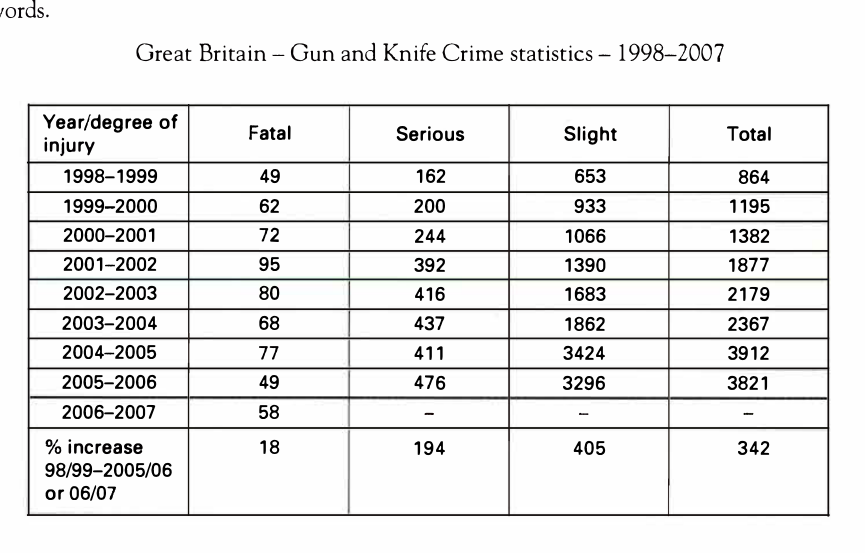
The table shows the number of fatal, serious and slight injuries resulting from gun and knife crime in Great Britain from 1998 to 2007 and the percentage increase for each degree of injury over the period.
Summarise the information by selecting and reporting the main features, and make comparisons where relevant.
Great Britain - Gun and Knife Crime statistics - 1998-2007
Student answer (Band 5.0)
The give table illustrates the changing number of fatal, serious and slight injuries caused from gun and knife crime during the Great britain time from 1998 to 2007.
Overall, it is clear that the figure of slight and serious injury has significant increase over the decade. Fatal injury is also increased but reduce in numbers is seen during the last three years. However, total numbers of these injuries are getting higher by the time.
To begin with, it is seen that the biggest rise was seen in slight injuries which are more than double over the period from 1998 to 2007. Noticeably, the serious injuries also went up from 162 to 476 all over the years. Fatal injuries also gone up but in also last two years it reduce in numbers. In contrast, serious and slight injuries are completely vanished during 2006 to 2007.
Meanwhile, percentage of fatal injury is 18%, Serious injury 194%, and slight injury is 405% during the whole decades. Sum of the total percent is 342%.
AI examiner evaluation
| Criterion | Band |
|---|---|
| Task Achievement / Task Response | 5.0 |
| Coherence and Cohesion | 5.5 |
| Lexical Resource | 5.0 |
| Grammatical Range and Accuracy | 5.0 |
| Overall | 5.0 |
Task Achievement / Task Response: Band 5.0
You identify the broad pattern that serious and slight injuries increased and include the percentage changes, which are relevant features. However, the account only partially reports the table and contains important inaccuracies. Slight injuries did not merely “more than double”: they rose from 653 to 3,296 by 2005–06, and the total peaked at 3,912 in 2004–05 before falling. The statement that serious and slight injuries “vanished” in 2006–07 is unsupported; those entries are unavailable, not zero. You also say fatal injuries increased, but they ended at 58, compared with 49 initially, after fluctuating and reaching 95. Select the main figures accurately and distinguish missing data from a decline.
Coherence and Cohesion: Band 5.5
The response has a recognisable structure: an introduction, an overview, and two detail paragraphs. Sequencing phrases such as “Overall,” “To begin with,” and “Meanwhile” help signal movement between points. However, progression is not consistently clear: the final paragraph shifts to percentages without explaining how they relate to the yearly figures, and “In contrast” does not establish a meaningful contrast before the claim that categories vanished. Some points are repeated, particularly the general increase in injuries, while the overview does not clearly prioritise the sharp rise in slight injuries or the total’s peak and subsequent fall. Group the main trends together and use linking expressions only where the relationship between facts is clear.
Lexical Resource: Band 5.0
You use some task-relevant vocabulary, including “fatal,” “serious,” “slight,” “percentage,” and “over the period,” so the reader can identify the subject. However, the range is limited and several word choices or collocations are inaccurate, making parts of the report awkward or unclear. For example, “the give table” and “Great britain time” do not express the intended meaning naturally, while “completely vanished” wrongly suggests the figures became zero. “Sum of the total percent” is also imprecise for the reported overall percentage increase. Aim for accurate reporting verbs and trend language, such as “rose,” “fluctuated,” “peaked,” and “fell,” and use standard place-name capitalisation.
Grammatical Range and Accuracy: Band 5.0
The response includes simple statements and attempts longer constructions, for example, “Overall, it is clear that…” and “In contrast…”. However, the range is limited, and errors occur frequently in verb forms, agreement, articles, and sentence construction. Examples include “Fatal injury is also increased,” “Fatal injuries also gone up,” and “it reduce in numbers”; these should use consistent past-tense forms such as “increased,” “went up,” and “it fell.” Agreement is also faulty in “the figure … have significant increase,” and the opening sentence lacks a clear grammatical structure. These errors sometimes make relationships between figures difficult to follow. Practise accurate past-tense reporting and build clear sentences around each comparison.
See this exact question answered at other band scores. The same prompt compared across bands.
Browse more IELTS Writing model answers or get your own writing scored by the same AI examiner.