Band 6.0 IELTS Writing Task 1 Model Answer
Overall Band Score: 6.0 · IELTS Momentum Workout · 2026-11-26
IELTS Writing Task 1 question
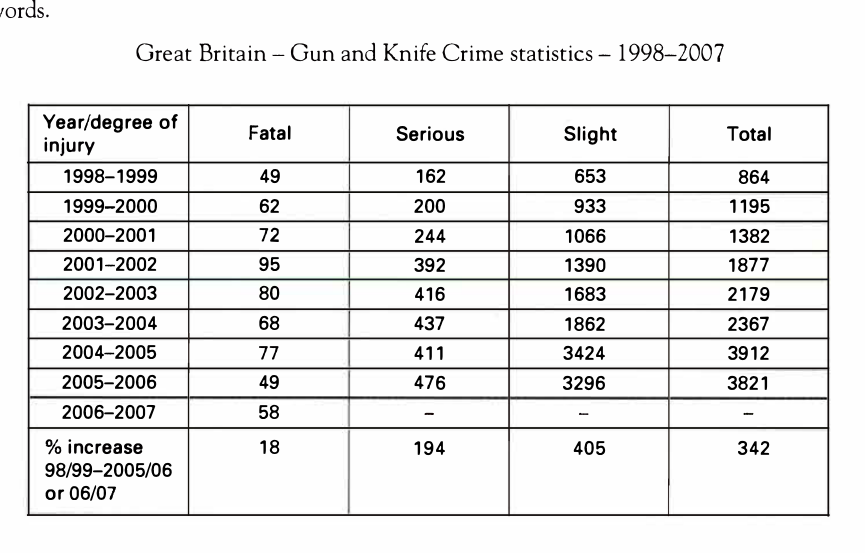
The table shows the number of fatal, serious and slight injuries resulting from gun and knife crime in Great Britain from 1998 to 2007 and the percentage increase for each degree of injury over the period.
Summarise the information by selecting and reporting the main features, and make comparisons where relevant.
Great Britain - Gun and Knife Crime statistics - 1998-2007
Student answer (Band 6.0)
The table represents the number of injured people from gun and knife crime and how severe the injuries are(fatal, serious and slight) in Great Britain between 1998 and 2007, and the percentage increase for each section of injury over time.
Overall, the number of slight injured people had increased significantly. However, the number of fatal injured people decreased over time.
The number of slight injured poeple increased significantly till [redacted phone], which was 3424, although in [redacted phone] the number decreased by 128. Additionally, the increase rate of the percentage of slightly injured people was the highest, which was 405%. Though the number of serious injured people decreased slighty in [redacted phone], which was 411, it was the second highest and got increased again in [redacted phone] by 65, which was 476. The increase percentage of serious injured people was 194%.
However, the number of fatal injured people are significantly less over the period, and it was 58 in [redacted phone]. It increased till [redacted phone], which was 95, and it was the highest number in fatal category. After that it started decreased and the percentage of fatal injured people was 18% over time.
AI examiner evaluation
| Criterion | Band |
|---|---|
| Task Achievement / Task Response | 6.0 |
| Coherence and Cohesion | 6.5 |
| Lexical Resource | 5.5 |
| Grammatical Range and Accuracy | 5.5 |
| Overall | 6.0 |
Task Achievement / Task Response: Band 6.0
You identify the main pattern of growth in slight injuries and report the peak in 2004–05, the subsequent fall, and the 2005–06 figure. You also cover serious and fatal injuries, including the fatal peak of 95 in 2001–02 and the final figure of 58. However, the overview is incomplete: fatal injuries did not simply “decrease over time,” as they fluctuated and ended above the starting figure of 49. The serious-injury trend also rose overall, reaching 476 in 2005–06, but this is not clearly summarised. In addition, the 405% increase belongs to slight injuries, while the table gives 342% for the total; make clear that the percentages refer to the period shown. More balanced coverage of the overall total and key trends would strengthen the report.
Coherence and Cohesion: Band 6.5
The response has a clear overall arrangement: an introduction, a brief overview, and separate discussion of slight, serious, and fatal injuries. This makes the information easy to follow, and linking words such as “Additionally,” “Though,” and “However” help signal relationships. The progression is generally logical, but some connections are mechanical or unclear. For example, “Though the number of serious injured people decreased slightly…” is followed by “it was the second highest,” leaving the comparison’s reference unclear. The overview also separates the two main trends without explaining how they relate. To improve, group related figures more deliberately and use precise references such as “the serious-injury figure” rather than repeating “the number of … injured people.”
Lexical Resource: Band 5.5
You use relevant vocabulary for describing data, including “increased significantly,” “decreased,” “percentage,” and “highest,” so the main comparisons are understandable. However, several repeated or inaccurate phrases limit precision. “Slight injured people” and “fatal injured people” are unnatural; use “people with slight injuries” and “fatalities” or “fatal injuries.” “Increase rate of the percentage” is unnecessarily wordy, while “the percentage increase” is the appropriate expression. There are also spelling errors in “poeple” and “slighty.” Aim for accurate collocations and vary the language for describing trends, for example “rose,” “fell,” “reached a peak,” and “accounted for.”
Grammatical Range and Accuracy: Band 5.5
You attempt a mix of simple and complex sentences, including clauses introduced by “although,” “though,” and “which,” and the meaning is generally clear. Some grammatical errors remain. In “the number of slight injured people had increased,” the adjective and verb form are not well controlled; write “the number of people with slight injuries increased.” In “the number of fatal injured people are,” the singular subject “number” requires “is,” and “it started decreased” should be “it started to decrease” or “it began decreasing.” The sentence beginning “Though the number…” is also awkwardly joined to its main clause. Check subject–verb agreement, verb patterns after “start,” and sentence boundaries while retaining your attempts at complex structures.
See this exact question answered at other band scores. The same prompt compared across bands.
Browse more IELTS Writing model answers or get your own writing scored by the same AI examiner.