Band 5.0 IELTS Writing Task 1 Model Answer
Overall Band Score: 5.0 · IELTS Momentum Workout · 2026-11-26
IELTS Writing Task 1 question
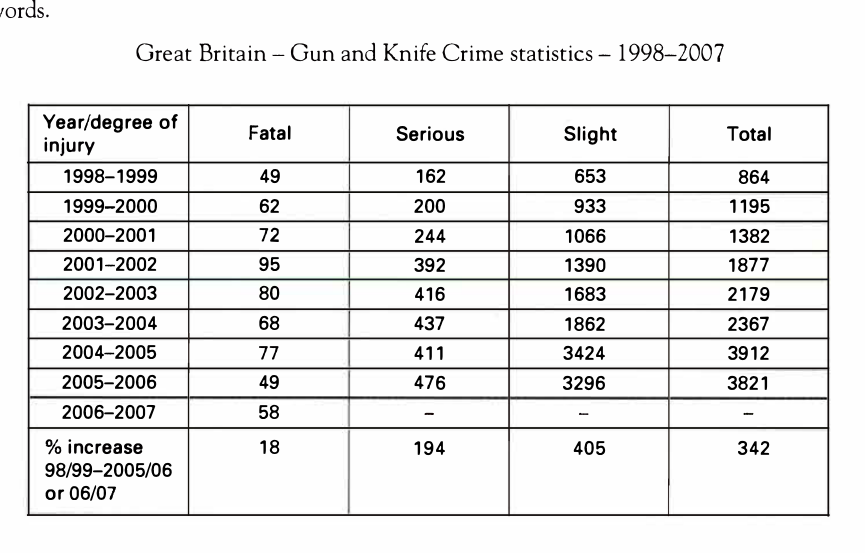
The table shows the number of fatal, serious and slight injuries resulting from gun and knife crime in Great Britain from 1998 to 2007 and the percentage increase for each degree of injury over the period.
Summarise the information by selecting and reporting the main features, and make comparisons where relevant.
Great Britain - Gun and Knife Crime statistics - 1998-2007
Student answer (Band 5.0)
The table chart compares the number of gun and knif crime statistics in Great Britain between 1998 and 2007. Unites accounted as percentage. Overall, the injuried by slight was the most high rated crime at the beginning of the period ,while fatal recorded the lowest one. At the end of the period the number of slight crime increased dramatically as well as serious and fatal were rise.
In 1998 to 19999, fatal accounted at 49 ,while slight had 653 percentage and total was stood at 864. In first 20th century, Every crime was expaned. In 2001 to 2002 fatal saw a rise from 72 to 95 and declined slightly at 68 and at the end of period it just stayed at 58 ,while serious countinously grew year by year from 244 to 476 in 2005 to 2006. There had no record in 2006 to 2007 in serious and slight.
slight crime had extreme level crime in the UK. At the beginning, it recoreded 653 and total was 864. However, it boosted from 653 to 3296 at the end of period and total stood at 3821.
AI examiner evaluation
| Criterion | Band |
|---|---|
| Task Achievement / Task Response | 5.0 |
| Coherence and Cohesion | 4.5 |
| Lexical Resource | 5.0 |
| Grammatical Range and Accuracy | 5.0 |
| Overall | 5.0 |
Task Achievement / Task Response: Band 5.0
You identify the main broad pattern: slight injuries are the most numerous, fatal injuries are the fewest, and the figures generally rise. You also include several relevant values, such as 49 fatal injuries and 653 slight injuries at the start, and 3,296 slight injuries in 2005–06. However, the account only partly covers the table: it gives little attention to the total, whose peak is 3,912 in 2004–05, and does not clearly report the stated percentage increases. Some descriptions are inaccurate or unclear: slight injuries rose sharply to 3,424 in 2004–05 before falling to 3,296, rather than simply increasing to the end; serious injuries also did not rise every year. Select the key trends and compare them accurately to make the summary more complete.
Coherence and Cohesion: Band 4.5
The response has a basic paragraph structure, with an opening overview followed by details, and words such as “Overall,” “while,” and “However” attempt to connect ideas. Nevertheless, progression is difficult to follow because the figures are presented in a loose sequence, and the final paragraph repeats the starting and ending slight-injury figures without adding a clear comparison. The phrase “In first 20th century” also interrupts the timeline rather than linking the relevant years clearly. Group the information into a logical overview and one or two detail paragraphs—for example, describe fatal and serious injuries together, then slight injuries and totals. Use clear time references and avoid repeating the same data.
Lexical Resource: Band 5.0
You use some relevant terms, including “fatal,” “serious,” “slight,” “declined,” and “increased dramatically,” so the reader can recognise the subject and some trends. However, the range is limited and several word choices or collocations make the meaning awkward: “table chart,” “slight crime,” “most high rated,” and “extreme level crime” are not natural descriptions of injury figures. There are also noticeable spelling and word-form errors, including “knif,” “Unites,” “injuried,” “expaned,” and “recoreded.” These errors sometimes make the intended meaning less clear. Use precise terms such as “injuries,” “number of cases,” “rose,” and “fell,” and check spelling and collocations carefully.
Grammatical Range and Accuracy: Band 5.0
You attempt both simple and longer sentences, including a comparison with “while” and a sequence describing changes over time. However, the range is limited, and errors occur frequently enough to make some sentences difficult to interpret. Examples include “fatal accounted at 49,” “total was stood at 864,” and “serious and fatal were rise”; these show problems with verb forms and sentence construction. Articles, prepositions, and punctuation are also inconsistent, as in “In 1998 to 19999” and the spaces before commas. Aim for straightforward, accurate patterns such as “Fatal injuries stood at 49” and “The total reached 864.” Then practise combining these accurately with clauses using “while” or “whereas.”
See this exact question answered at other band scores. The same prompt compared across bands.
Browse more IELTS Writing model answers or get your own writing scored by the same AI examiner.