Band 5.0 IELTS Writing Task 1 Model Answer
Overall Band Score: 5.0 · IELTS Momentum Workout · 2026-11-27
IELTS Writing Task 1 question
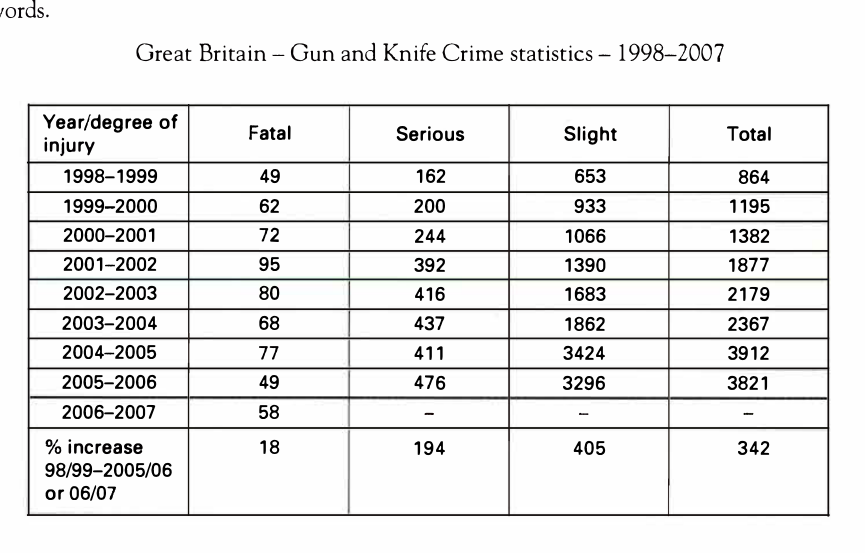
The table shows the number of fatal, serious and slight injuries resulting from gun and knife crime in Great Britain from 1998 to 2007 and the percentage increase for each degree of injury over the period.
Summarise the information by selecting and reporting the main features, and make comparisons where relevant.
Great Britain - Gun and Knife Crime statistics - 1998-2007
Student answer (Band 5.0)
The data illustrates the portion of fatal, serious and slight casualties resulting from gun and knife crime and proportion of each degree of injuryfrom 1998 to 2007.
Overall, the most number of injuries was found to be in the year [redacted phone] followed by the comming years while least was found in the year between [redacted phone]. Out of fatal, serious and slight injuries, the highest number of percentage increase was found in the slight injuries and the least was recorded in fatal injuries.
According to what is shown, the least number of crime was recorded in the first year with 864 crime followed by increasing number of year till it reaches 3821 by the year [redacted phone]. in addition slight injuries from a crime also followed a increasing trend from initial year to final year reaching 3296. The highest number of serious crime was found to be recorded in [redacted phone] with 476 and it also had shown a increasing trend till the year [redacted phone].
Furthermore, the total percentage increase of injuries from gun and kniofe was found to be 34
2. The most amount of increase in percentage was found to be 405 of the category of slight injuries while serious and fatal injuries was found to be at 194 and 18.
AI examiner evaluation
| Criterion | Band |
|---|---|
| Task Achievement / Task Response | 5.5 |
| Coherence and Cohesion | 5.0 |
| Lexical Resource | 5.0 |
| Grammatical Range and Accuracy | 5.0 |
| Overall | 5.0 |
Task Achievement / Task Response: Band 5.5
You identify the broad pattern that totals were lowest at the start and that slight injuries had the largest percentage increase, and you include several relevant figures. However, some key details are inaccurate or unclear: the total peaked at 3,912 in 2004–05, then fell to 3,821 in 2005–06, rather than rising to 3,821 in 2006–07; the table gives no total for 2006–07. You also describe 476 as the highest number of serious injuries but attach it to 2005–06 without clearly distinguishing it from the preceding years. The overview is present, but the account is only partly accurate and does not clearly compare the main trends across the period. Check each figure against its row and explain the overall rise and final decline.
Coherence and Cohesion: Band 5.0
The response has a recognisable structure, with an introduction, an overview and two detail paragraphs, and it uses basic linking expressions such as “Overall,” “According to what is shown” and “Furthermore.” However, progression is not consistently clear: the discussion moves from totals to slight injuries, then serious injuries, and finally percentage increases without a well-defined grouping of information. Some links are repetitive or do not clarify relationships, and the sentence beginning “The highest number of serious crime…” is difficult to follow because it combines a peak figure with a claim about an earlier upward trend. Organise the details into clearer comparisons—for example, totals and injury counts first, then percentage changes—and use references that make the year and category being discussed unmistakable.
Lexical Resource: Band 5.0
You use some task-relevant vocabulary, including “fatal,” “serious,” “slight injuries,” “percentage increase” and “recorded,” so the reader can generally identify the categories being discussed. However, the range is limited and several word choices or collocations are inaccurate or repetitive. “The most number of injuries” and “the least number of crime” are not natural expressions; use “the highest number of injuries” and “the lowest total.” “Portion” is also unsuitable when reporting counts, and “crime” is repeatedly used where “injuries” or “incidents” is intended. There are spelling errors such as “comming” and “kniofe,” and the split “34 / 2” makes the percentage figure hard to read. Aim for precise terms and check spelling before submitting.
Grammatical Range and Accuracy: Band 5.0
You attempt both simple and longer sentences, and the overall meaning is usually recoverable. However, errors occur frequently in sentence construction, agreement, articles and verb forms, which sometimes make the information difficult to interpret. For example, “the most number of injuries was found” has faulty agreement and phrasing, while “serious and fatal injuries was found to be at 194 and 18” does not agree with its plural subject. The sentence “it also had shown a increasing trend” uses an awkward tense and article, and several sentences begin with lowercase “in addition.” Practise building accurate comparisons with a clear subject and verb, such as “Slight injuries increased from 653 to 3,296,” and check agreement, articles and sentence punctuation.
See this exact question answered at other band scores. The same prompt compared across bands.
Browse more IELTS Writing model answers or get your own writing scored by the same AI examiner.