Band 5.0 IELTS Writing Task 1 Model Answer
Overall Band Score: 5.0 · IELTS Momentum Workout · 2026-11-28
IELTS Writing Task 1 question
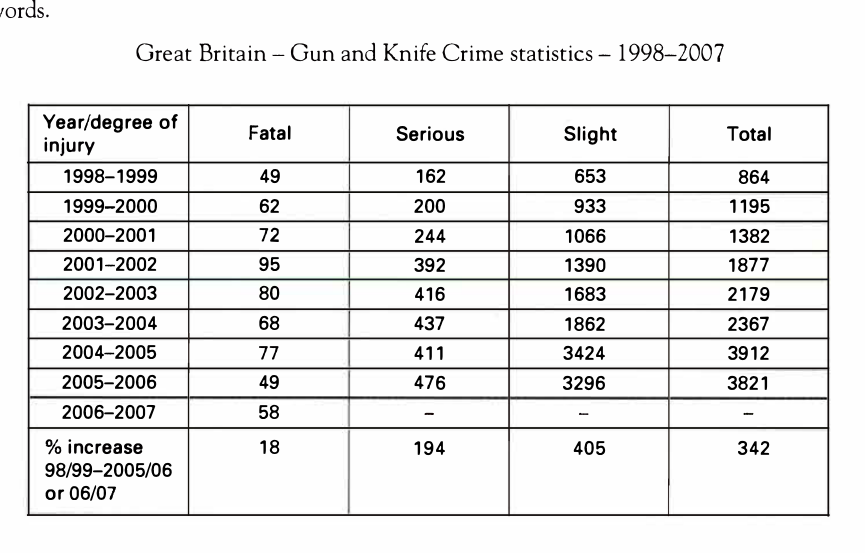
The table shows the number of fatal, serious and slight injuries resulting from gun and knife crime in Great Britain from 1998 to 2007 and the percentage increase for each degree of injury over the period.
Summarise the information by selecting and reporting the main features, and make comparisons where relevant.
Great Britain - Gun and Knife Crime statistics - 1998-2007
Student answer (Band 5.0)
The table gives information about Great Britain gun and knife crime, where the number of
fatal, serious and slight injuries during the period between 1998 and 2007.
Overall, it can be seen that all three injuries increase from 1998 to 2007. Serious and slight injuries sharply go up. But fatal injuries rise slowly.
In meantime, the percentage of slight injuries increase to 342% in 2006. Same time the percentage of serious injuries increase to 194% in 2007. During period [redacted phone] the number of slight injuries is 653. But the time [redacted phone] in Great Briten for gun and knife crime many people slight injuries it stopped in 2396. In[redacted phone] serious injuries rise 162 to 476.
Moving on 1998 to 2007 Great Britain gun and knife crime there are fatal injuries increase slowly. It can be seen that fatal injuries in
[redacted phone] number was 49.. But the end of 2006 to 2007 fatal injuries number 58. It slowly rise between 1998 and 2007.
In conclution, it can be seen that Great Britain gun and knife crime increase. Serious and slight injuries rapidly increase but fatal injuries slowly climb.
AI examiner evaluation
| Criterion | Band |
|---|---|
| Task Achievement / Task Response | 5.5 |
| Coherence and Cohesion | 5.0 |
| Lexical Resource | 5.0 |
| Grammatical Range and Accuracy | 4.5 |
| Overall | 5.0 |
Task Achievement / Task Response: Band 5.5
You identify the broad pattern that injuries increased and distinguish the slower rise in fatal cases from the larger increases in serious and slight injuries. You also include some relevant figures, such as fatal injuries rising from 49 to 58. However, the overview is not fully accurate: fatal injuries did not rise steadily, and slight injuries peaked at 3,424 in 2004–05 before falling to 3,296, rather than stopping at 2,396. The percentage figures are also misattributed: 342% is the increase in the total, while slight injuries rose by 405%; serious injuries rose by 194%. Several key comparisons are therefore unclear or incorrect, leaving the main features only partially reported.
Coherence and Cohesion: Band 5.0
The response has a recognisable structure, with an introduction, an overview, detail paragraphs and a conclusion. This gives the reader some organisation, and phrases such as “Overall” and “Moving on” signal transitions. However, there is no clear progression through the data: the discussion shifts between percentages, slight injuries and fatal injuries, then repeats the overview in the conclusion. Linking is often mechanical or unclear, as in “In meantime” and “Same time,” and “it” in “it stopped in 2396” has no clear reference. Group the figures by injury category or compare the start and end of the period, and use transitions that accurately show how each point relates to the previous one.
Lexical Resource: Band 5.0
You use some relevant topic vocabulary, including “fatal,” “serious,” “slight,” “percentage” and “increase,” so the subject is generally identifiable. However, the range is limited and several expressions are repeated, particularly “increase” and “injuries.” Some word choices or collocations make the data difficult to interpret, such as “it stopped in 2396” and “many people slight injuries”; “rise slowly” is also repeated without much variation. There are noticeable spelling errors, including “Briten” and “conclution.” Use precise reporting language for trends and values, and check spelling carefully. A wider, more accurate range would make the comparisons clearer and more suitable for an academic summary.
Grammatical Range and Accuracy: Band 4.5
You attempt both simple and longer sentence forms, and some basic statements are understandable, such as “fatal injuries rise slowly.” However, the range is limited, and errors occur frequently in sentence construction, verb forms and articles. For example, “where the number of fatal, serious and slight injuries during the period” is an incomplete clause, while “the percentage of slight injuries increase” has subject–verb disagreement. “In meantime” and “the time 2005-2006” also show problems with article use and sentence patterns. Punctuation is inconsistent, including the double full stop after “49.” Build complete sentences around each comparison, check singular and plural subjects, and use consistent past-tense forms when describing the table.
See this exact question answered at other band scores. The same prompt compared across bands.
Browse more IELTS Writing model answers or get your own writing scored by the same AI examiner.