Band 5.5 IELTS Writing Task 1 Model Answer
Overall Band Score: 5.5 · IELTS Momentum Workout · 2026-11-28
IELTS Writing Task 1 question
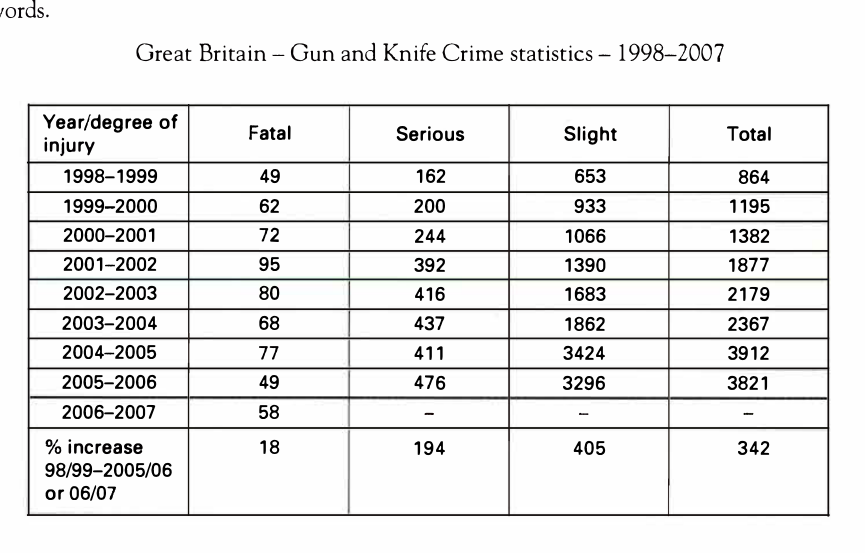
The table shows the number of fatal, serious and slight injuries resulting from gun and knife crime in Great Britain from 1998 to 2007 and the percentage increase for each degree of injury over the period.
Summarise the information by selecting and reporting the main features, and make comparisons where relevant.
Great Britain - Gun and Knife Crime statistics - 1998-2007
Student answer (Band 5.5)
The given table reveals three types of injuries from 1998 to 2007 by bullet and knife crime, indicating an increasing trend in each category.
Overall, over increasing trend is observed in various injuries like fatal serious and slight from 1998 to 2007. slight injuries are in higer than serious while srious is grater than fatal, furthermore percentage also increased among three categories like slight, serious and fatal respectively 405%, 194% and 18 Percent.
Highest observation is recorded in slight injuries which is several time s higher than fatal while almost four time than serious injuries.The gradual increase in each year in slight injuries from 653 in [redacted phone] and recorded 3296 in [redacted phone] while [redacted phone] data is not available.Serious injuries are noticed 162 in [redacted phone] and steady increase in number in each years final obsrved in 476 in [redacted phone] while [redacted phone] data not available.
Fatal injuries are recored lowest in number as compare to serious and slight injuries 49 in [redacted phone] and smooth uplift and gain 58 in [redacted phone]. The percentage trend is highest in slight injuries stand at 405% from whole period while 194% recorded in seriouso observed 194 % over the period.Lowest percentage recorded in Fatal injurires 18 % in fatal injures over the period.
AI examiner evaluation
| Criterion | Band |
|---|---|
| Task Achievement / Task Response | 6.0 |
| Coherence and Cohesion | 5.5 |
| Lexical Resource | 5.0 |
| Grammatical Range and Accuracy | 5.0 |
| Overall | 5.5 |
Task Achievement / Task Response: Band 6.0
You identify the main categories and give a relevant overview: slight injuries were the most numerous, fatal injuries the fewest, and the percentage increases were greatest for slight injuries and smallest for fatal injuries. Several figures are also accurate, including the slight-injury counts of 653 and 3,296 and the fatal count of 58 in 2006–07. However, the overview says all categories rose, although fatal injuries fluctuated and ended only slightly above their starting point. The description of serious injuries as increasing steadily also overlooks the fall from 437 to 411 in 2004–05. The total figures are not discussed, and “almost four time” as many slight as serious injuries is not consistently supported by the data. More precise comparisons and a clearer account of fluctuations would strengthen the report.
Coherence and Cohesion: Band 5.5
The response has a recognisable structure: an introduction, an overview, and paragraphs describing the injury categories. This helps the reader locate the main information. However, progression within the paragraphs is weakened by repeated points, especially the percentage increases, which appear in both the overview and the final paragraph. Linking expressions such as “furthermore” and “while” are used, but some connections are awkward or unclear, as in “while almost four time than serious injuries.” The final paragraph also combines fatal-injury figures with a repeated summary of percentages. Grouping the main trends more deliberately and using clear references between comparisons would make the organisation more coherent and less repetitive.
Lexical Resource: Band 5.0
You use relevant topic vocabulary, including “fatal,” “serious,” “slight,” “percentage,” and “trend,” so the reader can generally understand the subject. There are also attempts to describe change with phrases such as “gradual increase” and “smooth uplift.” However, word choice and spelling errors are noticeable and sometimes make the meaning less clear: “higher” is misspelled as “higer,” “serious” as “srious,” and “recorded” as “recored.” Some expressions are not natural in this context, including “highest observation,” “smooth uplift,” and “from whole period.” Aim for accurate, conventional reporting language and check spelling carefully; this will make your comparisons more precise and easier to follow.
Grammatical Range and Accuracy: Band 5.0
You attempt both simple statements and longer sentences, and the response is generally understandable. However, control of sentence structure is inconsistent, particularly when several ideas are joined together. For example, “Overall, over increasing trend is observed…” has an incomplete or misformed opening, while “slight injuries are in higer than serious” lacks a correct comparative structure. Articles, agreement, and punctuation also need attention; “Highest observation is recorded” would require a more suitable sentence construction, and several sentences run together without clear punctuation. Practise building accurate comparison sentences, such as “Slight injuries were more numerous than serious injuries,” and separate each main point into a complete sentence. More reliable control of these patterns would improve clarity.
See this exact question answered at other band scores. The same prompt compared across bands.
Browse more IELTS Writing model answers or get your own writing scored by the same AI examiner.