Band 6.0 IELTS Writing Task 1 Model Answer
Overall Band Score: 6.0 · IELTS Momentum Workout · 2026-11-06
IELTS Writing Task 1 question
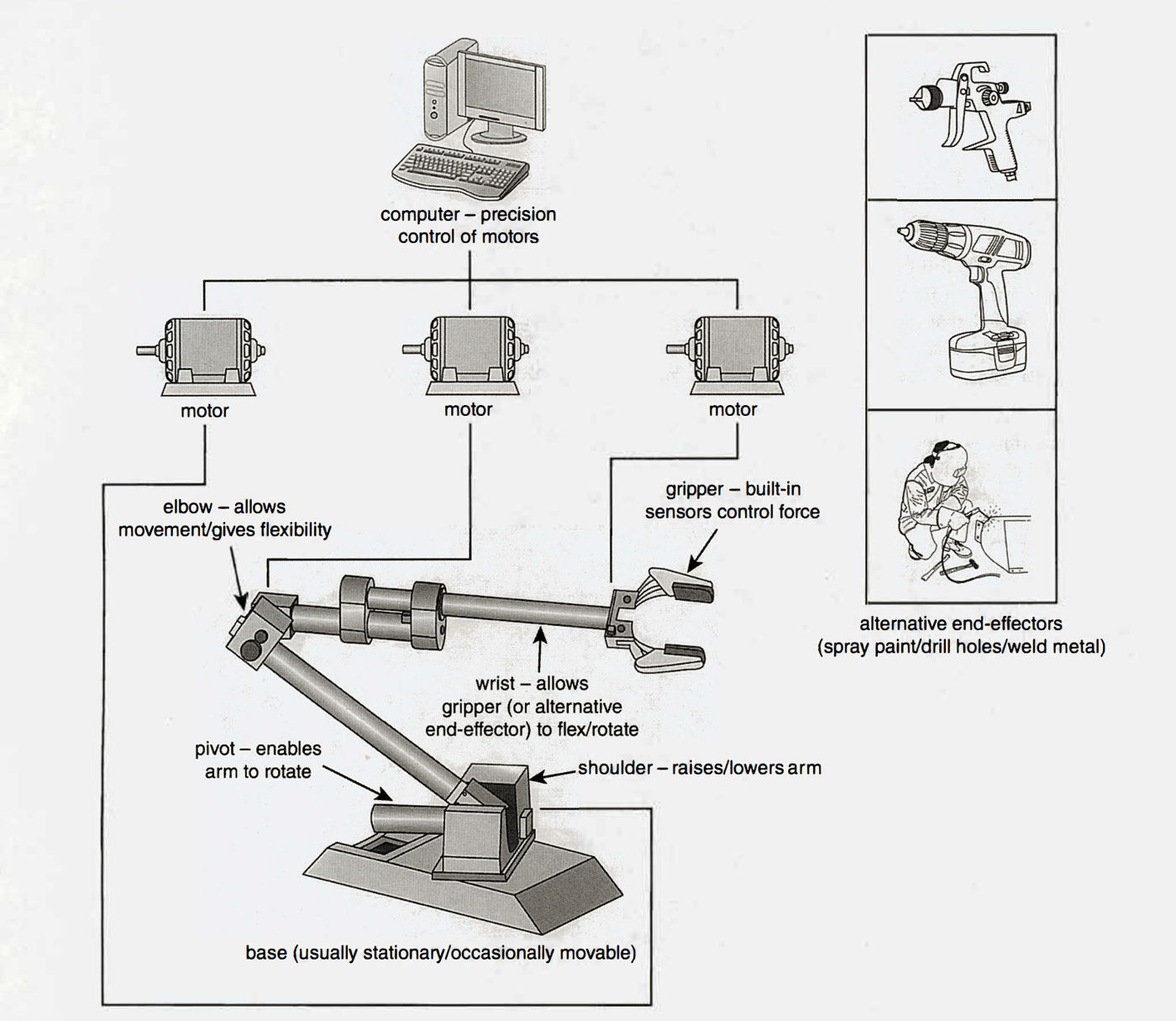
The diagram below shows how a mechanical arm works, and how the joints that make up the arm function in the same way as those in a human arm. Summarise the information by selecting and reporting the main features, and make comparisons where relevant.
Student answer (Band 6.0)
The diagram given portraits how a mechanical arm functions, moreover, how the joints that make up the industrial arm work in the same way as the human arm joints.
Overall, we can understand from the diagram that the computer monitors all of the movement that the mechanical arm does; it can give it commands to: grip, move flexibly, and raise or lower its shoulders.
The computer can control the arm through three different motors. The first motor is located in the base of the arm, it is responsible for moving the arm up and down. The second motor is located in the elbow, it is the motor that gives the arm the ability to move and flex. The third motor is right in the end of the wrist, it is the one that gives the arm the ability to grip; it has a built in sensors that allows it to control force.
There are also other parts shown in the diagram, such as; the base and the pivot which enables the arm to rotate.
AI examiner evaluation
| Criterion | Band |
|---|---|
| Task Achievement / Task Response | 5.5 |
| Coherence and Cohesion | 6.0 |
| Lexical Resource | 6.0 |
| Grammatical Range and Accuracy | 5.5 |
| Overall | 6.0 |
Task Achievement / Task Response: Band 5.5
You identify the diagram’s main subject and give an overview of computer control and several arm functions. However, some key details are misreported: the first motor is not described as being in the base or as moving the arm up and down; the diagram associates the shoulder with raising and lowering, while the base supports the arm. The motor connections are also not accurately matched to the elbow, wrist area and gripper. The comparison with human joints is mentioned in the introduction but not explained, and the alternative end-effectors (spraying, drilling and welding) are omitted. To strengthen the response, describe the arm’s parts and functions in their shown positions, and include the interchangeable tools as a main feature.
Coherence and Cohesion: Band 6.0
The response has a recognisable structure: an introduction, an overview and two paragraphs of details. This makes the information reasonably easy to follow, and the progression from computer control to arm components is generally logical. Some connections between ideas are less clear, however. The overview lists commands, while the following paragraph assigns functions to motors in a way that does not clearly correspond to the diagram. The final paragraph introduces the base and pivot abruptly and ends without covering the alternative end-effectors. Punctuation around “such as;” is also distracting. Grouping the description by the control system, the arm’s joints and its tools would create a more complete progression, with clearer links between each part and its function.
Lexical Resource: Band 6.0
You use an adequate range of task-related vocabulary, including “motors,” “pivot,” “flex,” “grip” and “control force,” so the subject is generally clear. There are also attempts at more specific phrasing, such as “built in sensors.” Some word choices and collocations are inaccurate or informal: “portraits” is not the right verb for describing a diagram, and “the diagram given” is awkward. “Shoulders” is also imprecise when referring to the mechanical arm’s shoulder joint. Repetition of “the ability to” makes the description less concise. Aim for precise technical terms and natural reporting language, such as “illustrates,” “is connected to,” and “the shoulder joint,” while avoiding repeated general phrases.
Grammatical Range and Accuracy: Band 5.5
You use a mix of simple and more complex structures, including the overview clause beginning “that the computer monitors” and the relative clause “which enables the arm to rotate.” Meaning is usually understandable, but some grammatical errors remain. In “The first motor is located in the base of the arm, it is responsible…,” two independent clauses are joined with a comma; use a full stop or a conjunction. “It has a built in sensors that allows it” has errors in article, number agreement and verb agreement; write “it has built-in sensors that allow it.” The colon after “commands to” is unnecessary, and the semicolon after “such as” is incorrectly placed. More accurate sentence boundaries and agreement would improve control.
See this exact question answered at other band scores. The same prompt compared across bands.
Browse more IELTS Writing model answers or get your own writing scored by the same AI examiner.