Band 5.0 IELTS Writing Task 1 Model Answer
Overall Band Score: 5.0 · IELTS Momentum Workout · 2026-11-10
IELTS Writing Task 1 question
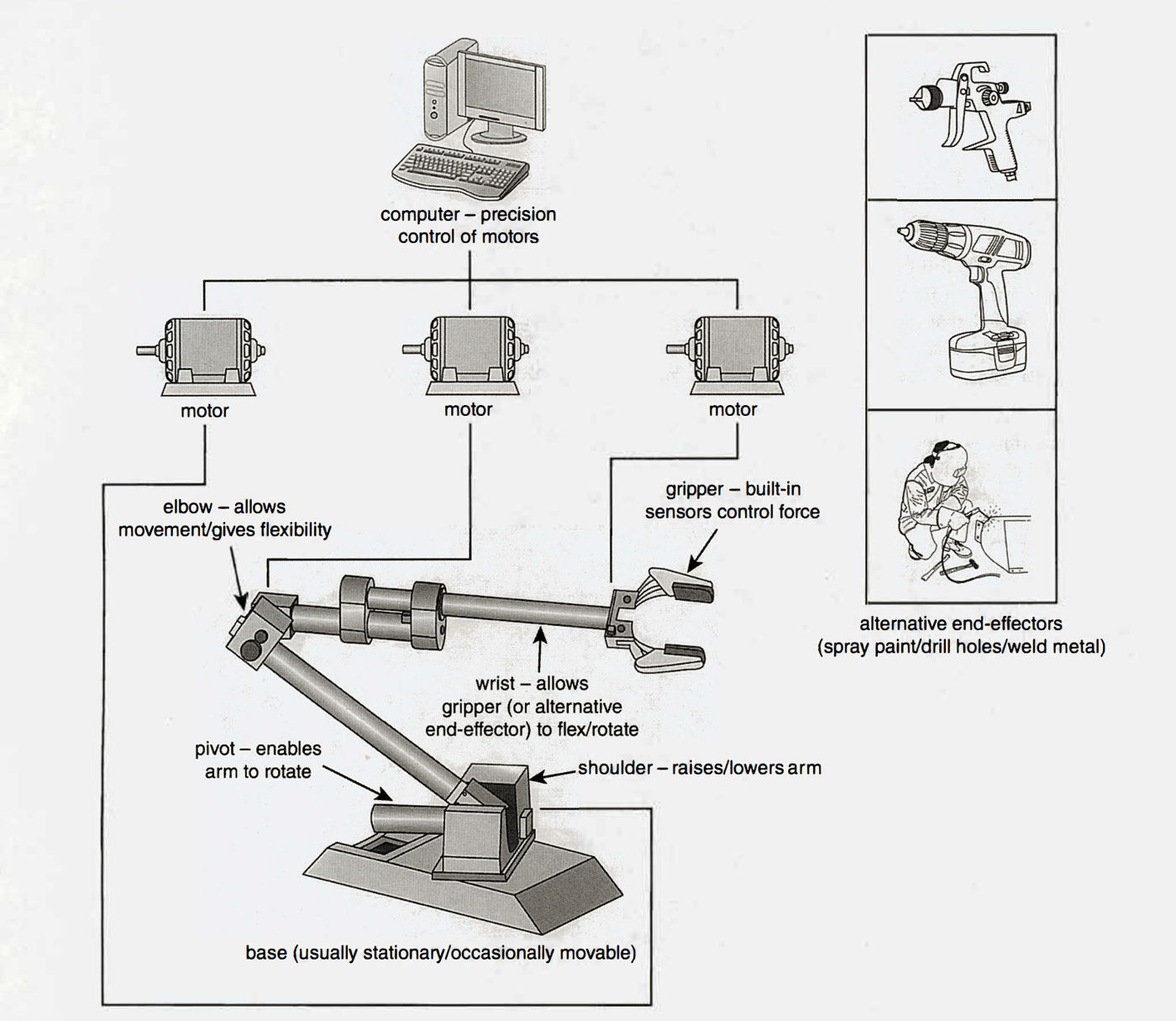
The diagram below shows how a mechanical arm works, and how the joints that make up the arm function in the same way as those in a human arm. Summarise the information by selecting and reporting the main features, and make comparisons where relevant.
Student answer (Band 5.0)
The procedure diaghram explain the mechanical arm and show its function which is resemble to the human arm. Overall the different components of a mechanical arm is explained and the alternative same function by a human is also mentioned.
Firstly, the mechanical arm is cosist of a number of different components, starting with the main computer-precision which control all the three motor responsible for different functions. The first motor is installed at the shhoulder which raises and lowers the shoulder just above the base which is completely stationary. The second motor manage the movment of machine same as a human elbow.
While the third motor perform the main task of a gripper having built-in sensors which control force and supported by the wrist allowing them to flex and rotate and can perfom same function as a human hand do.
AI examiner evaluation
| Criterion | Band |
|---|---|
| Task Achievement / Task Response | 4.5 |
| Coherence and Cohesion | 5.5 |
| Lexical Resource | 5.5 |
| Grammatical Range and Accuracy | 5.0 |
| Overall | 5.0 |
Task Achievement / Task Response: Band 4.5
You identify the diagram’s subject and mention the computer, three motors, shoulder, elbow, wrist and gripper, so the response includes several relevant features. However, the account is incomplete and some details are inaccurate: the base is described as “completely stationary,” although it is usually stationary and can sometimes move, and the shoulder is said to raise and lower itself rather than the arm. The pivot and its rotation function, the gripper’s alternative end-effectors, and the examples of spraying, drilling and welding are omitted. The overview is also vague, and the comparison with a human arm is not clearly developed. The response is 11 words below the required minimum, which further limits the coverage. Add a concise overview and report the main functions and alternatives accurately.
Coherence and Cohesion: Band 5.5
The response has a basic overall sequence: it introduces the diagram, then describes components and their functions. Paragraph breaks help separate the introduction from the details, and “Firstly” and “While” signal progression. However, the description does not follow the arm’s layout consistently, and the final paragraph combines the gripper, wrist and human-hand comparison in a way that makes their relationships unclear. The opening overview repeats the idea that the components and human equivalents are explained without summarising the main arrangement. Some linking is also mechanical, and the final “While” clause is not clearly connected to a complete main clause. Organise the body from the base and shoulder upwards, then explain the motors and end-effectors, using clear references such as “this joint” where needed.
Lexical Resource: Band 5.5
You use some relevant technical vocabulary, including “precision,” “motor,” “built-in sensors,” “force,” and “flex and rotate,” which helps convey the diagram’s subject. However, the range is limited, and several word choices or forms are inaccurate or awkward: “procedure diagram” is less suitable than “diagram,” “main computer-precision” does not express the label clearly, and “alternative same function” is difficult to interpret. Spelling errors such as “diaghram,” “cosist,” “shhoulder,” and “movment” are noticeable and reduce precision. Some repetition of “function” also limits variety. Use the diagram’s labels accurately and choose natural collocations, for example, “the computer controls three motors” and “alternative end-effectors include a spray gun, drill and welding equipment.”
Grammatical Range and Accuracy: Band 5.0
You attempt both simple and more extended sentence forms, including a relative clause in “a gripper having built-in sensors which control force.” However, control is inconsistent, and errors sometimes make relationships difficult to follow. Examples include “The procedure diagram explain” and “the different components … is explained,” where subject–verb agreement is incorrect, and “the third motor perform,” which also needs a plural-form verb. The sentence beginning “While the third motor…” is a dependent clause without a clear main clause. There are also awkward constructions such as “allowing them to flex and rotate” and “same function as a human hand do.” Practise accurate agreement, complete sentence structures and clear comparisons; shorter, well-controlled sentences would improve readability before adding more complex forms.
See this exact question answered at other band scores. The same prompt compared across bands.
Browse more IELTS Writing model answers or get your own writing scored by the same AI examiner.