Band 5.5 IELTS Writing Task 1 Model Answer
Overall Band Score: 5.5 · IELTS Momentum Workout · 2026-11-11
IELTS Writing Task 1 question
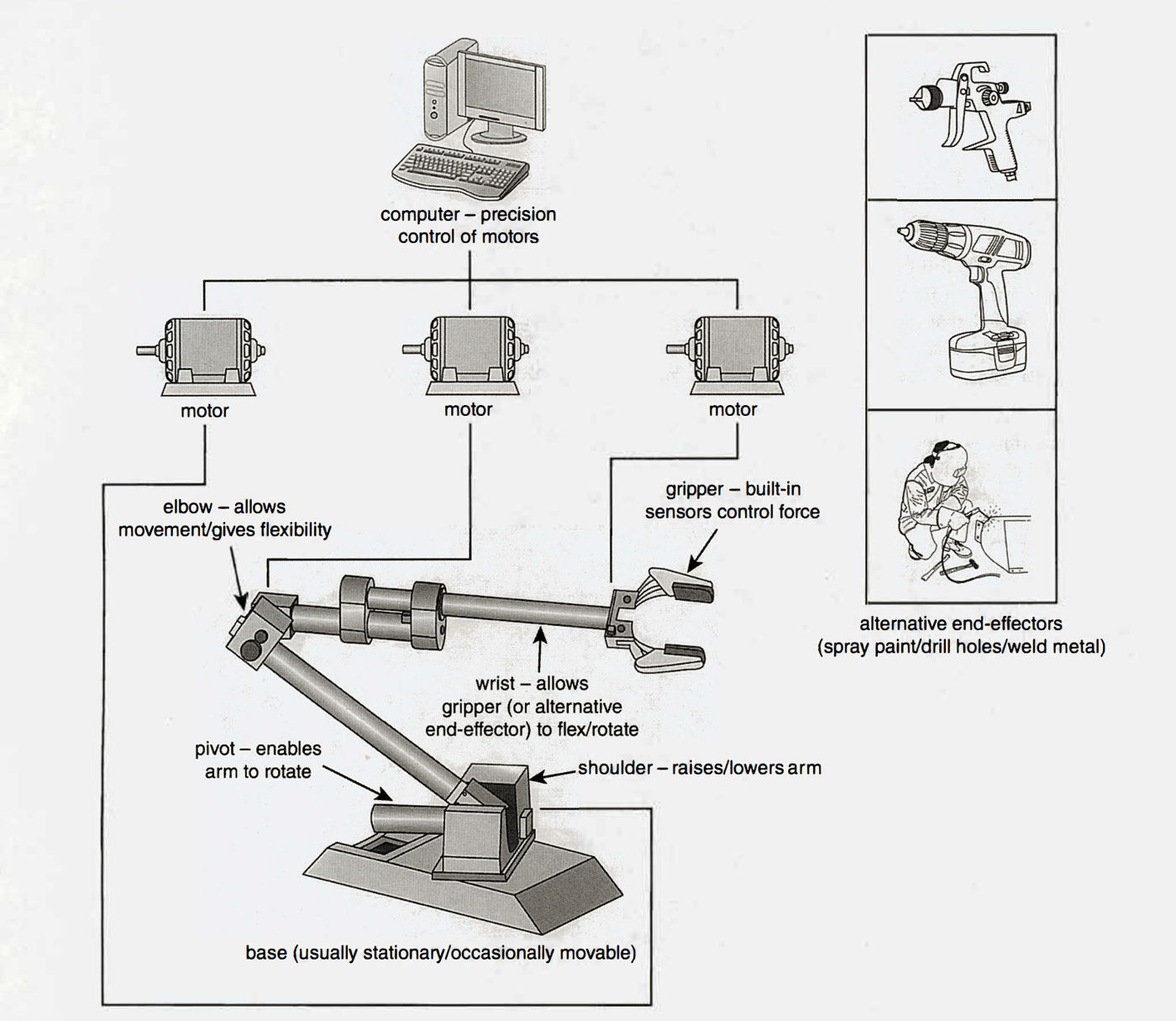
The diagram below shows how a mechanical arm works, and how the joints that make up the arm function in the same way as those in a human arm. Summarise the information by selecting and reporting the main features, and make comparisons where relevant.
Student answer (Band 5.5)
The below diagram shows the detailed steps of how mechanical arm works. It shows how similarly arm function like human arm. This is a man made process.
Overall, the whole process consist of three motor which play vita role in the movement of mechanical arm. There is a computer precision control of motors. There are total five steps involved in the working of mechanical arm.
Firstly, there is a motor based stand which is movable and a shoulder which makes up and down the arm. A pivot helps to rotate the arm. The elbow act as a middle part of the arm which helps to give flexibility and allow movement with the help of motor.
A alternative end effector help the wrist to allow gripper to rotate. A motor is used in the gripperwhich has built in sensors control force. the alternative end effectors help to spray paint, drill holes and weld metal.
AI examiner evaluation
| Criterion | Band |
|---|---|
| Task Achievement / Task Response | 5.5 |
| Coherence and Cohesion | 6.0 |
| Lexical Resource | 5.5 |
| Grammatical Range and Accuracy | 5.0 |
| Overall | 5.5 |
Task Achievement / Task Response: Band 5.5
You identify several relevant components, including the computer-controlled motors, the shoulder, pivot, elbow, gripper and alternative end-effectors, and you mention the functions of some of them. However, the account only partly summarises the diagram: the overview says there are “five steps,” although the image presents components and their functions rather than a sequence of steps. The base is also described as a “motor based stand” that is movable, whereas it is usually stationary and only occasionally movable. The comparison with a human arm is introduced but not explained. To make the summary more complete, give an accurate overview of how the computer and motors control the arm’s joints, then describe the main parts and their functions without presenting them as stages.
Coherence and Cohesion: Band 6.0
The response has a recognisable overall arrangement: an introduction and overview are followed by descriptions of the base and arm, then the end-effectors. This gives the reader a basic route through the information. However, the progression is not always clear, and some links between ideas are abrupt. For example, “A alternative end effector help the wrist” does not clearly explain how the wrist, gripper and interchangeable tools relate. The claim that there are “five steps” also makes the organisation sound like a process sequence, which does not match the diagram. Use clearer grouping—control system, joints and end-effector—and connect each component to its function with precise references. This would make the cohesion less mechanical and the relationships easier to follow.
Lexical Resource: Band 5.5
You use relevant task vocabulary such as “pivot,” “flexibility,” “built in sensors,” “gripper” and “end effectors,” so the reader can identify many of the diagram’s parts. However, the range is limited and several word choices or collocations are inaccurate, which sometimes makes the description unclear. “Motor based stand” is not an accurate name for the base, and “makes up and down the arm” does not express the shoulder’s function naturally. “Five steps” is also an imprecise description of the diagram’s components. Aim for precise functional phrases such as “raises and lowers the arm” and “allows the arm to rotate.” Check spelling and spacing in terms such as “gripperwhich” and “end-effectors” to improve clarity.
Grammatical Range and Accuracy: Band 5.0
You attempt a few longer structures, including “The elbow act as a middle part of the arm which helps to give flexibility,” but most sentences rely on simple patterns, and errors occur often enough to make some relationships difficult to follow. Subject–verb agreement is inconsistent: “the whole process consist” and “The elbow act” should use “consists” and “acts.” Articles and plurals also need attention, as in “A alternative end effector” and “three motor.” The phrase “There are a computer precision control of motors” has an unclear grammatical structure, while the final sentence begins with a lowercase “the” after a full stop. Practise accurate sentence patterns for describing components and functions, checking agreement, articles and punctuation in each sentence.
See this exact question answered at other band scores. The same prompt compared across bands.
Browse more IELTS Writing model answers or get your own writing scored by the same AI examiner.