Band 6.0 IELTS Writing Task 1 Model Answer
Overall Band Score: 6.0 · IELTS Momentum Workout · 2026-11-13
IELTS Writing Task 1 question
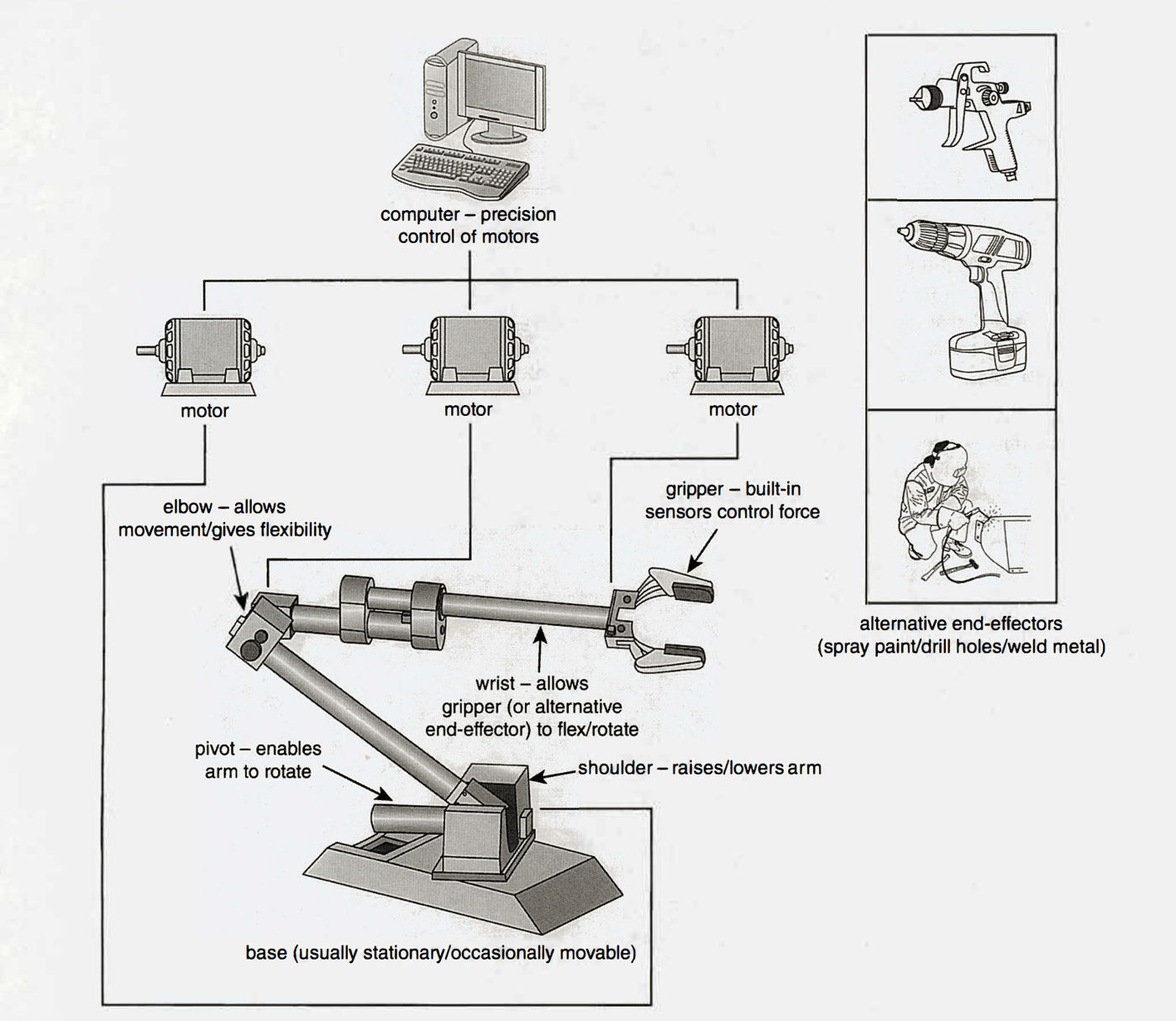
The diagram below shows how a mechanical arm works, and how the joints that make up the arm function in the same way as those in a human arm. Summarise the information by selecting and reporting the main features, and make comparisons where relevant.
Student answer (Band 6.0)
The diagram illustrates how a mechanical arm functions and how the joints follow a human arm to make the arm workable.
Overall, this is a complex process where computer and three motors work combinely to make a robotic arm funtionale and movable.
Computer is the main part of this whole system where it controls three motors which are connected to three different part of the arm. One motor is placed over a rarely movable base which controls the shoulder in order to raise or lower the arm. A pivot is added to the shoulder which helps in the arm's rotation. Then the second motor is connected with the elbow of the arm which provide flexibility as well as movements.The last motor is set with gripper where sensors are installed to control force. A wrist is used between elbow and gripper to ease gripper's circulation. Alternative end effectors such as spray paint, drill holes, weld metals can also be added with gripper to do difficult tasks.
AI examiner evaluation
| Criterion | Band |
|---|---|
| Task Achievement / Task Response | 6.0 |
| Coherence and Cohesion | 6.0 |
| Lexical Resource | 6.0 |
| Grammatical Range and Accuracy | 5.5 |
| Overall | 6.0 |
Task Achievement / Task Response: Band 6.0
You cover the main components and their functions, including computer control of three motors, the shoulder, pivot, elbow, wrist and sensor-equipped gripper. You also mention the alternative end-effectors and their uses, so the response addresses the diagram’s key information. The overview identifies the system as computer-controlled and movable, but it could more clearly summarise how the arm’s joints enable movement and how attachments can be changed for different tasks. Some details are misassigned or unclear: the base is described as rarely movable, whereas it is usually stationary and only occasionally movable; the pivot is above the base, rather than added to the shoulder. Clarifying the motor-to-joint connections and the alternative tools would make the account more complete.
Coherence and Cohesion: Band 6.0
The response has a clear overall sequence: it introduces the diagram, gives a general overview, then describes components from the base and shoulder towards the gripper before mentioning alternative tools. This makes the information reasonably easy to follow. However, the description sometimes jumps between parts, and the motor connections are not presented in a fully consistent order: the first motor is linked to the shoulder in the text, while the elbow is discussed later as connected to the second motor. The long final body paragraph would be clearer if divided into two paragraphs, one for the arm’s structure and one for the alternative end-effectors. Use linking phrases such as “at the base,” “further along the arm,” and “in addition” selectively to make relationships clearer without relying on a list-like sequence.
Lexical Resource: Band 6.0
You use an adequate range of topic vocabulary, including “pivot,” “flexibility,” “sensors,” “gripper,” and “alternative end effectors,” which helps convey the diagram’s technical content. There are also attempts at less common wording, but several choices are inaccurate or unnatural: “workable,” “work combinely,” “funtionale,” and “gripper’s circulation” do not express the intended meanings clearly. “Rarely movable” also changes the meaning of the base label. Spelling errors such as “funtionale” and “movements” in this context reduce precision, although the main message remains understandable. Aim for standard technical collocations, for example, say that the computer “coordinates” the motors and that the wrist allows the gripper to “flex or rotate.”
Grammatical Range and Accuracy: Band 5.5
You use both simple statements and longer structures, including the overview clause “where computer and three motors work…” and the sentence explaining that the gripper’s sensors control force. Most relationships remain understandable, but some grammatical errors occur. In “three different part,” the noun should be plural; in “which provide flexibility,” the verb should agree with “elbow”; and “Computer is the main part” needs an article. The sentence beginning “One motor is placed…” also makes the motor’s connection to the shoulder unclear, partly because of the clause structure. There is a missing space after “movements.” and the following sentence begins immediately. Check articles, subject–verb agreement, and punctuation, and use clearer sentence structures when describing which motor controls each joint.
See this exact question answered at other band scores. The same prompt compared across bands.
Browse more IELTS Writing model answers or get your own writing scored by the same AI examiner.