Band 5.0 IELTS Writing Task 1 Model Answer
Overall Band Score: 5.0 · IELTS Momentum Workout · 2026-11-13
IELTS Writing Task 1 question
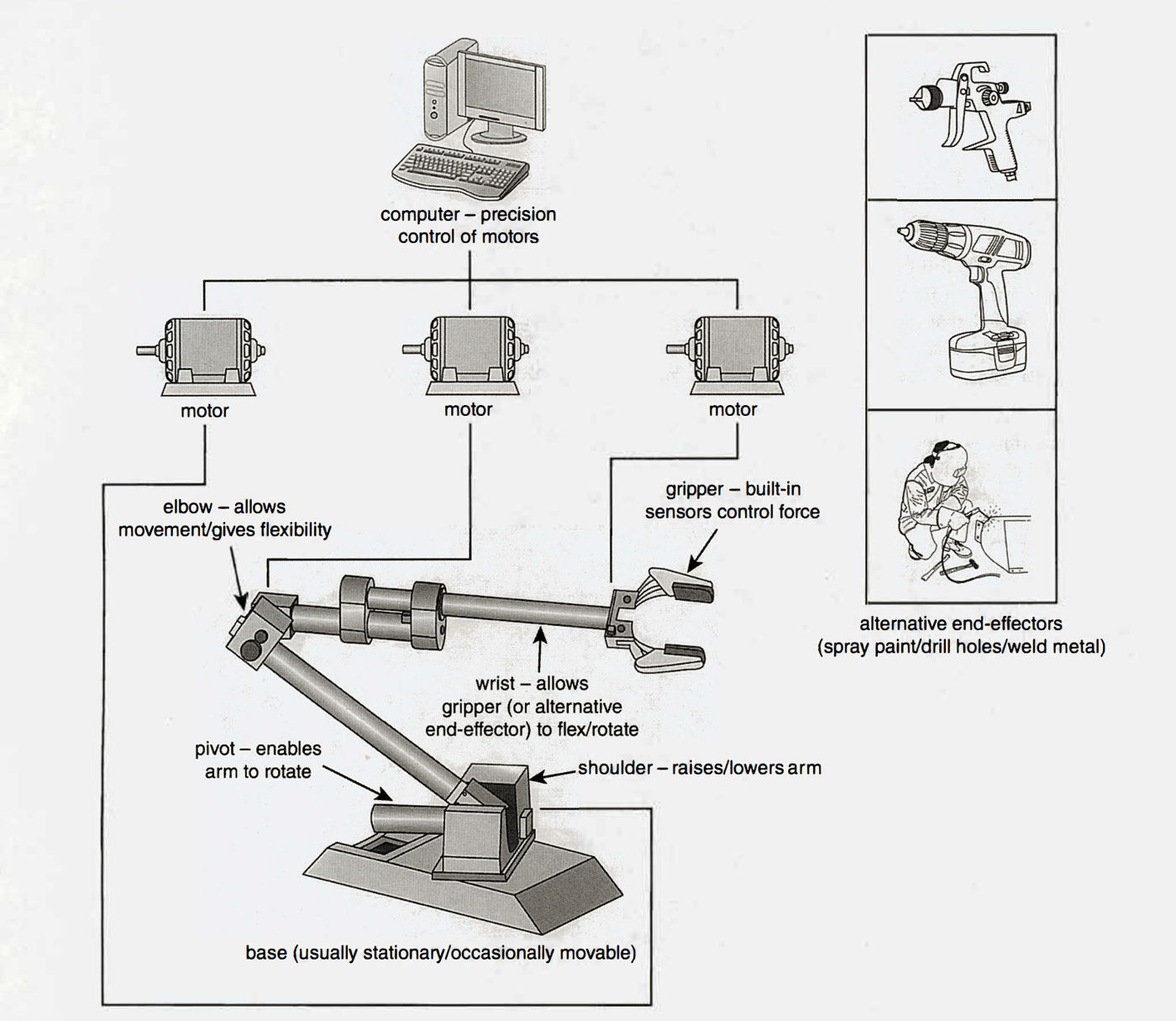
The diagram below shows how a mechanical arm works, and how the joints that make up the arm function in the same way as those in a human arm. Summarise the information by selecting and reporting the main features, and make comparisons where relevant.
Student answer (Band 5.0)
THE DIAGRAM ILLUSTRATES HOW A MECHANICAL ARM WORKS, AND HOW THE JOINTS THAT MAKE UP TEH ARM THE SAME FUNCTION AS THOSE IN HUMAN ARM.THE BASE IS USUALLY STATIONARY, THERE IS A FIRST MOTOR CONNECTED TO IT IS THE SHOULDER TO RAISES/ LOWER ARM. THERE IS A PIVOT THAT ENABLES ARM TO ROTATE. ELBOW IS CONNECTED TO THE SHOULDER, ITS ALLOWS MOVEMENT AND GIVES FLEXIBILITYAND CONNECTED TO THE SECOND MOTOR.FOLLOW BY WRIST THAT ALLOWS GRIPPER THEN THE THIRD MOTOR IS CONNECTED TO GRIPPER ITS A BUILT-IN SENSORS CONTROL FORCE. ALL THE THREE MOTORS ARE CONNECTED TO ONE COMPUTER FOR THE PRECISION CONTROL OF MOTORS.
OVERALL, THIS METHODS HELPS SOME PEOPLE TO KNOW WHAT ARE THE PARTS AND USE OF THE FOLLOWING PARTS. IT WILL GUIDE US STEP BY STEP ON HOW IT WILL WORKS. ON THE OTHER SIDE IS A ALTENATIVE END- EFFECTORS, SOME EXAMPLES ARE SPRAY PAIN/DRILL HOLES AND WELD METAL.
AI examiner evaluation
| Criterion | Band |
|---|---|
| Task Achievement / Task Response | 5.0 |
| Coherence and Cohesion | 5.5 |
| Lexical Resource | 5.5 |
| Grammatical Range and Accuracy | 4.5 |
| Overall | 5.0 |
Task Achievement / Task Response: Band 5.0
You identify the diagram’s subject and report several relevant components, including the base, shoulder, pivot, elbow, wrist, gripper and computer-controlled motors. You also mention the alternative end-effectors. However, the account is incomplete and some relationships are unclear or inaccurate: for example, the diagram shows three motors linked to different parts, but the sequence “first motor connected to it is the shoulder” does not clearly describe those connections. The overview is not a useful summary of the main features; “this methods helps some people to know” comments on the diagram rather than explaining how the arm operates. The response is also 140 words, below the required 150; the 12 words copied from the prompt were not counted. Add a clearer overview and explain the arm’s main movements and interchangeable tools.
Coherence and Cohesion: Band 5.5
There is some overall organisation: you begin by introducing the diagram, describe components and their functions, and then mention the alternative end-effectors. This gives the reader a basic route through the information. However, most of the description is compressed into one long block, and the sequence of connections is difficult to follow, particularly in “there is a first motor connected to it is the shoulder” and “elbow … connected to the second motor.” Linking expressions such as “follow by” and “on the other side” do not clearly show the relationships between stages or parts. Separate the introduction, main description and overview into paragraphs, and use precise links such as “at the base,” “above this,” and “at the end of the arm” to make the progression clearer.
Lexical Resource: Band 5.5
You use some task-relevant vocabulary, including “pivot,” “flexibility,” “built-in sensors,” “precision control” and “end-effectors,” which helps identify the diagram’s parts and functions. However, the range is limited and several word choices or forms make the description less clear, such as “this methods,” “a altenative,” and “spray pain.” Some phrases are also imprecise: “allows gripper” does not explain the wrist’s ability to flex or rotate, while “what are the parts and use” is not a suitable description of the diagram’s purpose. Aim for accurate technical phrasing and check spelling and word forms. For example, describe the wrist as allowing the gripper to “flex or rotate,” and refer to “alternative end-effectors” rather than “a alternative end-effectors.”
Grammatical Range and Accuracy: Band 4.5
The response attempts to combine information about components and their functions, but sentence structures are often incomplete or faulty, and errors frequently make relationships hard to understand. For instance, “the joints that make up the arm the same function” is missing a verb, while “the shoulder to raises/lower arm” has an incorrect verb pattern. There are also problems with articles, agreement and sentence boundaries, as in “its a built-in sensors control force.” Most sentences rely on simple present forms, with little accurate variety. Practise building complete sentences with a clear subject and verb, and use relative clauses to explain functions: “The shoulder raises and lowers the arm,” or “The gripper has built-in sensors that control the force applied.”
See this exact question answered at other band scores. The same prompt compared across bands.
Browse more IELTS Writing model answers or get your own writing scored by the same AI examiner.