Band 6.0 IELTS Writing Task 1 Model Answer
Overall Band Score: 6.0 · IELTS Momentum Workout · 2026-11-17
IELTS Writing Task 1 question
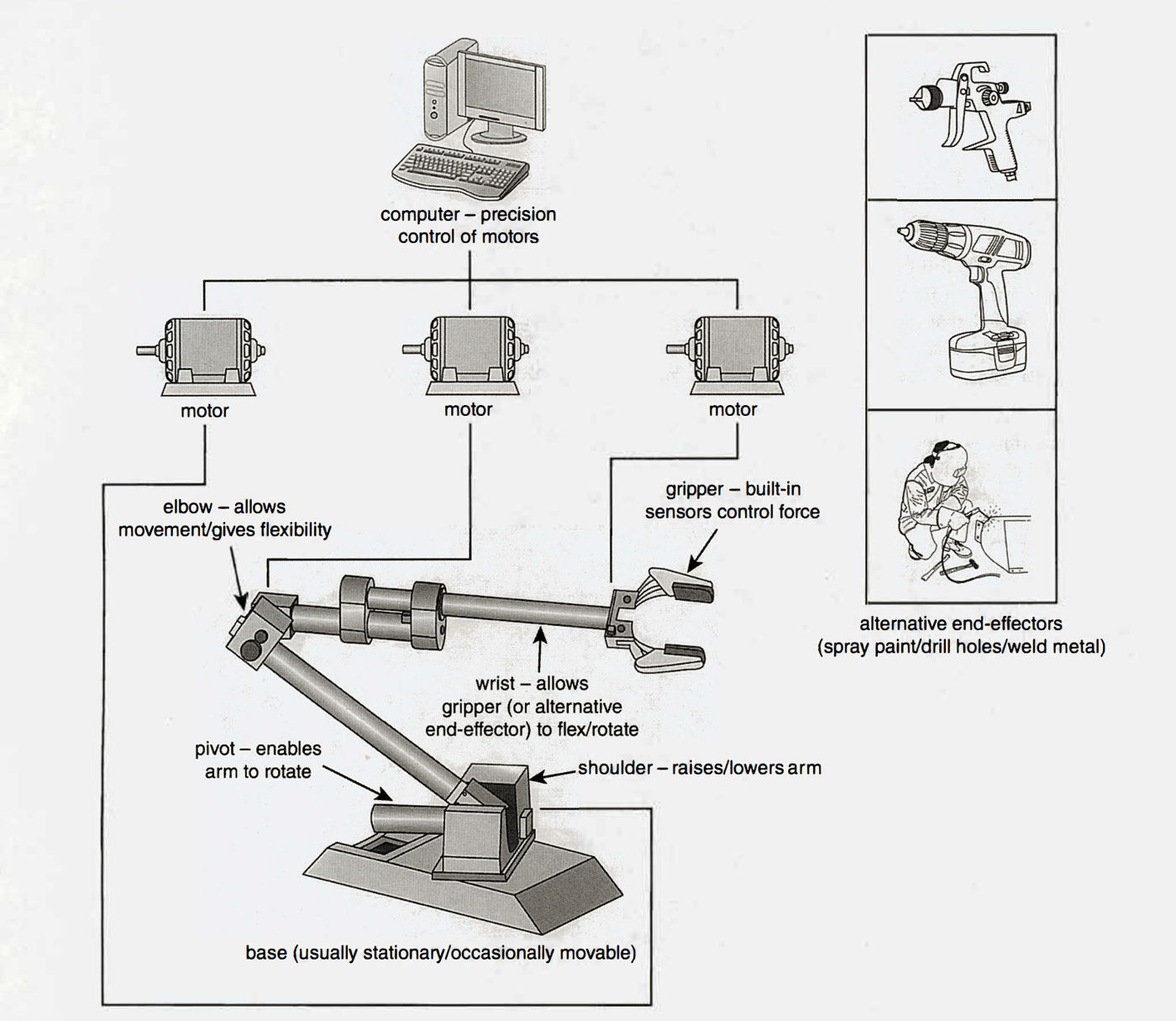
The diagram below shows how a mechanical arm works, and how the joints that make up the arm function in the same way as those in a human arm. Summarise the information by selecting and reporting the main features, and make comparisons where relevant.
Student answer (Band 6.0)
The process diagram gives the information about the working of a mechanical arm, and how the joints of the arm move similiarly like a human arm.
Overall, it can be seen from the figure that mechanical arms function is a multi-step linear process with three different stages namely motor control, joints movement, and lower parts movement.
Specifically, three motors are used to control the whole mechanical arm through different joints which is operated by a computer for precision. Consequently, first motor is connected to the shoulder, second motor controls the movement of elbow, and final one is attached to wrist.
The elbow allows movement and gives flexibility, wrist allows the gripper (or alternative end-effector such as spray paint, drill holes or weld metal) to flex/rotate. The gripper has built-in sensors to control force.The base is usually stationary, pivot enables the arm to rotate, and lastly the shoulder raises or lowers arm when needed.
AI examiner evaluation
| Criterion | Band |
|---|---|
| Task Achievement / Task Response | 6.0 |
| Coherence and Cohesion | 6.0 |
| Lexical Resource | 6.0 |
| Grammatical Range and Accuracy | 6.0 |
| Overall | 6.0 |
Task Achievement / Task Response: Band 6.0
You identify the diagram’s subject and report several relevant functions, including the computer’s precision control, the elbow’s flexibility, the wrist’s rotation, and the gripper’s force sensors. The overview also attempts to group the components. However, some key relationships are misreported: the first motor is linked to the elbow, the second to the arm section near the wrist, and the third to the gripper—not respectively to the shoulder, elbow, and wrist as stated. The description also calls the diagram a “multi-step linear process,” although it shows a set of connected components rather than stages in a sequence. To make the account more complete and precise, describe the base, pivot, shoulder, arm sections, and alternative end-effectors in their correct positions and relationships.
Coherence and Cohesion: Band 6.0
The response has a recognisable structure: an introduction, an overview, and two paragraphs describing components. This gives the reader a general route through the information. However, the progression is not consistently clear. The overview’s “three different stages” does not accurately frame the diagram, and the final paragraph moves from the elbow and wrist to the gripper, base, pivot, and shoulder without a clear spatial sequence. “Specifically” and “Consequently” provide some linking, but the latter suggests a result rather than the component relationships being described. Organise the details from the base upwards along the arm, then explain the computer and motors, and use clearer references to show which motor connects to which part.
Lexical Resource: Band 6.0
You use an adequate range of task-related vocabulary, including “precision,” “flexibility,” “built-in sensors,” “pivot,” and “alternative end-effector.” These terms help convey the diagram’s functions, and the meaning is generally understandable. Some choices are imprecise or awkward, however: “lower parts movement” is unclear, “joints movement” is not a natural collocation, and “similiarly like” is both misspelled and redundant. “Multi-step linear process” also describes the visual inaccurately. Aim for precise language such as “components,” “connections,” and “functions,” rather than presenting the diagram as a sequence of stages. Check spelling and use natural collocations when describing how parts move or operate.
Grammatical Range and Accuracy: Band 6.0
There is a mix of simple and more complex sentence forms, including the opening clause beginning “how the joints…” and the sentence explaining the elbow and wrist functions. Most ideas remain understandable, but some grammatical errors are noticeable. For example, “mechanical arms function is” needs a possessive form or a different construction, while “three motors … which is operated” has a number-agreement problem. Articles are also missing in phrases such as “first motor” and “raises or lowers arm.” The final paragraph contains a run-on boundary in “control force.The base,” and the list of functions would benefit from clearer punctuation. Review agreement, articles, possessives, and sentence boundaries to make the relationships easier to follow.
See this exact question answered at other band scores. The same prompt compared across bands.
Browse more IELTS Writing model answers or get your own writing scored by the same AI examiner.