Band 5.0 IELTS Writing Task 1 Model Answer
Overall Band Score: 5.0 · IELTS Momentum Workout · 2026-11-17
IELTS Writing Task 1 question
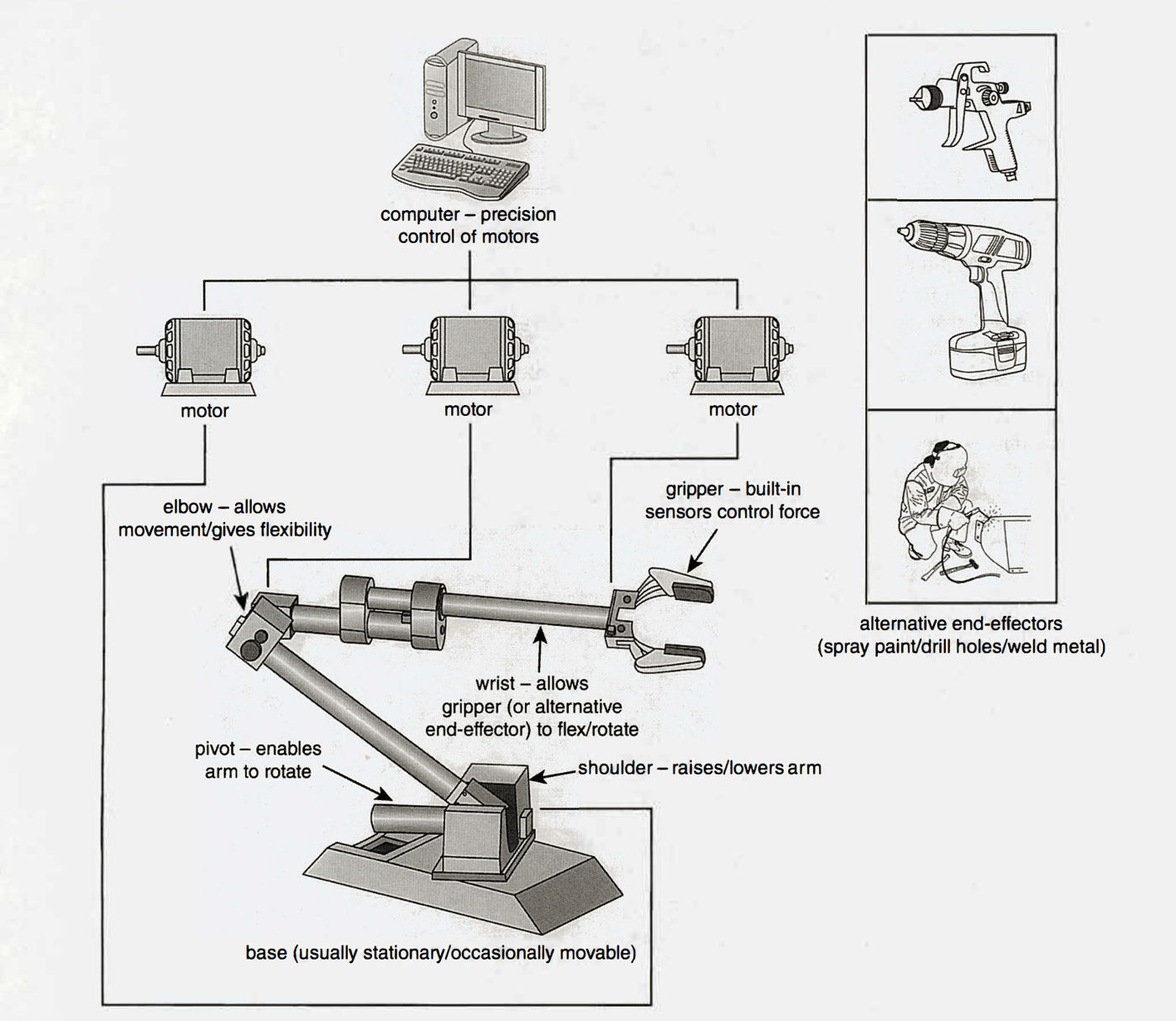
The diagram below shows how a mechanical arm works, and how the joints that make up the arm function in the same way as those in a human arm. Summarise the information by selecting and reporting the main features, and make comparisons where relevant.
Student answer (Band 5.0)
The process diagram illustrates the arm functioning of mechanical joints. Overall, the linear process has seven different stages baginning with motor controls of computer and ending with wrist that allows to rotate the gripper.
The control over motors is initated by computer. Motor then divided into three parts. One of the motors allow movement that give elbow flexibility. Next, the in-built sensors control the force of a gripper that allows the gripper to rorate side-by-side through the wrist. Later on, pivot enables arm to rotate. The base tends to move.
AI examiner evaluation
| Criterion | Band |
|---|---|
| Task Achievement / Task Response | 4.0 |
| Coherence and Cohesion | 5.0 |
| Lexical Resource | 5.5 |
| Grammatical Range and Accuracy | 5.0 |
| Overall | 5.0 |
Task Achievement / Task Response: Band 4.0
You identify several relevant components, including the computer, motors, elbow, gripper, wrist, pivot and base, and you attempt an overview. However, the description is incomplete and includes inaccuracies: the diagram does not show a seven-stage linear process ending at the wrist, and the base is usually stationary, only occasionally movable—not simply “tends to move.” The shoulder’s role in raising and lowering the arm is omitted, as are the alternative end-effectors and their uses. The response is also substantially below the required 150 words, leaving too little space to report the main features and comparisons. To improve, describe the arm’s arrangement and functions accurately, include the alternatives, and develop a fuller overview.
Coherence and Cohesion: Band 5.0
The response has a basic paragraph structure: an opening overview followed by a short description of components. Some sequencing is signalled by “Overall,” “Next,” and “Later on,” so the reader can follow parts of the account. However, the progression is not consistently logical: the description moves from the motors to the gripper and wrist, then to the pivot and base, without explaining how these parts fit together along the arm. “Motor then divided into three parts” also makes the relationship between the computer and the three motors unclear. Organise the information from the base and shoulder up to the gripper, then mention the computer control and alternative end-effectors. Clearer links between components would strengthen the flow.
Lexical Resource: Band 5.5
You use some relevant technical vocabulary, including “in-built sensors,” “pivot,” “flexibility,” and “gripper,” which helps identify parts of the diagram. However, the range is limited and several choices or spellings reduce precision: “arm functioning of mechanical joints” is awkward, “linear process” mislabels the diagram, and “side-by-side” does not accurately describe the wrist’s ability to flex or rotate. There are also spelling errors such as “baginning,” “initated,” and “rorate.” Aim for accurate, natural descriptions such as “the arm’s components,” “the system is controlled by a computer,” and “the wrist allows the gripper to flex or rotate.” More varied vocabulary for functions and connections would make the account clearer.
Grammatical Range and Accuracy: Band 5.0
You produce several short sentences and attempt a longer construction, for example, “One of the motors allow movement that give elbow flexibility.” However, the range is limited, and errors in agreement and sentence formation occur frequently enough to affect clarity. In that example, the singular subject requires “allows,” and the relative clause needs “gives” or a clearer reformulation. “Motor then divided into three parts” is missing a finite verb, while “the gripper that allows the gripper to rorate” creates an unclear grammatical relationship between the parts. Practise forming complete sentences with clear subjects and verbs, and use relative clauses to explain each component’s function. Accurate simple structures should come before adding complexity.
See this exact question answered at other band scores. The same prompt compared across bands.
Browse more IELTS Writing model answers or get your own writing scored by the same AI examiner.