Band 6.5 IELTS Writing Task 1 Model Answer
Overall Band Score: 6.5 · IELTS Momentum Workout · 2026-11-23
IELTS Writing Task 1 question
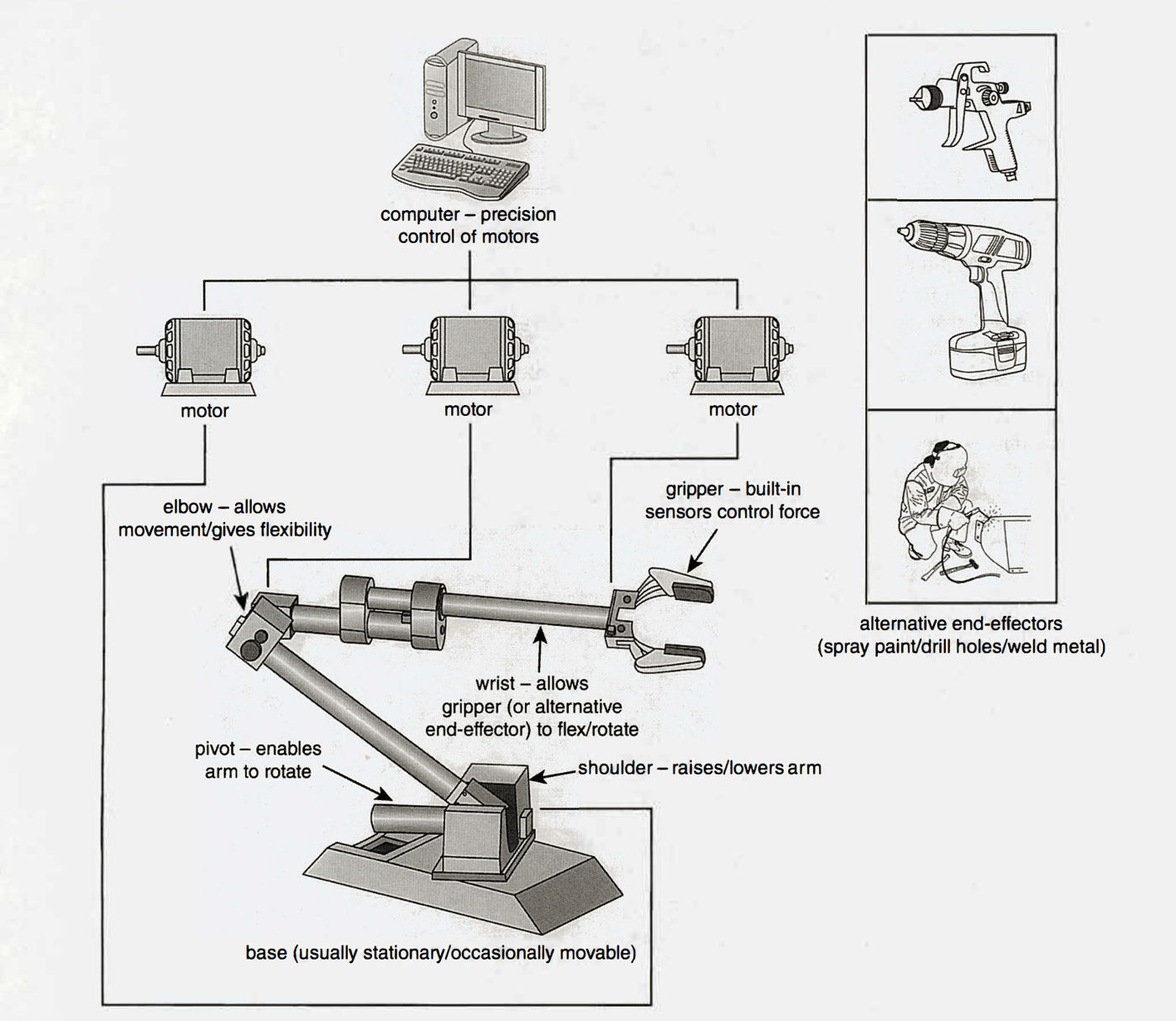
The diagram below shows how a mechanical arm works, and how the joints that make up the arm function in the same way as those in a human arm. Summarise the information by selecting and reporting the main features, and make comparisons where relevant.
Student answer (Band 6.5)
The diagram illustrates how an artificial appendage functions and how each joint that constitutes it works in comparison with a real human arm. The mechanical arm is primarily composed of four main parts namely shoulder, elbow, wrist, and gripper; all of which are found in our arms.
These main parts do not just resemble the physicality of a legit arm but they as well perform almost the same purpose. For instance, the shoulder provides the artificial arm the ability to be raised or be lowered. The elbow capacitates the machine to move and be flexible. Moreover, the wrist enables the gripper to flex and rotate. Finally, the gripper, which can be compared to our fingers in this case, allows the artificial arm to exert force due to the sensors that are built with it.
Furthermore, the three motors, which connect vital parts of the machine with one another, act as human joints. They guarantee that all components get to execute their specific tasks by intensely running around. Ultimately, the computer, which is in charge of the accurate supervision of motors, is comparable to the human brain that generally directs our arms' functions and locomotions.
AI examiner evaluation
| Criterion | Band |
|---|---|
| Task Achievement / Task Response | 6.0 |
| Coherence and Cohesion | 6.5 |
| Lexical Resource | 6.5 |
| Grammatical Range and Accuracy | 6.5 |
| Overall | 6.5 |
Task Achievement / Task Response: Band 6.0
You identify the main components and explain several functions accurately, including the shoulder raising and lowering the arm, the elbow providing movement, and the wrist allowing the gripper to flex or rotate. The comparison with a human arm is also relevant. However, some important features are omitted: the base and its pivot, the computer’s control of the motors, and the alternative end-effectors for spraying, drilling and welding. The claim that the three motors “act as human joints” is a broad interpretation rather than a clearly shown comparison, and “running around” does not explain their role precisely. To make the account more complete, describe how the arm is supported and controlled, and include the interchangeable tools shown in the diagram.
Coherence and Cohesion: Band 6.5
The response has a clear overall progression: it introduces the arm, describes its main joints, and then discusses the motors and computer. Paragraphing helps separate the component functions from the control system, while signposts such as “For instance,” “Moreover,” and “Finally” make the sequence easy to follow. This organisation is effective, though the links between ideas can feel somewhat formulaic, and the final paragraph introduces the motors and computer without connecting them clearly to the earlier description of the arm’s structure. A more systematic order—base and pivot, joints and end-effector, then computer control—would strengthen the progression. More precise references to how each motor connects to a component would also make the relationships clearer.
Lexical Resource: Band 6.5
You use a reasonably varied range of vocabulary, including “constitutes,” “flex,” “rotate,” “exert force,” and “accurate supervision.” These choices allow you to describe both the arm’s parts and their functions. However, some less common expressions are inaccurate or unnatural in this context: “capacitates the machine,” “physicality of a legit arm,” and “intensely running around” do not convey the intended technical meaning clearly. “Locomotions” is also an awkward choice for the movements controlled by the computer. Aim for precise, conventional process vocabulary rather than elevated wording that does not fit the meaning. Terms such as “controls,” “supports,” “rotates,” and “movement” would make the description more natural and exact.
Grammatical Range and Accuracy: Band 6.5
You use a mix of simple and complex structures, including relative clauses such as “which connect vital parts” and “which is in charge of the accurate supervision of motors.” Most sentences communicate their meaning, and punctuation is generally controlled. Some grammatical choices are less accurate, however. In “the shoulder provides the artificial arm the ability,” the construction would be clearer as “provides the artificial arm with the ability.” The phrase “be raised or be lowered” is unnecessarily repetitive, and “the sensors that are built with it” uses an unclear grammatical relationship; “sensors built into it” is more direct. The sentence beginning “The mechanical arm is primarily composed…” also has an awkwardly separated “all of which” clause. Continue using complex sentences, while checking that clause attachments and verb patterns are precise.
See this exact question answered at other band scores. The same prompt compared across bands.
Browse more IELTS Writing model answers or get your own writing scored by the same AI examiner.