Band 6.0 IELTS Writing Task 1 Model Answer
Overall Band Score: 6.0 · IELTS Momentum Workout · 2026-11-24
IELTS Writing Task 1 question
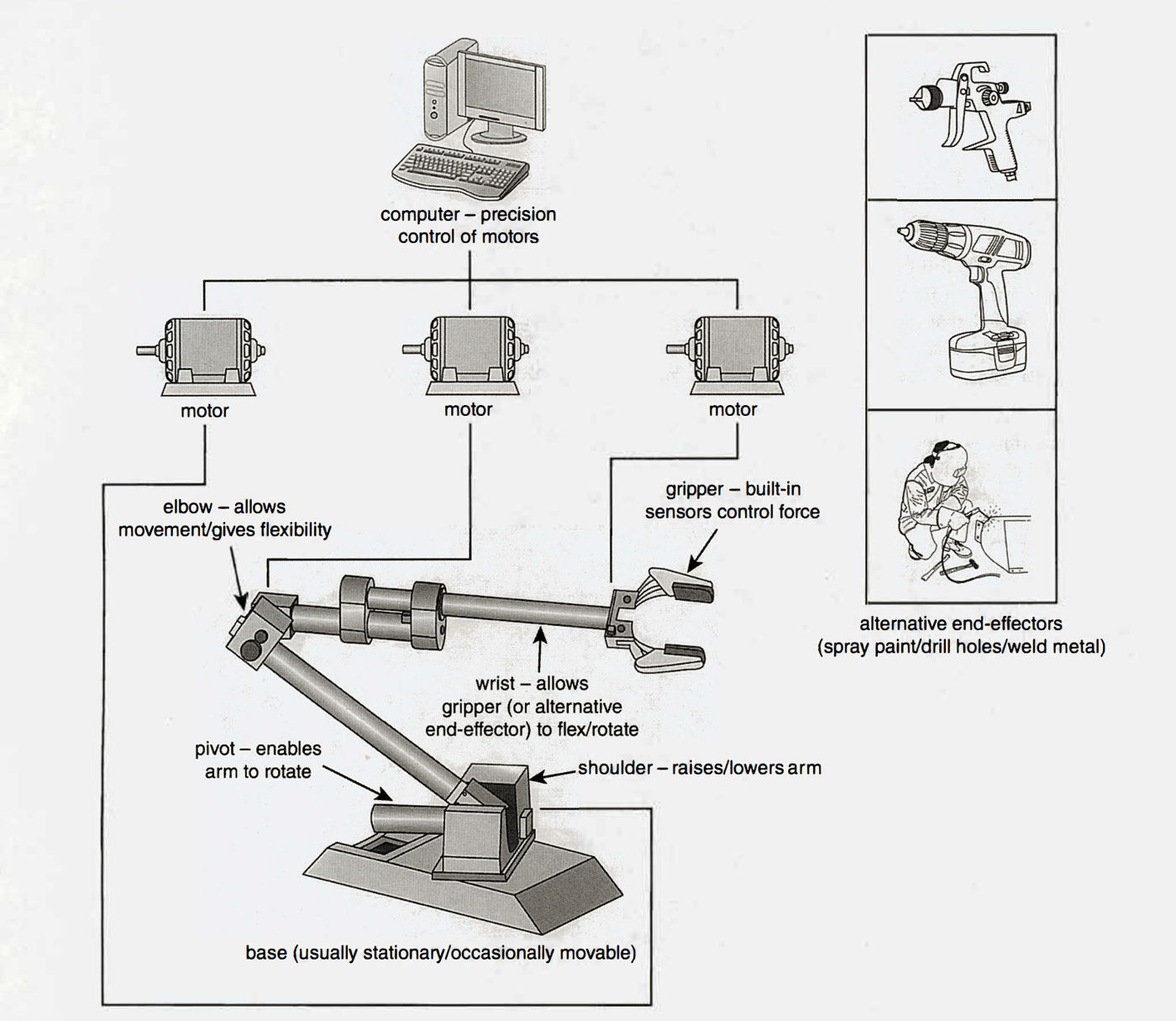
The diagram below shows how a mechanical arm works, and how the joints that make up the arm function in the same way as those in a human arm. Summarise the information by selecting and reporting the main features, and make comparisons where relevant.
Student answer (Band 6.0)
The diagram illustrates the working of a robotic arm. It is a device which is able to perform various tasks by mimicing the movement of human arm. It is similar to a human arm with joints at shoulder, elbow and wrist. The device is supported on a base which is usually stationary. A pivot near the base allows arm to rotate. The arm is raised or lowered by the use of a motor placed at the shoulder joint. A motor at the elbow joint provides the arm with the range of motion. At the wrist, a provision is provided to use suitable end-effectors needed to carry out specific tasks. The device is capable to perform tasks such as gripping of an object which can be moved at another place using movements of the arm. Different attachments are available to perform tasks such as spray paint, drill holes or welding of metal.
AI examiner evaluation
| Criterion | Band |
|---|---|
| Task Achievement / Task Response | 6.0 |
| Coherence and Cohesion | 6.0 |
| Lexical Resource | 6.5 |
| Grammatical Range and Accuracy | 6.0 |
| Overall | 6.0 |
Task Achievement / Task Response: Band 6.0
The response identifies the diagram as a robotic arm and reports several relevant features, including the base, pivot, shoulder, elbow, wrist and alternative end-effectors. The examples of spraying paint, drilling and welding are also accurate. However, the account is selective: it does not explain the computer’s precision control of the motors or the gripper’s built-in sensors, and it describes gripping and moving an object as a task without clearly explaining the gripper’s role. Some details are also imprecise: the diagram says the shoulder raises or lowers the arm, but does not specify a motor placed at that joint. A clearer overview of how the controlled joints enable movement, followed by more precise coverage of the labelled components, would make the summary more complete.
Coherence and Cohesion: Band 6.0
The information follows a generally sensible path from the base and pivot up through the arm to its end-effectors, so the reader can follow the description. The sentences are connected mainly through repeated references to the arm and location phrases such as “At the wrist” and “At the elbow.” This is clear, but the response is presented as one continuous paragraph and the progression from the arm’s structure to its uses is somewhat abrupt. Grouping the description into a structural overview and a separate account of functions and applications would strengthen organisation. More explicit links between the computer, motors and joints would also clarify how the parts work together rather than leaving the reader to infer those relationships.
Lexical Resource: Band 6.5
The response uses an adequate range of task-related vocabulary, including “pivot,” “end-effectors,” “range of motion” and “attachments,” and most choices communicate the intended meaning. There is some useful technical language, but precision and natural collocation are uneven. For example, “a provision is provided” is repetitive and awkward, while “capable to perform” is not the natural form for expressing ability. “Mimicing” is also misspelled, and “movement of human arm” is less natural than a correctly formed reference to a human arm. These issues do not prevent understanding, but more accurate collocations and consistent technical terms would improve control and make the description more fluent.
Grammatical Range and Accuracy: Band 6.0
The response includes both simple statements and longer sentences, such as “Different attachments are available to perform tasks such as spray paint, drill holes or welding of metal.” Most meanings remain clear, but some grammatical errors persist. Articles are missing in “movement of human arm” and “allows arm to rotate”; the latter also needs a possessive or article before “arm.” The construction “capable to perform” is grammatically unsuitable, and “a provision is provided” creates an awkward passive structure. The sentence about the shoulder motor also presents a specific mechanism not stated in the diagram. Greater accuracy with articles and verb patterns, alongside varied sentence structures, would strengthen the response.
See this exact question answered at other band scores. The same prompt compared across bands.
Browse more IELTS Writing model answers or get your own writing scored by the same AI examiner.