Band 5.0 IELTS Writing Task 1 Model Answer
Overall Band Score: 5.0 · IELTS Momentum Workout · 2026-11-25
IELTS Writing Task 1 question
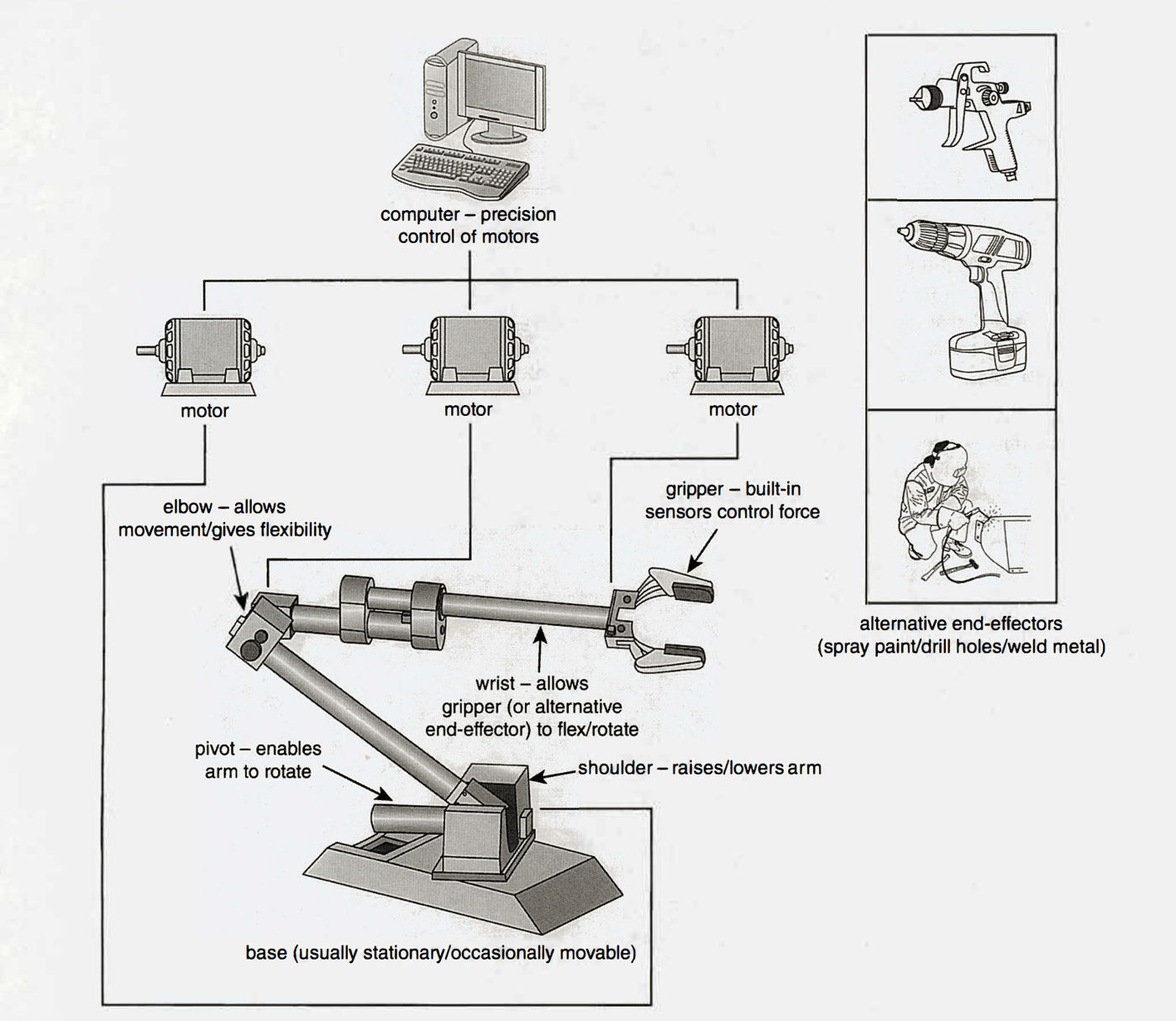
The diagram below shows how a mechanical arm works, and how the joints that make up the arm function in the same way as those in a human arm. Summarise the information by selecting and reporting the main features, and make comparisons where relevant.
Student answer (Band 5.0)
The diagram below represents how a mechanical arm works. It also illustrates how the jonts that make up the arm function in the same way as those in human arm. Here are the main features of a mechanical arm and how it works the same as a human arm.
The mechanical arm has a strong base which helps it in standing and it is movable and easy to carry. The mechanical arm also has a shoulder like the human arm. The shoulder helps to raise and lower the arm. It also enables arm to rotate. Than, there is an elbow exists in the middle of the mechanical arm. Elbow allows movement and flexibility. There is a wrist as well, which allows the gripper to flex or rotate. At the end of the mechanical arm there is a gripper. It work as a hand to do the main task.
AI examiner evaluation
| Criterion | Band |
|---|---|
| Task Achievement / Task Response | 4.0 |
| Coherence and Cohesion | 5.5 |
| Lexical Resource | 5.0 |
| Grammatical Range and Accuracy | 5.0 |
| Overall | 5.0 |
Task Achievement / Task Response: Band 4.0
You identify several relevant parts of the arm, including the shoulder, elbow, wrist and gripper, and explain some of their functions. However, the response only minimally covers the diagram: it omits the computer and motors, the pivot’s separate role, and the alternative end-effectors shown for spraying, drilling and welding. It also incorrectly says the base is movable and easy to carry; the diagram says it is usually stationary and only occasionally movable. The comparison with a human arm is asserted rather than explained, and there is no clear overview of how the components work together. The response is 135 words, below the required 150; the 13 words copied from the prompt are excluded from this count. Add the missing features and a concise overview.
Coherence and Cohesion: Band 5.5
The response has a basic sequence, moving from the base up through the shoulder, elbow and wrist to the gripper, so the reader can follow the parts being described. The opening also signals the topic. However, the ideas are presented in one paragraph, and the repeated pattern of “The mechanical arm…” and “There is…” makes the progression feel list-like rather than clearly organised. “Than” is used to introduce the next component, but it does not create a clear logical link. Group the control system and base separately from the joints and end-effector, and use accurate references and transitions to show how the parts connect and operate.
Lexical Resource: Band 5.0
You use relevant basic terms such as “shoulder,” “elbow,” “wrist,” “gripper,” “raise and lower,” and “flex or rotate,” which make the main subject understandable. However, the vocabulary is limited and repetitive, and some choices are inaccurate or imprecise. Calling the base “strong” and “easy to carry” is not supported by the diagram, while “do the main task” is vague and does not describe the gripper’s function precisely. There are also noticeable spelling and word-form errors, including “jonts” and “Than.” Use the diagram’s specific terms, such as “pivot,” “motors,” “force sensors,” and “alternative end-effectors,” and choose precise verbs to explain their functions.
Grammatical Range and Accuracy: Band 5.0
Most sentences use simple structures, and the basic meaning is generally recoverable. There are attempts to add information through relative clauses, as in “which allows the gripper to flex or rotate,” and the sequence of component descriptions is understandable. However, the range is limited, and errors occur frequently enough to affect fluency. For example, “in the same way as those in human arm” is missing an article, “It work” has incorrect subject–verb agreement, and “Than, there is an elbow exists” combines incompatible sentence patterns. “It also enables arm to rotate” also lacks an article. Practise accurate article use and agreement, and build longer sentences by joining a component to its function without adding a second, conflicting verb structure.
See this exact question answered at other band scores. The same prompt compared across bands.
Browse more IELTS Writing model answers or get your own writing scored by the same AI examiner.