Band 5.5 IELTS Writing Task 1 Model Answer
Overall Band Score: 5.5 · IELTS Momentum Workout · 2026-11-25
IELTS Writing Task 1 question
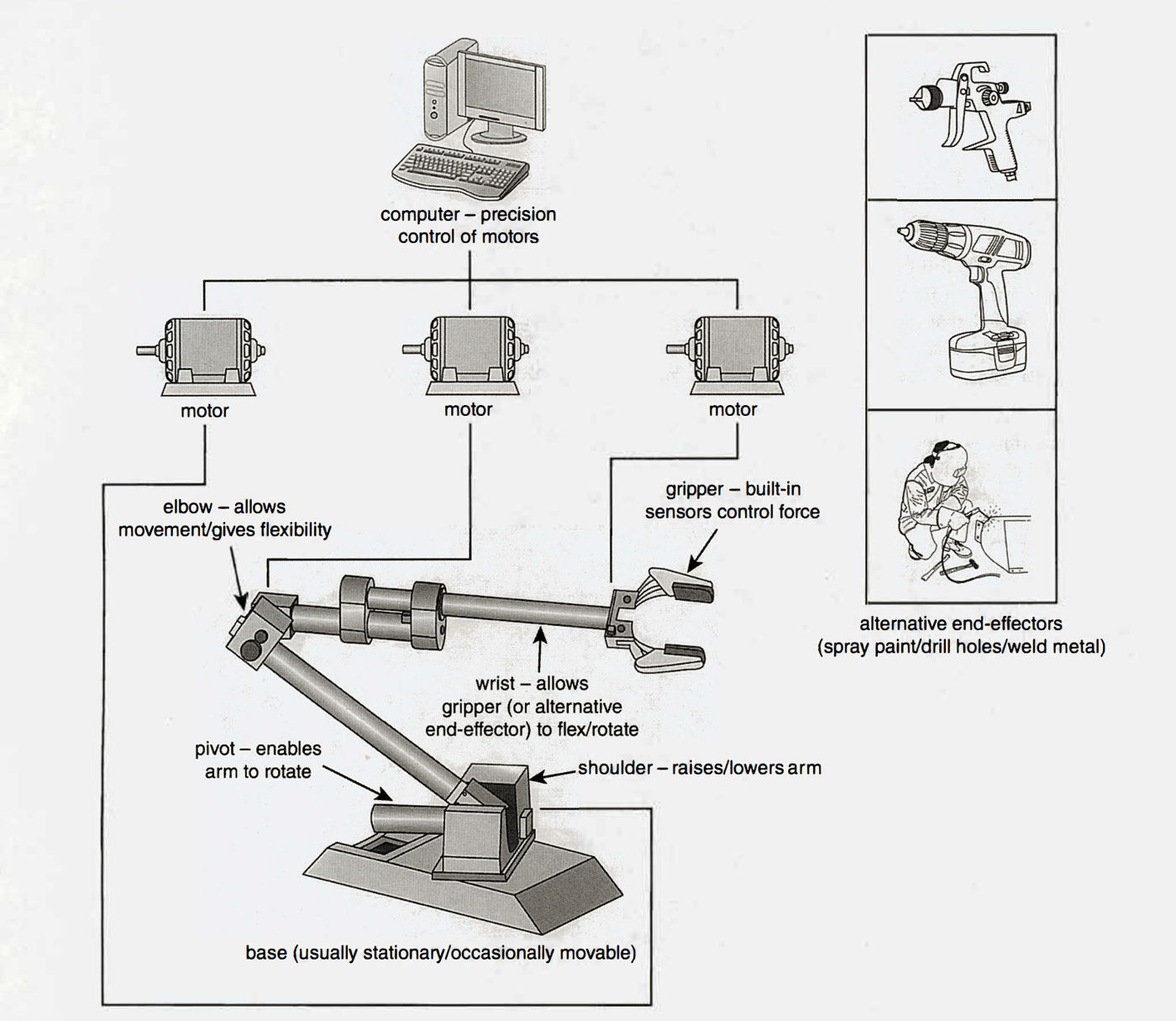
The diagram below shows how a mechanical arm works, and how the joints that make up the arm function in the same way as those in a human arm. Summarise the information by selecting and reporting the main features, and make comparisons where relevant.
Student answer (Band 5.5)
The process diagram illustrates how a mechanical arm work, and how the joints work the arm function in the same way as human arm.
Overall, it is a linear process and it contains several stages starting from computer precision control of three motors which regulate the technancial arm.
Looking at the diagram in more detail, initially three motors are controled by computer. Then this motors connected with mechanical arm to make them moveable. First motor is connected by the base (usually stationary / occasionally movable) and there is also pivot which allows arm to rotate. Subsequently, shoulder is used to rises/lowers arm.
Second motor is connected with elbow which allows movementand gives flexibility. Following by, the final rod is wrist enables gribber (or althernative end-effector) to flex/rotate. The third motor is attached with the end of the gripper built in sensors control force. It is make with alternatives end-efforts (spray paint/drill holes/weld metal).
AI examiner evaluation
| Criterion | Band |
|---|---|
| Task Achievement / Task Response | 5.0 |
| Coherence and Cohesion | 5.5 |
| Lexical Resource | 5.5 |
| Grammatical Range and Accuracy | 5.0 |
| Overall | 5.5 |
Task Achievement / Task Response: Band 5.0
You identify the diagram’s main components, including computer-controlled motors, the joints, the gripper and alternative end-effectors. However, the account only partially explains how these parts relate: for example, the motor connections are assigned inaccurately, since the diagram links the left motor to the elbow, the centre motor to the arm near the wrist, and the right motor to the gripper. The overview calls this a “linear process,” which does not clearly capture the arm’s structure and functions. Several functions are mentioned, but the base, pivot and shoulder are not described in a fully accurate sequence. The response is also 145 words, five words below the required minimum; eight words copied from the prompt were excluded from the count. Add a clearer overview and accurately report the key connections and functions.
Coherence and Cohesion: Band 5.5
The response has a basic paragraph structure: an introduction, an overview and two paragraphs of detail. Sequencing expressions such as “initially,” “subsequently” and “following by” show an attempt to guide the reader through the information. However, the progression is not consistently clear because the description moves between the base, pivot, shoulder and motors without accurately tracing the arm’s layout. Some links are also awkward or unclear, as in “First motor is connected by the base” and “Following by, the final rod is wrist.” Use a more systematic order—from the computer and motors, through the base and joints, to the gripper—and connect each component to its function with clear references.
Lexical Resource: Band 5.5
You use relevant technical vocabulary, including “pivot,” “shoulder,” “elbow,” “wrist,” “gripper” and “end-effector,” which helps identify the diagram’s parts. There is also some attempt to describe function with phrases such as “allows arm to rotate” and “gives flexibility.” However, inaccurate word forms, spelling and collocations are noticeable and sometimes make the description harder to follow: “technancial,” “controled,” “gribber,” “althernative” and “end-efforts” are examples. Phrases such as “make them moveable” and “It is make with alternatives” are also imprecise for describing a diagram. Aim for accurate technical terms and natural verb-noun combinations, such as “the motors control movement” and “the gripper is fitted with sensors.”
Grammatical Range and Accuracy: Band 5.0
The response attempts both simple and longer sentences, and the overall meaning can usually be followed. However, grammatical errors occur frequently, including subject–verb agreement (“a mechanical arm work”), missing or incorrect articles (“human arm,” “First motor”), and faulty verb forms (“shoulder is used to rises/lowers arm,” “It is make”). Some sentence structures are incomplete or difficult to parse, particularly “Following by, the final rod is wrist enables gribber…” and “The third motor is attached with the end of the gripper built in sensors control force.” These errors sometimes obscure how the components connect. Practise forming complete sentences with a clear subject and verb, and check agreement, articles and verb patterns. For example: “The shoulder raises and lowers the arm.”
See this exact question answered at other band scores. The same prompt compared across bands.
Browse more IELTS Writing model answers or get your own writing scored by the same AI examiner.