Band 5.5 IELTS Writing Task 1 Model Answer
Overall Band Score: 5.5 · IELTS Momentum Workout · 2026-11-27
IELTS Writing Task 1 question
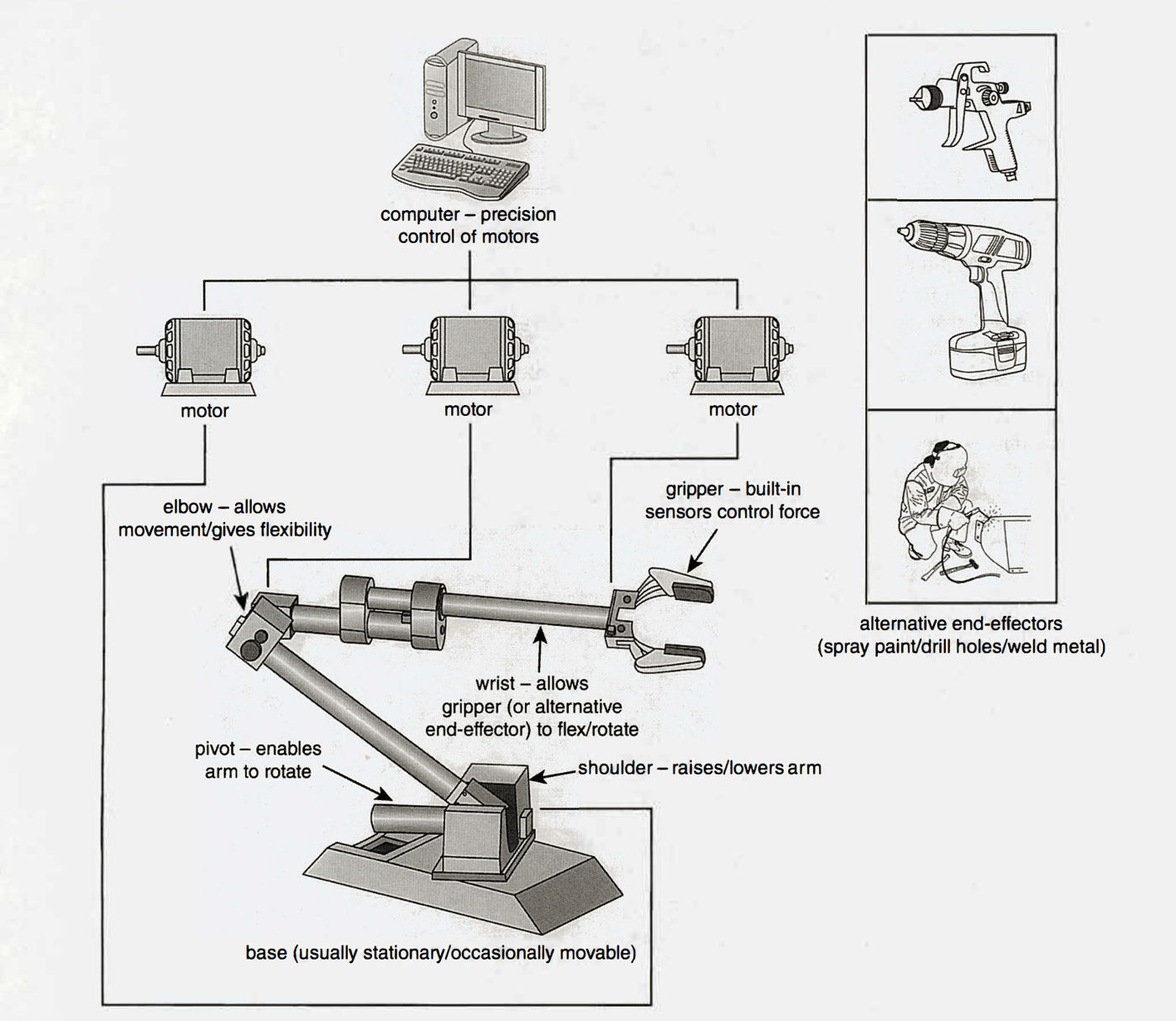
The diagram below shows how a mechanical arm works, and how the joints that make up the arm function in the same way as those in a human arm. Summarise the information by selecting and reporting the main features, and make comparisons where relevant.
Student answer (Band 5.5)
The diagram illustrates the working of mechanical arms and formation of arm by using motors same as human arm.
Overall, the computer is connected to the motors that make sure the precision and control the motors; moreover, five major parts shoulder, elbow, wrist and gripper of mechanical arm and a base which enable to bend, raise and up.
Commencing with the major part, which is base that is stationary and occasionally can be moved when needed; furthermore, pivot is attached to the base that enables arm to move, shoulder assits to raise lowers arm; beyond that an elbow that allows arm to bend and provide flexibility and adaptablity, a wrist contribute to the rotation of arm;in addition, gripper that contains built in sensors that has ability to contro; force and perform task using spray for painting the objects like wall, drills for holes in wall and in other objects and for welding metals
AI examiner evaluation
| Criterion | Band |
|---|---|
| Task Achievement / Task Response | 6.0 |
| Coherence and Cohesion | 5.5 |
| Lexical Resource | 6.0 |
| Grammatical Range and Accuracy | 5.0 |
| Overall | 5.5 |
Task Achievement / Task Response: Band 6.0
You identify the main components and several of their functions, including the computer-controlled motors, the base, pivot, shoulder, elbow, wrist and sensor-equipped gripper. The examples of alternative uses—painting, drilling and welding—are also relevant. However, the overview is unclear and does not explain the system’s main arrangement: the computer controls three motors, while the arm is mounted on a base and its joints enable movement. Some details are imprecise: the pivot enables rotation, rather than simply movement, and the wrist allows the gripper or another end-effector to flex or rotate. The comparison with a human arm is mentioned in the opening but not developed. A clearer overview and more precise reporting of these relationships would make the response more complete.
Coherence and Cohesion: Band 5.5
The response follows a broadly sensible order, moving from the computer and motors to the base and then along the arm’s joints to the gripper. This gives the reader a basic route through the diagram. However, the information is presented in one long paragraph, and the overview does not clearly separate the system’s general structure from the component details. Linking expressions such as “moreover,” “furthermore,” and “beyond that” are used repeatedly, sometimes making the sequence feel mechanical rather than clarifying relationships. The final sentence also combines the gripper’s function with three examples of alternative tools without a clear transition. Use a short overview paragraph followed by a logically grouped description, and make each connector show a precise relationship.
Lexical Resource: Band 6.0
You use a relevant range of topic vocabulary, including “precision,” “pivot,” “flexibility,” “built in sensors,” and “welding,” which helps convey the diagram’s subject. Some less common terms are attempted, but several choices or forms are inaccurate or awkward: “formation of arm,” “raise and up,” and “adaptablity” do not express the intended meanings naturally. “A wrist contribute to the rotation of arm” is also imprecise, since the diagram says the wrist allows the gripper or an alternative end-effector to flex or rotate. Spelling and typing slips such as “assits” and “contro” reduce polish. Aim for precise technical collocations and check spelling; for example, describe the arm as “comprising” parts and say that the shoulder “raises or lowers” it.
Grammatical Range and Accuracy: Band 5.0
You attempt both simple statements and longer sentences with clauses, as in “which is base that is stationary and occasionally can be moved when needed.” However, the longer constructions are not consistently controlled, and some errors make relationships difficult to follow. Examples include “shoulder assits to raise lowers arm,” where the verb pattern and coordination are faulty, and “a wrist contribute,” where subject–verb agreement is incorrect. Articles and sentence boundaries also need attention: “which is base” lacks an article, while the final sentence runs on and ends without clear punctuation. The opening phrase “working of mechanical arms and formation of arm” also shows problems with grammatical phrasing. Build accuracy by using shorter, complete sentences first, then add subordinate clauses only when their structure is clear.
See this exact question answered at other band scores. The same prompt compared across bands.
Browse more IELTS Writing model answers or get your own writing scored by the same AI examiner.