Band 6.0 IELTS Writing Task 1 Model Answer
Overall Band Score: 6.0 · IELTS Momentum Workout · 2026-11-27
IELTS Writing Task 1 question
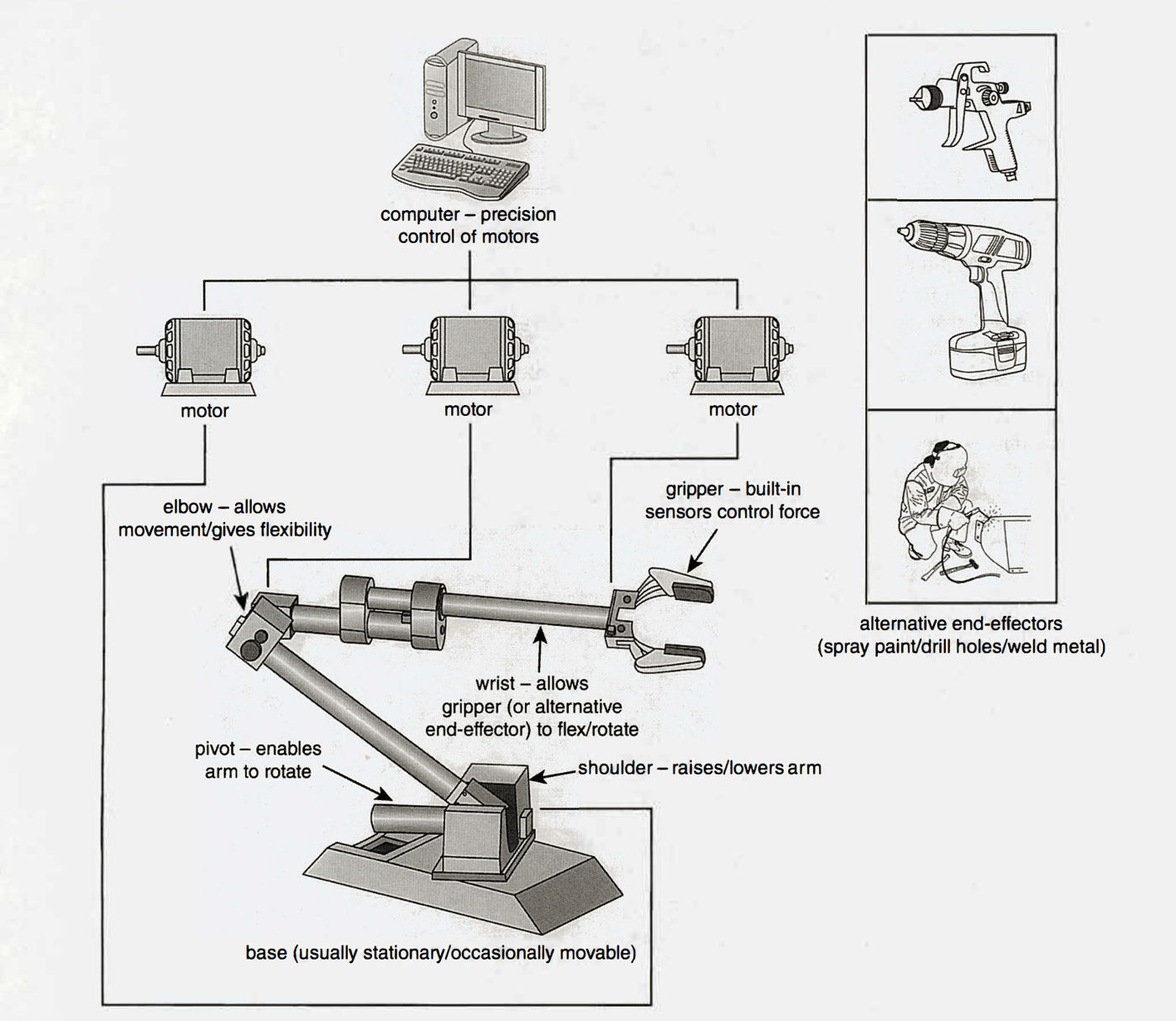
The diagram below shows how a mechanical arm works, and how the joints that make up the arm function in the same way as those in a human arm. Summarise the information by selecting and reporting the main features, and make comparisons where relevant.
Student answer (Band 6.0)
The given diagram illustrates the information regarding the work of mechanical arm and how their joint functions same as in a human arm.
Overall, it is crystal clear that most of their joints are movable such as shoulder, wrist and elbow which shows that it has flexibility like human arm. Base is the cornerstone of this mechanical arm where all joints have been placed. Though, it is not the only tool which looks like human arm, some other tools such as spray paint, drill holes and weld metal look similar to it
There are three motors which are used to function different parts of the mechanical arm controlled by computer. First motor is placed just below the shoulder which is responsible to raises or lowers the arm and pivot allows arm to rotate in the different directions. Elbow which allows movement and gives flexibility is placed in the centre of upper and lower arm. Additionally, second motor is placed is right next to elbow.
Wrist which is in a cylindrical shape is responsible for allowing gripper to hold the tools and it can also flex and rotate. Third motor is placed behind the gripper. Interestingly, gripper which is exactly similar to human hand is use to control force by using their built-in sensors.
AI examiner evaluation
| Criterion | Band |
|---|---|
| Task Achievement / Task Response | 6.0 |
| Coherence and Cohesion | 5.5 |
| Lexical Resource | 6.0 |
| Grammatical Range and Accuracy | 5.5 |
| Overall | 6.0 |
Task Achievement / Task Response: Band 6.0
You identify the diagram’s main components and give a general overview of the arm’s movable joints and computer-controlled motors. The descriptions of the elbow, pivot, wrist and sensor-equipped gripper are relevant, and you also mention the alternative tools. However, some details are unclear or do not match the visual: the first motor is not described as being just below the shoulder, and the second motor’s connection to the arm is left vague. The spray gun, drill and welding function as alternative end-effectors, rather than tools that look similar to a human arm. To make the account more complete, explain the arrangement from the base and shoulder through the elbow to the wrist and gripper, and clarify how the motors connect to these parts.
Coherence and Cohesion: Band 5.5
The response has a recognisable structure: an introduction, an overview and two paragraphs describing components. This gives the reader a broad route through the information, and sequencing words such as “First,” “Additionally” and “Interestingly” help signal progression. However, the organisation is not consistently logical: the overview introduces the alternative tools before the body returns to the arm, and the motor descriptions do not follow a fully clear path along its structure. Some references, including “their joints” and “it,” are not immediately precise. Grouping the information in physical order—from base and pivot, to shoulder and elbow, then wrist and gripper—would strengthen progression and make the links between details clearer.
Lexical Resource: Band 6.0
You use an adequate range of task-related vocabulary, including “pivot,” “flexibility,” “cylindrical,” “gripper” and “built-in sensors.” These terms help convey the diagram’s technical features, and the meaning is generally understandable. Some word choices and collocations are imprecise, however: “the work of mechanical arm” is awkward, “cornerstone” is an unsuitable metaphor for the base, and “hold the tools” does not accurately describe the gripper’s role in this diagram. The phrase “drill holes” names an action rather than the alternative end-effector itself. Aim for precise labels and natural technical collocations, such as “the arm’s operation,” “supports the arm,” and “a drilling attachment.”
Grammatical Range and Accuracy: Band 5.5
You attempt both simple and more complex sentences, including a relative clause in “Elbow which allows movement and gives flexibility” and a contrast introduced by “Though.” The main ideas remain understandable, but some grammatical errors recur. Examples include “how their joint functions same as” (missing articles and an appropriate verb construction), “responsible to raises or lowers” (incorrect infinitive form), and “is use to control” (incorrect participle). There are also agreement and article problems, such as “mechanical arm” and “their built-in sensors.” Practise complete relative clauses and consistent subject–verb agreement, and check verb patterns after phrases such as “responsible for” or “allows.”
See this exact question answered at other band scores. The same prompt compared across bands.
Browse more IELTS Writing model answers or get your own writing scored by the same AI examiner.