Band 5.5 IELTS Writing Task 1 Model Answer
Overall Band Score: 5.5 · IELTS Momentum Workout · 2026-11-27
IELTS Writing Task 1 question
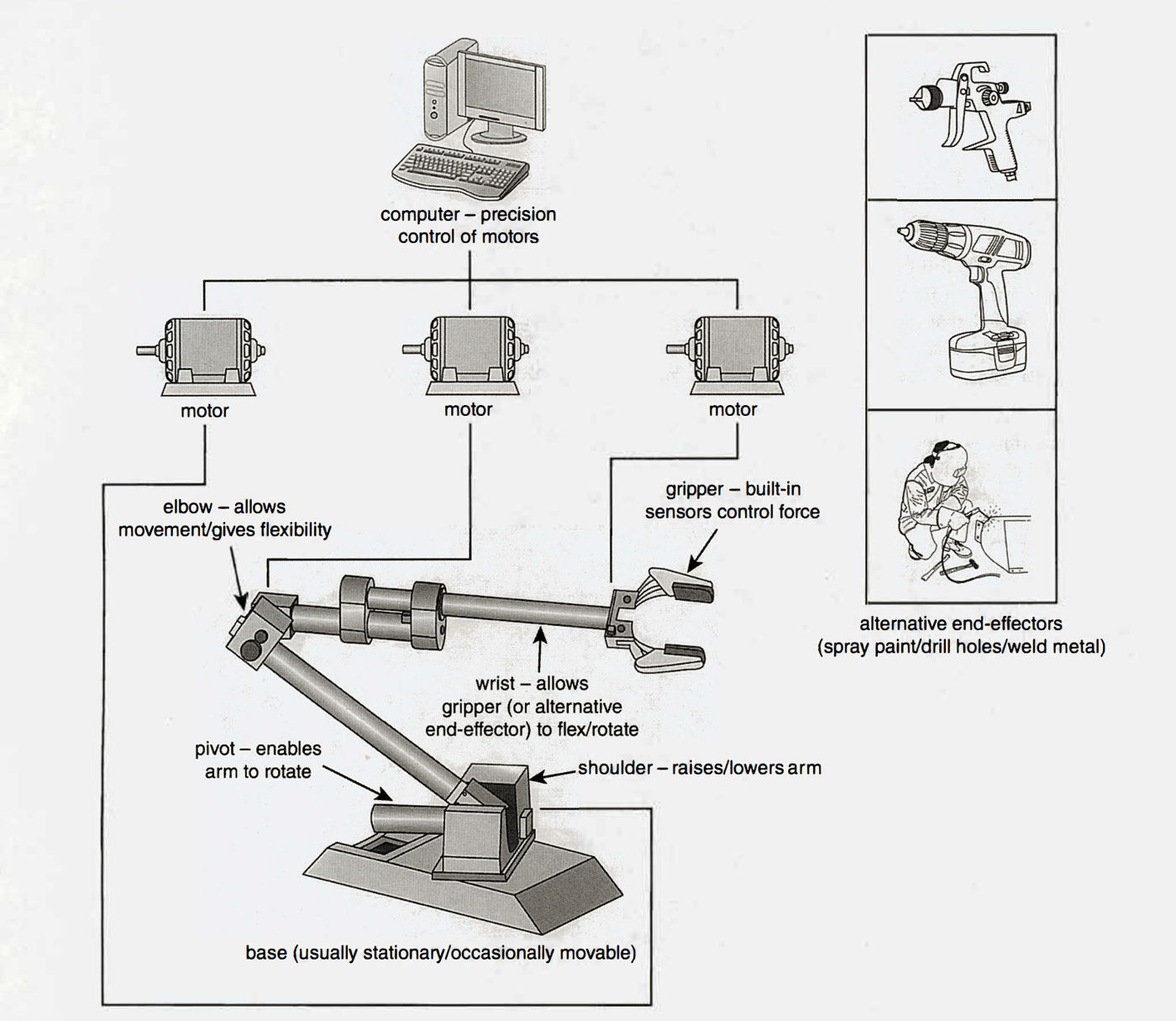
The diagram below shows how a mechanical arm works, and how the joints that make up the arm function in the same way as those in a human arm. Summarise the information by selecting and reporting the main features, and make comparisons where relevant.
Student answer (Band 5.5)
The given diagram illustrates the working of the mechanical arm and it also demonstrate the function of the arm joints. Overall the diagram shows several parts of the mechanical arm and it also mention their working procedure.
The process starts with the computer which is used to control the precision of the three motors. Each motor has connected with different part of the mechanical arm and also served the different function. The motor on the right side of the diagram is connected with gripper, it has built-in sensors which control the force of the grip. The motor in the middle is attached with part of the mechanical arm act like real elbow, this part allows the movement of the entire arm anlso provide the flexibility to bend the arm. Moreover, the motor on the left end directly attached with the part act as shoulder it controls the arm movement such as raising and lowering the arm. Furthermore, the shoulder is installed on the base like platform it also has a pivot pointwhich enables the machine arm to rotate. The base usually stationary but it could be move on certain circumstances.
However, to build this whole mechanical arm certain factors also contribute in this procedure, It includes the spray painting on the parts of the machine, drilling to develop holes and in the end welding of the metal parts.
AI examiner evaluation
| Criterion | Band |
|---|---|
| Task Achievement / Task Response | 5.0 |
| Coherence and Cohesion | 5.5 |
| Lexical Resource | 5.5 |
| Grammatical Range and Accuracy | 5.5 |
| Overall | 5.5 |
Task Achievement / Task Response: Band 5.0
You identify the computer, three motors, gripper, shoulder, pivot and base, and you report several functions, including force control and rotation. However, some key relationships are misread: the middle motor connects to the arm near the wrist, not to the elbow, while the left motor connects to the elbow rather than the shoulder. The wrist’s ability to flex or rotate and the gripper’s replaceable end-effectors are also important features that are not clearly explained. Most significantly, the final paragraph treats spraying, drilling and welding as steps in building the arm; the diagram presents them as tasks performed by alternative end-effectors. The overview is general rather than summarising the arm’s structure and operation. Select the main components accurately and distinguish their functions from the applications.
Coherence and Cohesion: Band 5.5
The response has a basic paragraph structure: an introduction and overview, a description of the components, and a final paragraph. The sequence from computer control to the arm and base gives the reader some progression, and linking expressions such as “Moreover” and “Furthermore” help connect details. However, the final paragraph shifts abruptly to manufacturing, which disrupts the explanation because those illustrations show alternative uses, not construction stages. Several sentences also combine multiple details without clear relationships, particularly the description of the motors and joints. Use one paragraph to explain the control system and arm from base to gripper, then a separate paragraph for the alternative end-effectors. More precise referencing would make the progression easier to follow.
Lexical Resource: Band 5.5
You use relevant task vocabulary, including “built-in sensors,” “pivot point,” “stationary,” and “flexibility,” which helps communicate the diagram’s subject. There is some variation in how you describe functions, such as “control,” “allows,” and “enables.” However, several phrases are imprecise or awkward, including “working procedure,” “part of the mechanical arm act like real elbow,” and “certain factors also contribute in this procedure.” The last phrase also leads to an inaccurate description of the illustrations as construction activities. Spelling slips such as “anlso” and “pointwhich” reduce accuracy. Aim for concise, conventional process-description language, and use the diagram’s labels—especially “wrist,” “elbow,” and “alternative end-effectors”—to describe components precisely.
Grammatical Range and Accuracy: Band 5.5
You attempt a mixture of simple and longer sentences, using clauses with “which,” “such as,” and “Moreover” to add information. Meaning is generally recoverable, but errors occur in both sentence structure and basic forms. For example, “it also demonstrate” needs subject–verb agreement, while “Each motor has connected” requires a passive form such as “is connected.” In “the middle is attached with part … act like real elbow,” the clause needs a subject and a correctly formed verb. The sentence beginning “However, to build this whole mechanical arm…” is also awkwardly constructed and punctuated, including an unnecessary capital after the comma. Practise accurate passive constructions and relative clauses, and check agreement, articles, and sentence boundaries during revision.
See this exact question answered at other band scores. The same prompt compared across bands.
Browse more IELTS Writing model answers or get your own writing scored by the same AI examiner.