Band 5.5 IELTS Writing Task 1 Model Answer
Overall Band Score: 5.5 · IELTS Momentum Workout · 2026-11-25
IELTS Writing Task 1 question
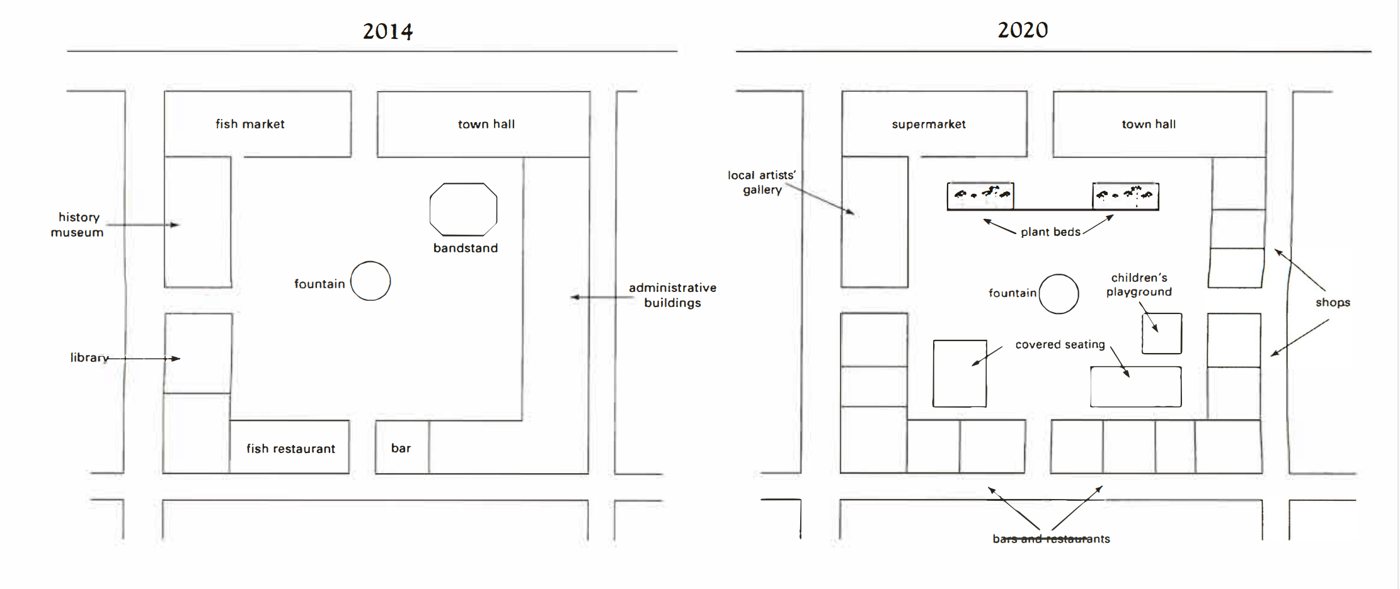
The diagram below shows a town square and surrounding area in 2014 and the plans for development of the area to be completed by 2020. Summarise the information by selecting and reporting the main features, and make comparisons where relevant.
Student answer (Band 5.5)
The diagram illustrates both year of 2014 and 2020 of a squared town and its surrounding area. In 2014, the town have fountain in the middle,whereas there's fish market and town hall in the front of it and ooposite have both fish restaurant and bar. On the left side of the fountain there's a library that's close to history museum and in front of that tje abministrative building is situated.
The future plan for the same are in 2020 show some changes that includes plants beds, children's playground with two covered seating. There are several replacements of the marketplace of fish which planned to be supermerket meanwhile history museum will be replaced with loval artist's gallery. Adminitrative buildings, bar and fish restaurant are planned to be diminished and there places to be taken by shops.
In conclusion, there was sevral vancant places in the town in 2014 whereas in 2020 the placed are planned to be filled with more beneficial arrangments.
AI examiner evaluation
| Criterion | Band |
|---|---|
| Task Achievement / Task Response | 5.5 |
| Coherence and Cohesion | 6.0 |
| Lexical Resource | 5.0 |
| Grammatical Range and Accuracy | 5.0 |
| Overall | 5.5 |
Task Achievement / Task Response: Band 5.5
You identify the main purpose of the plans and report several important changes: the fish market becomes a supermarket, the history museum becomes a local artists’ gallery, and new planting, play and seating areas are introduced. The central fountain and town hall are also correctly noted as remaining. However, the overview is unclear and includes an unsupported claim that there were “several vacant places” in 2014. Some locations are misreported: the town hall and fish market are not both “in the front” of the fountain, and the administrative buildings are on the eastern side, not in front of the library and museum. The southern businesses are reorganised rather than simply diminished. A clearer overview and more accurate spatial comparisons would strengthen the report.
Coherence and Cohesion: Band 6.0
The response has a recognisable sequence: it describes the 2014 layout, moves to the 2020 plan, and ends with a conclusion. This gives the reader a coherent overall arrangement. Linking expressions such as “whereas,” “meanwhile,” and “In conclusion” help signal comparisons and stages. However, some references are difficult to follow, particularly “in the front of it,” “opposite,” and “in front of that,” because the locations they refer to are not precise. The final conclusion repeats a general idea rather than summarising the main transformation. Grouping the changes by area—for example, northern buildings, central square, and southern/eastern perimeter—and using clearer location references would improve progression and cohesion.
Lexical Resource: Band 5.0
You use relevant vocabulary for describing a map, including “fountain,” “library,” “replaced,” “children’s playground,” and “covered seating.” These terms show an attempt to describe both existing features and planned changes. However, the range is limited, and several spelling and word-choice errors make parts of the report harder to understand, such as “supermerket,” “loval artist’s gallery,” and “diminished.” “Vacant places” is also inaccurate for the map, while “beneficial arrangements” is vague and evaluative rather than descriptive. Aim for precise map language such as “located,” “converted into,” “removed,” and “reconfigured,” and check spelling and collocations carefully. This would make the description clearer and more appropriate to an academic report.
Grammatical Range and Accuracy: Band 5.0
You attempt both simple and more complex sentence forms, including a contrast with “whereas” and a relative clause in “the marketplace of fish which planned to be supermerket.” However, the complex construction is faulty because it needs a passive verb form, and errors occur in basic sentence patterns too. For example, “the town have fountain” has incorrect subject–verb agreement and is missing an article, while “the future plan … show” also has agreement problems. Some punctuation is missing, as in “middle,whereas,” and sentence boundaries are not consistently controlled. Practise accurate present and future passive forms for planned changes, and check articles, agreement, and punctuation in each sentence.
See this exact question answered at other band scores. The same prompt compared across bands.
Browse more IELTS Writing model answers or get your own writing scored by the same AI examiner.