Band 5.5 IELTS Writing Task 1 Model Answer
Overall Band Score: 5.5 · IELTS Complete Catalyst · 2026-11-16
IELTS Writing Task 1 question
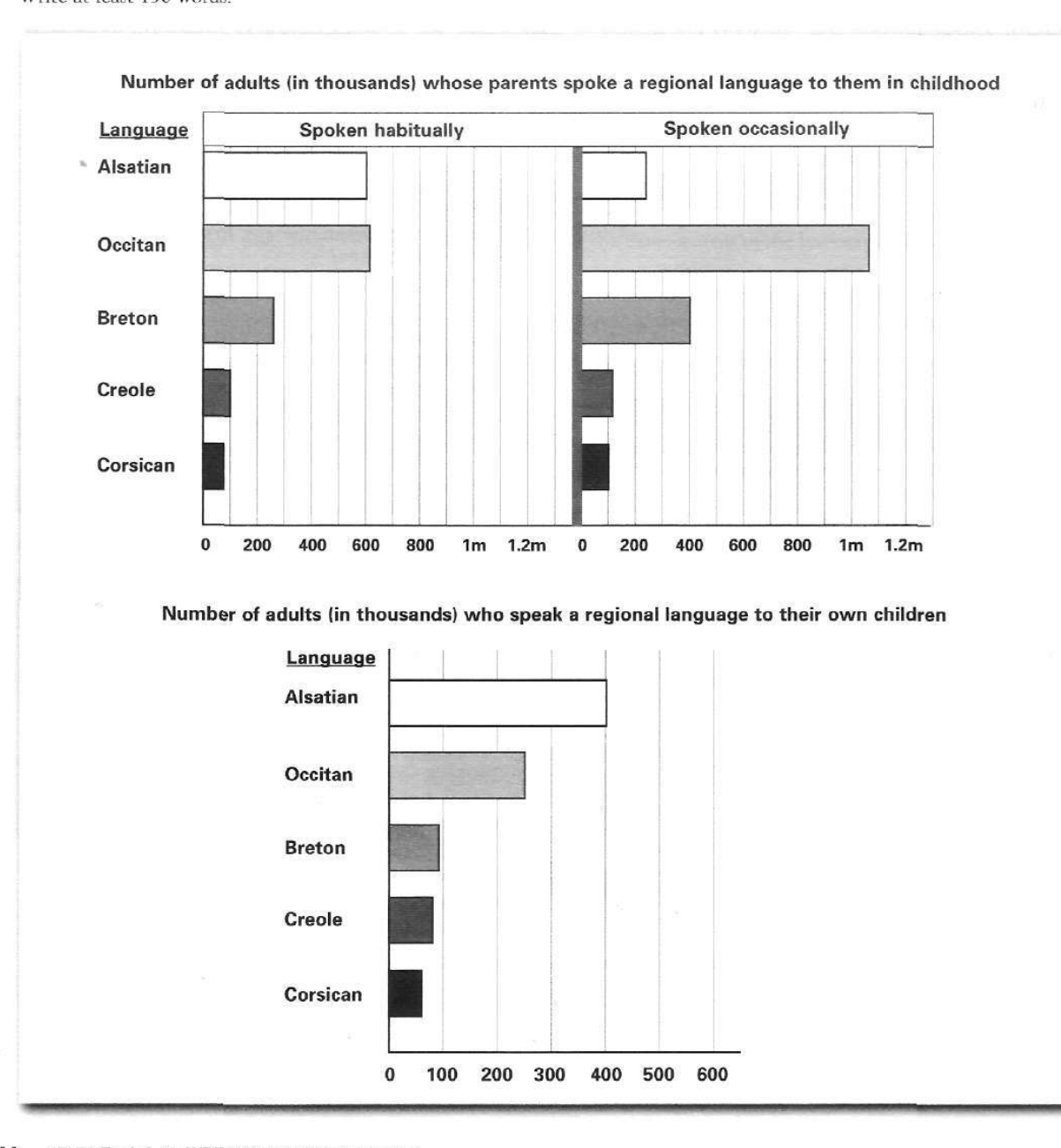
The charts below show the number of French adults whose parents spoke a French regional language to them when they were children and the number who speak a French regional language to their own children.
Write a report for a university lecturer describing the information below.
Number of adults (in thousands) whose parents spoke a regional language to them in childhood
Student answer (Band 5.5)
This graph illustrate the number of French mature persons whose gardians spoke a french regional language to them and also the number of parents who speak french language to their kids.
Overall,the adults speak occitan language most as compared to other languages habitually or occasionally. Meanwhile Alsatian language is spoken most with the children.
Occitan language is spoken most by persons just more 600 habitually and considerably more than 1m occassionally. Alsatian is spoken by 600 adults habitually and just more than 200 occassionally. The Breton language spoken by 400 adults occassionally more than spoken habitually which is less than 300.The other languages Creole and Corsican has less spoken.
The language that is spoken more by adults their kids is Alsatian which is spoken by 400 parents.Occitan is spoke by less than 300 adults.Mean while Breton,Creole and Corsican these languages are less spoken by adults mainly less than 100 adults.
AI examiner evaluation
| Criterion | Band |
|---|---|
| Task Achievement / Task Response | 6.0 |
| Coherence and Cohesion | 6.0 |
| Lexical Resource | 5.5 |
| Grammatical Range and Accuracy | 5.0 |
| Overall | 5.5 |
Task Achievement / Task Response: Band 6.0
You cover both charts and provide a clear overview: Occitan has the highest figures for adults who heard a regional language, while Alsatian leads for adults speaking to their children. Several key comparisons are also accurate, including Occitan at just over 1 million occasional speakers and Alsatian at about 600,000 habitual speakers. However, some details are incomplete or imprecise. For example, saying the other languages “has less spoken” does not show that occasional Breton (about 400,000) exceeds habitual Breton (about 260,000), or that Creole and Corsican are the smallest groups. The second chart is summarised broadly, but the figures for Breton, Creole and Corsican could be compared more clearly. Select and report the main contrasts more fully to make the account more informative.
Coherence and Cohesion: Band 6.0
The response has a coherent overall arrangement: an introduction, an overview, details about the first chart, and then details about speaking to children. This makes the two chart topics easy to follow. The overview also helps the reader identify the main contrast between Occitan and Alsatian. Cohesion is sometimes mechanical or unclear, however. Repeated openings such as “Occitan language” and “The language” make the report sound list-like, while “Meanwhile” and “The other languages” do not always connect the comparisons precisely. The final sentence groups three languages together without explaining their relative figures. Use clearer comparison links, such as “by contrast” or “whereas,” and organise the smaller categories into a more explicit comparison.
Lexical Resource: Band 5.5
You use relevant vocabulary for describing charts, including “habitually,” “occasionally,” “compared to,” and “spoken most.” These choices help communicate the main trends, and the reader can generally understand the intended comparisons. However, the range is limited and some expressions are inaccurate or unnatural, such as “adults speak occitan language most,” “spoken more by adults their kids,” and “less spoken.” There are also spelling errors, including “occassionally” and “gardians,” and inconsistent capitalisation of language names. Aim for precise chart-reporting collocations such as “the largest number,” “was spoken to children,” and “the figure was lower.” Check spelling and use the same accurate terms consistently throughout.
Grammatical Range and Accuracy: Band 5.0
You attempt both simple statements and longer comparisons, and the overall meaning is usually recoverable. The response also uses some linking structures, for example, “which is spoken by 400 parents.” However, grammatical control is uneven, with errors in agreement, articles, and sentence construction. “This graph illustrate” needs a plural subject or a singular verb, and “The other languages Creole and Corsican has less spoken” is not a complete, correctly formed clause. In “The Breton language spoken by 400 adults,” the main verb is missing. Punctuation is also inconsistent, particularly the missing space after “Overall,” and the comma splice-like construction in the final sentence. Practise accurate subject–verb agreement and complete clauses before adding more complex comparisons.
See this exact question answered at other band scores. The same prompt compared across bands.
Browse more IELTS Writing model answers or get your own writing scored by the same AI examiner.