Band 5.0 IELTS Writing Task 1 Model Answer
Overall Band Score: 5.0 · IELTS Complete Catalyst · 2026-11-17
IELTS Writing Task 1 question
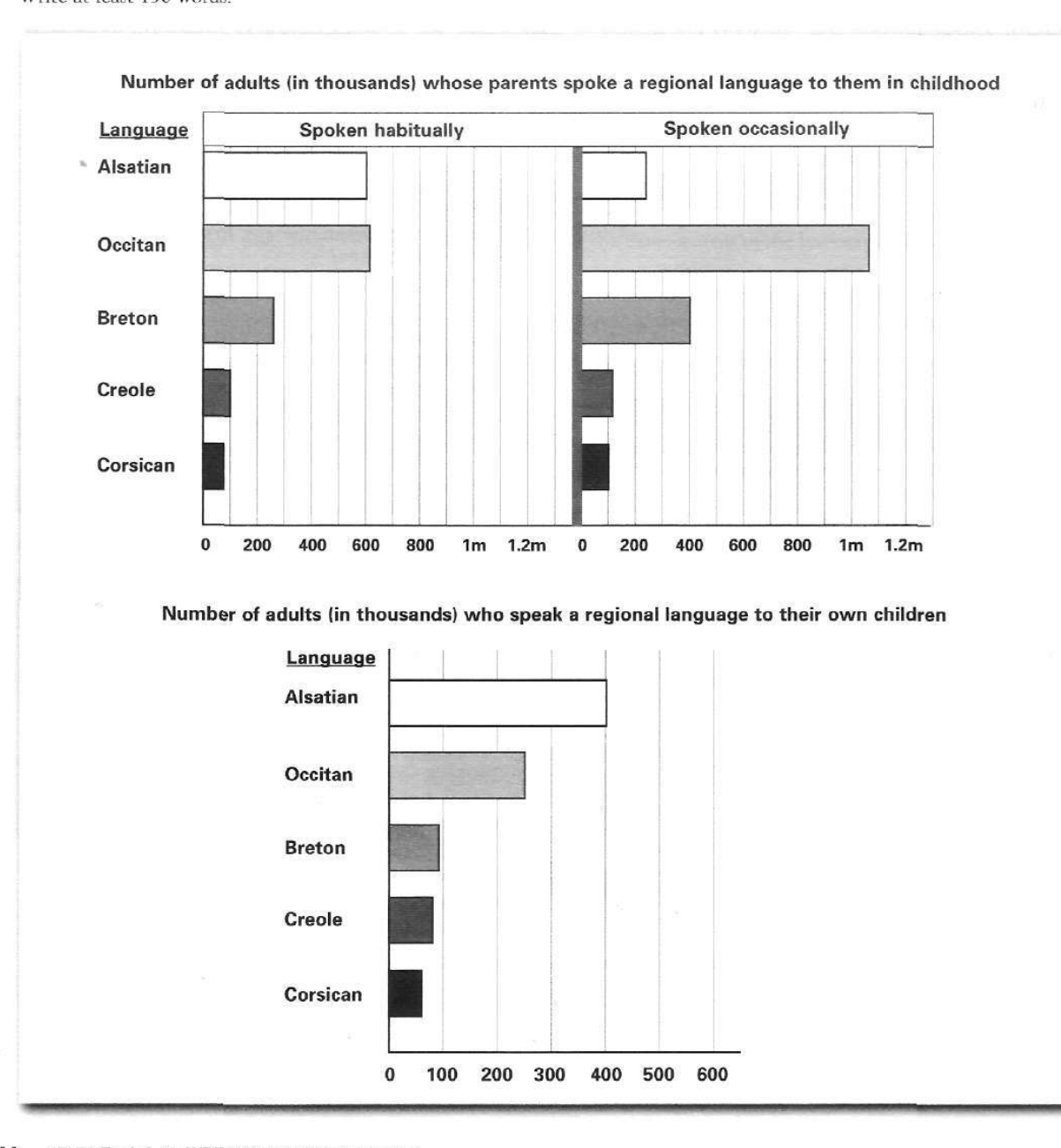
The charts below show the number of French adults whose parents spoke a French regional language to them when they were children and the number who speak a French regional language to their own children.
Write a report for a university lecturer describing the information below.
Number of adults (in thousands) whose parents spoke a regional language to them in childhood
Student answer (Band 5.0)
The bar graph illustrate the number of adults whose parentys soke their regional language in to them childhood and adults who spoke their regional langauge in their own childhoold the number is given in thousands.
As seen in chart, Alsatian and Occitane had simliar in spoken habitually at 600k, this number were different in who spoke this langugae occasionally and habitually in figure was 1.05m and 250k. 250k spoke Breton langauge habitually and the number were rose in occasionally speaker to 400k. The Creole and Coesican were less spoken by adults in both habitually and occasionally the number was under 200k.
The number of adults who spoke their regional language in the childhood in this chart, the Alsation language topped with 400k speaker and it follwed by Occitan who had 250k speakers. The number of speaker who spoke the Breton, Creole and Corsican language were under 100k when the adults were child.
Overall, the Alsation langauge were most spoken langauge in French and Coreole and Corsican were least famous languages.
AI examiner evaluation
| Criterion | Band |
|---|---|
| Task Achievement / Task Response | 5.0 |
| Coherence and Cohesion | 5.0 |
| Lexical Resource | 5.0 |
| Grammatical Range and Accuracy | 5.0 |
| Overall | 5.0 |
Task Achievement / Task Response: Band 5.0
You identify several relevant comparisons, including the high occasional figure for Occitan and the relatively low figures for Creole and Corsican. However, the report only partially covers the chart: it gives little clear account of the distinction between adults whose parents spoke a language habitually or occasionally and adults who now speak it to their own children. Some figures are inaccurate or unclear—for example, Alsatian and Occitan are not similar in habitual use (about 600,000 versus 620,000, which is close, but the later comparison of Occitan’s occasional and habitual figures is confused). The claim that Breton, Creole and Corsican are all below 100,000 in childhood is also inaccurate. The overview that Alsatian is the most spoken language is not supported across the data; Occitan has the largest occasional figure.
Coherence and Cohesion: Band 5.0
The response has some organisation: it begins with an introduction, groups several language comparisons in the middle, and ends with an overall statement. However, the progression is not consistently clear, and the final paragraph repeats information about childhood figures rather than developing a distinct overview. Connections between ideas are often awkward, as in “this number were different in who spoke this language occasionally and habitually,” which makes the comparison difficult to follow. The repeated use of “the number” and “spoke” also makes the report feel repetitive, while references such as “this chart” do not always clarify which group of adults is being discussed. Use a clearer sequence—overview first, then comparisons by chart category—and link each figure explicitly to its category.
Lexical Resource: Band 5.0
You use some task-relevant vocabulary, including “habitually,” “occasionally,” “speaker,” and “topped,” so the reader can recognise the intended subject. However, the range is limited and several word choices or spellings make the report difficult to read. Examples include “parentys,” “soke,” “langauge,” “Coesican,” and “least famous”; the last phrase is also unsuitable because the chart measures language use, not popularity. “Spoken” and “number” are repeated frequently, and phrases such as “in spoken habitually” are not natural collocations. Aim for accurate terms such as “habitual use,” “occasional use,” and “the number of adults who spoke the language,” and check language names carefully before submitting.
Grammatical Range and Accuracy: Band 5.0
The response communicates its general subject, but it relies mainly on simple statements and attempts at longer comparisons are often faulty. For example, “Alsatian and Occitane had similar in spoken habitually at 600k” lacks a clear grammatical structure, while “this number were different” has an agreement error and an unclear comparison. There are also recurring problems with articles, plurals, and sentence construction, as in “the number of speaker” and “the Alsation language were most spoken.” These errors sometimes make it hard to identify which figures belong to which category. Practise building complete comparison sentences with a clear subject and verb, and check agreement—for example, “Occitan had the highest figure for occasional use, at about 1.065 million adults.”
See this exact question answered at other band scores. The same prompt compared across bands.
Browse more IELTS Writing model answers or get your own writing scored by the same AI examiner.