Band 4.5 IELTS Writing Task 1 Model Answer
Overall Band Score: 4.5 · IELTS Complete Catalyst · 2026-11-17
IELTS Writing Task 1 question
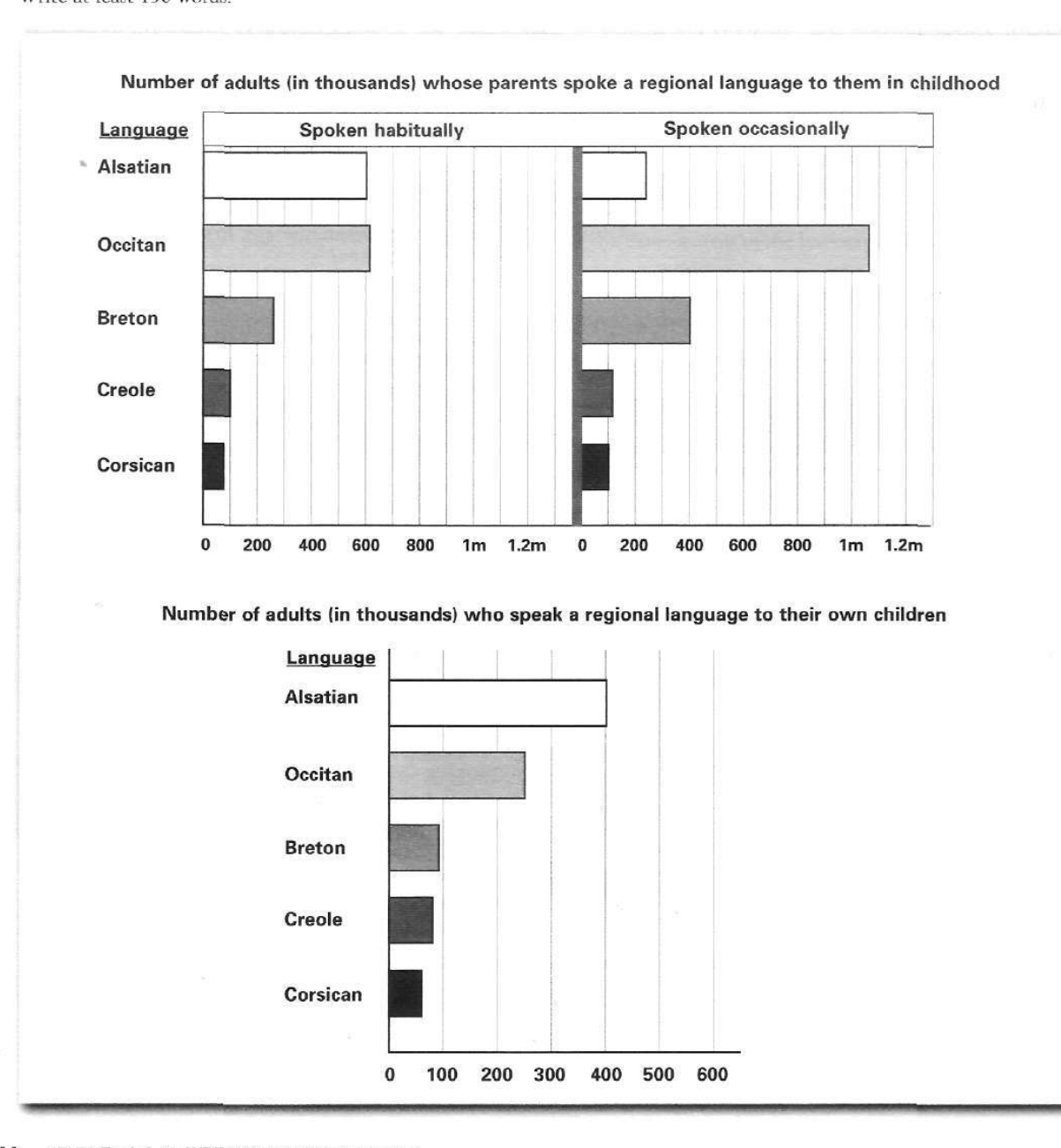
The charts below show the number of French adults whose parents spoke a French regional language to them when they were children and the number who speak a French regional language to their own children.
Write a report for a university lecturer describing the information below.
Number of adults (in thousands) whose parents spoke a regional language to them in childhood
Student answer (Band 4.5)
The following chart gives information about the number of French adults whose parents spoke a French regional language to them in their childhood and the number who speak a French language by their own children. Now there is a comparison chart between spoken habitually and occasionally, so we start with Alsatian language in which spoken habitually are around 600 and in occasionaly it is around 250. Moreover , Occitian parents spoke their language habitually are also around 600 and those whose spoke occasionally have a huge number which are above then 1m, then we have Breton language they spoke their regional language habitually are around 280 and occasionally are 400, Overall, If we take a result of higher number in the chart that is Alsatian language which is around 400.
AI examiner evaluation
| Criterion | Band |
|---|---|
| Task Achievement / Task Response | 3.0 |
| Coherence and Cohesion | 4.0 |
| Lexical Resource | 5.0 |
| Grammatical Range and Accuracy | 5.0 |
| Overall | 4.5 |
Task Achievement / Task Response: Band 3.0
The response identifies the chart’s subject and gives some approximate figures for Alsatian, Occitan and Breton, so it shows a basic understanding of part of the data. However, it does not adequately describe both charts: the figures for adults speaking languages to their own children are largely omitted, and Creole and Corsican are not covered. The statement that Alsatian is the highest figure overall is inaccurate: Occitan spoken occasionally is the largest childhood figure, at about 1,065 thousand, while Alsatian’s 400 thousand is the highest figure in the second chart. There is also no clear overview of the main patterns. The response is 116 words, below the required 150, which further limits its coverage. Include a concise overview and compare the key figures across both charts.
Coherence and Cohesion: Band 4.0
There is a basic sequence through some of the languages, and linking expressions such as “Moreover” and “then” indicate an attempt to connect information. However, the response is presented as one long paragraph, with no clear overview or separation between the two charts. The progression is difficult to follow because the discussion moves from childhood figures to the second chart only in the final sentence, without explaining that shift. Some connectors are also used mechanically or inaccurately, and the concluding “Overall” introduces a claim that does not summarise the data reliably. Organise the report into an introduction, an overview, and paragraphs comparing the main figures in each chart; use clear references to distinguish the two measures.
Lexical Resource: Band 5.0
The response uses some relevant chart vocabulary, including “number,” “comparison,” “habitually,” “occasionally” and “around,” which helps communicate the general topic. However, the range is limited and several word choices or forms are inaccurate, such as “Occitian” for “Occitan,” “occasionaly,” and “a French language by their own children.” Phrases such as “take a result of higher number” and “have a huge number” are imprecise and do not suit a formal data report. Repetition of “language” and “around” also limits flexibility. Use precise reporting expressions such as “the figure for,” “stood at,” and “was considerably higher than,” and check spelling of the language names.
Grammatical Range and Accuracy: Band 5.0
The response attempts to combine information using clauses, for example, “those whose spoke occasionally have a huge number,” but the sentence structures are often faulty and the range remains limited. Errors in verb forms and sentence construction appear in phrases such as “in which spoken habitually are around 600” and “parents spoke their language habitually are also around 600.” The opening sentence also has an unclear grammatical pattern in “the number who speak a French language by their own children.” Punctuation and spacing around commas are inconsistent, and the long sequence of clauses makes relationships between ideas hard to follow. Practise accurate simple comparison sentences first, then add controlled complex structures, ensuring each sentence has a clear subject and verb.
See this exact question answered at other band scores. The same prompt compared across bands.
Browse more IELTS Writing model answers or get your own writing scored by the same AI examiner.