Band 5.0 IELTS Writing Task 1 Model Answer
Overall Band Score: 5.0 · IELTS Complete Catalyst · 2026-11-17
IELTS Writing Task 1 question
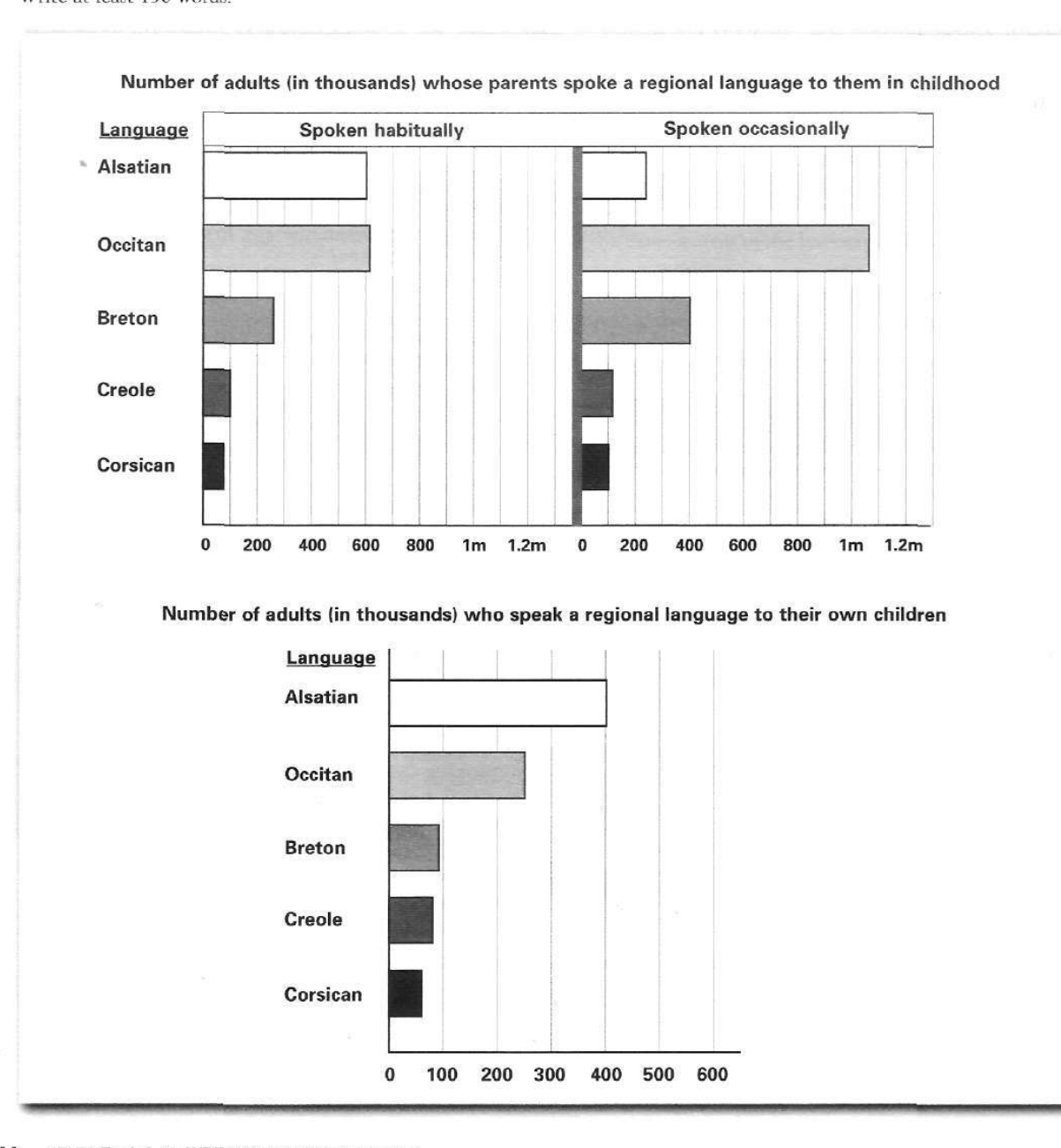
The charts below show the number of French adults whose parents spoke a French regional language to them when they were children and the number who speak a French regional language to their own children.
Write a report for a university lecturer describing the information below.
Number of adults (in thousands) whose parents spoke a regional language to them in childhood
Student answer (Band 5.0)
The charts below show the information of number of French adults whose parents spoke a French regional language to them when they were children and the number who speak a French regional language to their own children.
we can see there are number of adults who speak habitually and occasionally .In the spoken habitually we can observe that there are two languages spoken nost of the time which is aisatian and occitan which is of 600 thousand where as corsican is on the lowest spoken language .Coming to the next which is spoken occasionally there are adults who prefer speaking occitan alot which is 1,2m followed by breton which is of 400 thousand and the least prefered is creole and corsican which is of 100 to 110 thousand.
There is an another data which talks about the data number of adults who speak a regional language to their own children where aisatian language is most prefered language which is of 400 thousand and the lowest is corican language that people use less prefered language which is less than 100 thousand .
the most used language is aisatian where adults uses alot all over the data and the least used langauage is corsican .
AI examiner evaluation
| Criterion | Band |
|---|---|
| Task Achievement / Task Response | 5.0 |
| Coherence and Cohesion | 4.5 |
| Lexical Resource | 5.0 |
| Grammatical Range and Accuracy | 5.0 |
| Overall | 5.0 |
Task Achievement / Task Response: Band 5.0
You identify the two ways parents spoke to children and include the separate figures for adults who speak a language to their own children. Some comparisons are relevant: Occitan is highest for occasional use, while Corsican is lowest for habitual use. However, the overview is inaccurate: the final claim that Alsatian is the most used language “all over the data” overlooks Occitan’s much higher occasional figure (about 1,065 thousand). The report also says Alsatian and Occitan are both about 600 thousand for habitual use, but does not clearly distinguish their values or compare the two speaking patterns. Several figures are vague or inaccurate, such as grouping Creole and Corsican together at 100–110 thousand. Select the main contrasts and report them precisely.
Coherence and Cohesion: Band 4.5
The response has separate paragraphs for the introductory statement, the two childhood speaking patterns, and speaking to children, so the reader can identify the broad sections. However, progression within these sections is uneven, and the final summary repeats the claim that Alsatian is most used rather than drawing together the main comparisons accurately. Linking phrases such as “Coming to the next” and “There is an another data” are awkward and do not clearly signal relationships between the figures. Some sentences also run several comparisons together, making the information harder to follow. Organise the report around a concise overview followed by clearly ordered comparisons, and use precise links such as “by contrast” or “whereas.”
Lexical Resource: Band 5.0
You use some task-relevant vocabulary, including “habitually,” “occasionally,” “followed by,” and “lowest,” which helps communicate the chart categories and rankings. However, the range is limited and several expressions are repeated or imprecise, including “most prefered language,” “least used language,” and “alot.” Spelling errors such as “aisatian,” “corican,” “langauage,” and “prefered” are noticeable and reduce clarity. Some word combinations are also unnatural, for example “there are adults who prefer speaking occitan alot.” Use accurate language names and more precise chart vocabulary, such as “the largest figure,” “the smallest total,” and “the number fell to.”
Grammatical Range and Accuracy: Band 5.0
The response attempts to combine ideas using clauses, for example “where aisatian language is most prefered language,” but sentence structures are often faulty or incomplete. Errors in articles and sentence construction appear in phrases such as “There is an another data” and “the lowest is corican language that people use less prefered language.” Subject–verb agreement is also inconsistent: “adults uses” should be “adults use.” Capitalisation and punctuation are weak, with several sentences beginning in lowercase and missing spaces after full stops. These problems sometimes make comparisons difficult to interpret. Practise writing complete, controlled sentences with a clear subject and verb, and check articles, agreement, and punctuation before finishing.
See this exact question answered at other band scores. The same prompt compared across bands.
Browse more IELTS Writing model answers or get your own writing scored by the same AI examiner.