Band 4.5 IELTS Writing Task 1 Model Answer
Overall Band Score: 4.5 · IELTS Complete Catalyst · 2026-11-17
IELTS Writing Task 1 question
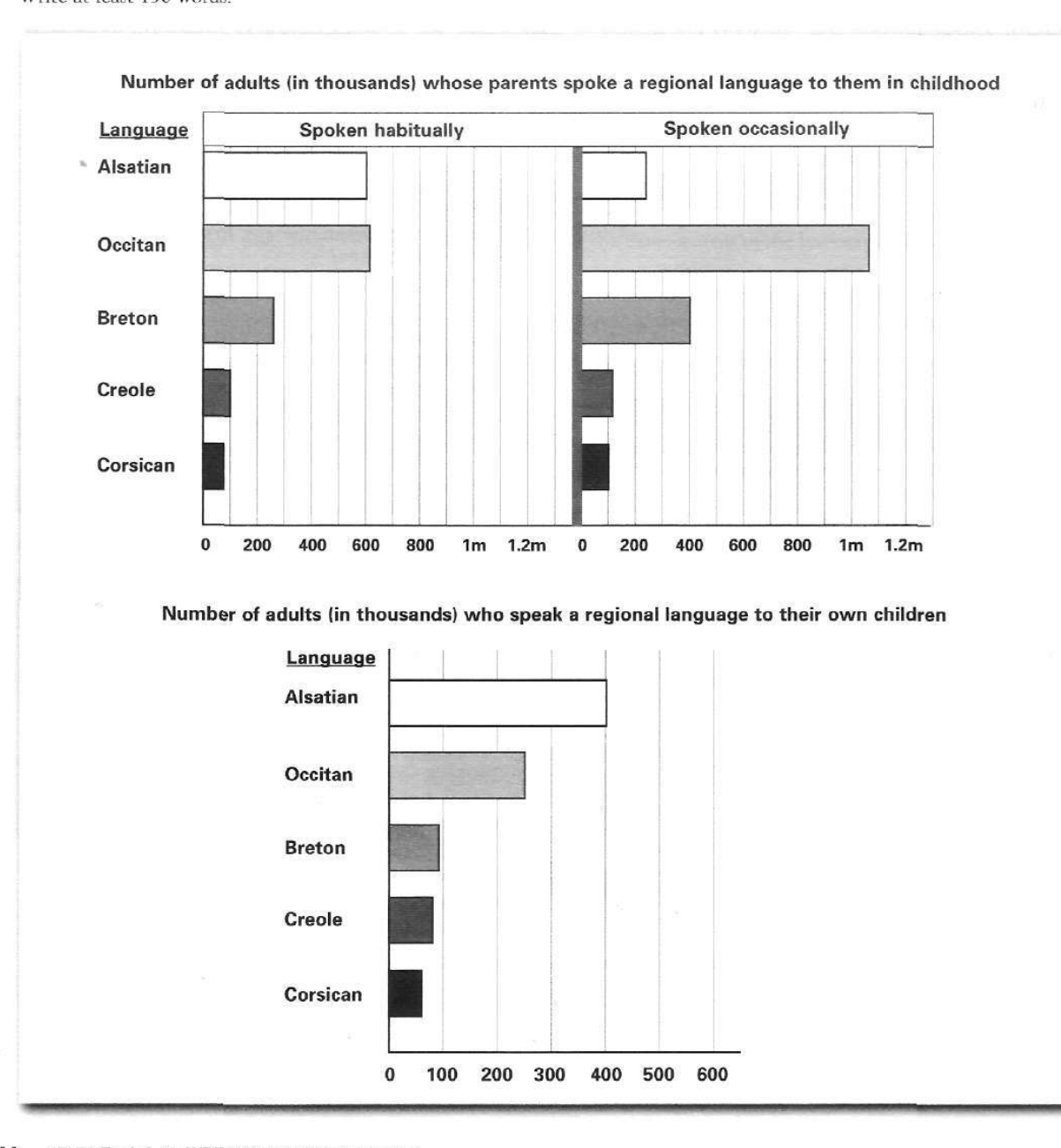
The charts below show the number of French adults whose parents spoke a French regional language to them when they were children and the number who speak a French regional language to their own children.
Write a report for a university lecturer describing the information below.
Number of adults (in thousands) whose parents spoke a regional language to them in childhood
Student answer (Band 4.5)
The supplied chart shows the numbers of individuals whose parents talk with them in their regional language and now they are speaking with their kids .
Firstly, alsatian and occitan languages were spoken same in daily life but occasionally occitian was used more where as now they are speaking alsatian more to their childrens and the other ones creole and corsican are very less spoken.
As we can clearly see only 3 lack people’s parents has spoken to them alsatian occasionally because it were spoken habitually and now 4 lacks are speaking with their childs.
AI examiner evaluation
| Criterion | Band |
|---|---|
| Task Achievement / Task Response | 3.5 |
| Coherence and Cohesion | 4.5 |
| Lexical Resource | 5.0 |
| Grammatical Range and Accuracy | 5.0 |
| Overall | 4.5 |
Task Achievement / Task Response: Band 3.5
The response identifies the broad topic and makes a relevant comparison between childhood language use and speaking to children now. However, it covers the chart only partially: it gives no clear overview of the main pattern across all five languages and omits most figures. The statement that Alsatian and Occitan were spoken “same in daily life” is inaccurate or unclear: habitual use was similar for these two, but occasional use was much higher for Occitan. The claim that only “3 lack” people had parents who spoke Alsatian occasionally also misreads the chart, which shows about 240,000. The response is 55 words below the required minimum, leaving too little detail to describe the data adequately. Include an overview and accurate comparisons for both series and the figures for adults speaking to their own children.
Coherence and Cohesion: Band 4.5
There is a basic attempt to organise the report, beginning with an introduction and using “Firstly” and “As we can clearly see” to introduce observations. The comparison between childhood use and current use is relevant, but the ideas do not develop in a clear sequence: the first paragraph combines several languages and trends, while the second focuses only on Alsatian. The relationship between “spoken same in daily life” and “occasionally” is also difficult to follow. Use separate paragraphs for an overview and key comparisons, then group the languages logically. Linking expressions should clarify contrasts rather than simply announce a point, and references such as “the other ones” should identify the languages precisely.
Lexical Resource: Band 5.0
The response uses some relevant topic vocabulary, including “regional language,” “habitually,” “occasionally,” and “spoken,” so the reader can recognise the subject. However, the range is limited and several choices are imprecise or informal for an academic report. “Talk with them” and “speaking with their kids” do not clearly express that parents spoke a language to their children; “the other ones” is vague, and “very less spoken” is not a natural comparison. There are also spelling errors in “occitian” and “alsatian,” and “lack” appears to be an inaccurate rendering of “lakh.” Use precise reporting phrases such as “spoke to their children” and “the remaining languages,” and check spelling and number terminology.
Grammatical Range and Accuracy: Band 5.0
The response attempts both simple and more complex sentence forms, including a contrast joined by “but” and a clause beginning “because.” However, control is inconsistent, and errors sometimes make the intended relationships difficult to understand. For example, “the numbers of individuals whose parents talk with them … and now they are speaking” shifts awkwardly between time frames and does not form a clear comparison. In “only 3 lack people’s parents has spoken,” the subject and verb do not agree, and the tense is unsuitable for describing chart data. The sentence beginning “Firstly” also lacks a clear grammatical structure around “spoken same.” Practise accurate past-tense descriptions, subject–verb agreement, and complete sentences with clear comparisons.
See this exact question answered at other band scores. The same prompt compared across bands.
Browse more IELTS Writing model answers or get your own writing scored by the same AI examiner.