Band 5.5 IELTS Writing Task 1 Model Answer
Overall Band Score: 5.5 · IELTS Complete Catalyst · 2026-11-18
IELTS Writing Task 1 question
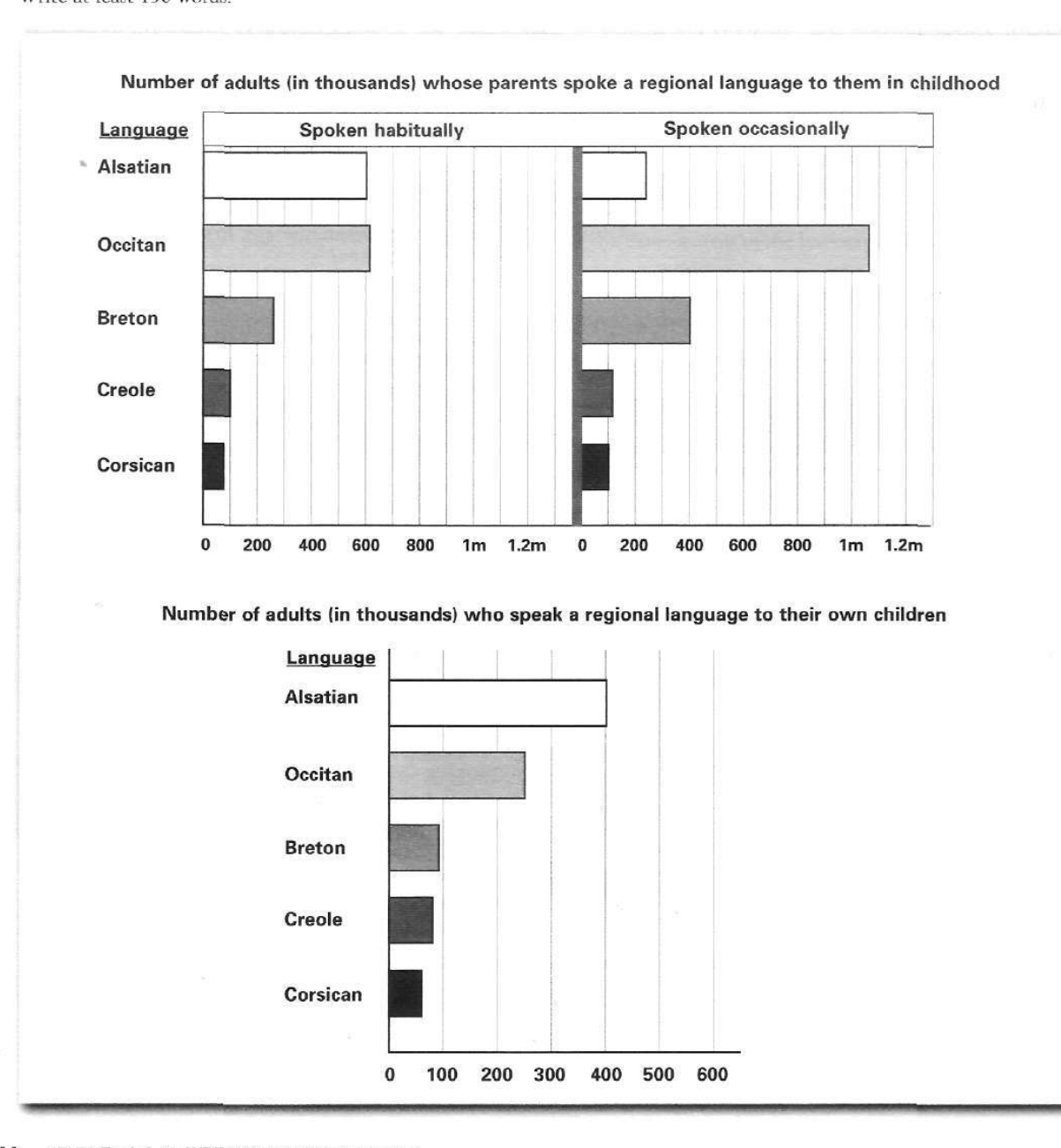
The charts below show the number of French adults whose parents spoke a French regional language to them when they were children and the number who speak a French regional language to their own children.
Write a report for a university lecturer describing the information below.
Number of adults (in thousands) whose parents spoke a regional language to them in childhood
Student answer (Band 5.5)
The two bar charts give information about how many french adults had parents who spoke a regional laguage to them when they were kids, and how many of them speak these language to their own children now.
Overall, it is clear that few parents are speaking regional languages to their children compared to the past. All the languages dropped in numbers, and alsatian and occitan are the most popular in both charts.
Lookin at the first chart, the aistan and occitan have almsot same result about 600,000 and these bosth are the most famous that spoken habitually. If ew check the result of both that spoken occasionally, the aisatian language spoken by 225,000 people, and occitan spoken about 1.5 million. The breton language spoken habitually by 250 thousand people and spoken occasionally by 400 thousand people. The creole and corsican language have same result in both spoken habitually and spoken occasionally araund about 100 thousand people.
Look to the second chart, the aistan language spoken by 400 thousand people. The occitan language spoken by 250 thousand peoples. Similarly breton language spoken by 100 thousand people. Other once is creole language spoken by arround about 80 thousand people. Furthermore, corsican language spoken by 50 thousand peoples.
AI examiner evaluation
| Criterion | Band |
|---|---|
| Task Achievement / Task Response | 6.0 |
| Coherence and Cohesion | 6.0 |
| Lexical Resource | 5.0 |
| Grammatical Range and Accuracy | 5.0 |
| Overall | 5.5 |
Task Achievement / Task Response: Band 6.0
You cover both charts and give a clear overview: the number speaking to children is lower than the childhood figures, and Alsatian and Occitan are prominent. Several comparisons are relevant, including the approximate habitual figures for Alsatian and Occitan and the figures for Breton. However, some data are inaccurate: Occitan spoken occasionally is about 1.065 million, not 1.5 million, and Alsatian spoken occasionally is about 240,000 rather than 225,000. The claim that all languages declined is broadly supported, but the overview would be stronger if it identified the especially large fall for Occitan and distinguished habitual from occasional speech. Some details, such as the similar Creole and Corsican figures, are also imprecise.
Coherence and Cohesion: Band 6.0
The report has a recognisable structure, with an introduction, an overview, and separate paragraphs for the two charts. This makes the main stages of the description easy to follow. You also use basic signposting such as “Overall,” “Looking at the first chart,” and “Furthermore.” However, the progression within the first-chart paragraph is sometimes difficult to track, particularly when you move between habitual and occasional speech without consistently naming the category. Phrases such as “both that spoken occasionally” are unclear, and repeated language-by-language statements make the report feel list-like. Grouping the figures by speech frequency, then highlighting the largest contrasts, would create smoother and more purposeful cohesion.
Lexical Resource: Band 5.0
You use relevant vocabulary for describing charts, including “bar charts,” “regional language,” “habitually,” “occasionally,” and “compared to the past.” This gives you enough topic-related language to communicate the main information. However, the range and control are limited by repeated wording such as “spoken by” and “language,” as well as awkward expressions including “same result” and “the most famous.” Several spelling errors—such as “laguage,” “Lookin,” and “arround”—also reduce accuracy and polish. Aim to use more precise reporting verbs and comparison phrases, and check spelling carefully. For example, “the most widely spoken” is more suitable than “the most famous” when describing the chart’s figures.
Grammatical Range and Accuracy: Band 5.0
You attempt both simple and more developed sentence forms, and the overall meaning is generally understandable. The opening sentence, for example, links the two charts and their time contexts. However, many sentences omit necessary verbs or use incomplete grammatical patterns: “the Alsatian language spoken by 400 thousand people” needs a finite verb, while “the Occitan language spoken by 250 thousand peoples” has the same problem. There are also errors in agreement and articles, as in “these language,” and the sentence beginning “If we check the result of both that spoken occasionally” is difficult to parse. Use complete subject–verb sentences consistently, and vary them with accurate comparisons such as “whereas” or “while.”
See this exact question answered at other band scores. The same prompt compared across bands.
Browse more IELTS Writing model answers or get your own writing scored by the same AI examiner.