Band 4.5 IELTS Writing Task 1 Model Answer
Overall Band Score: 4.5 · IELTS Complete Catalyst · 2026-11-19
IELTS Writing Task 1 question
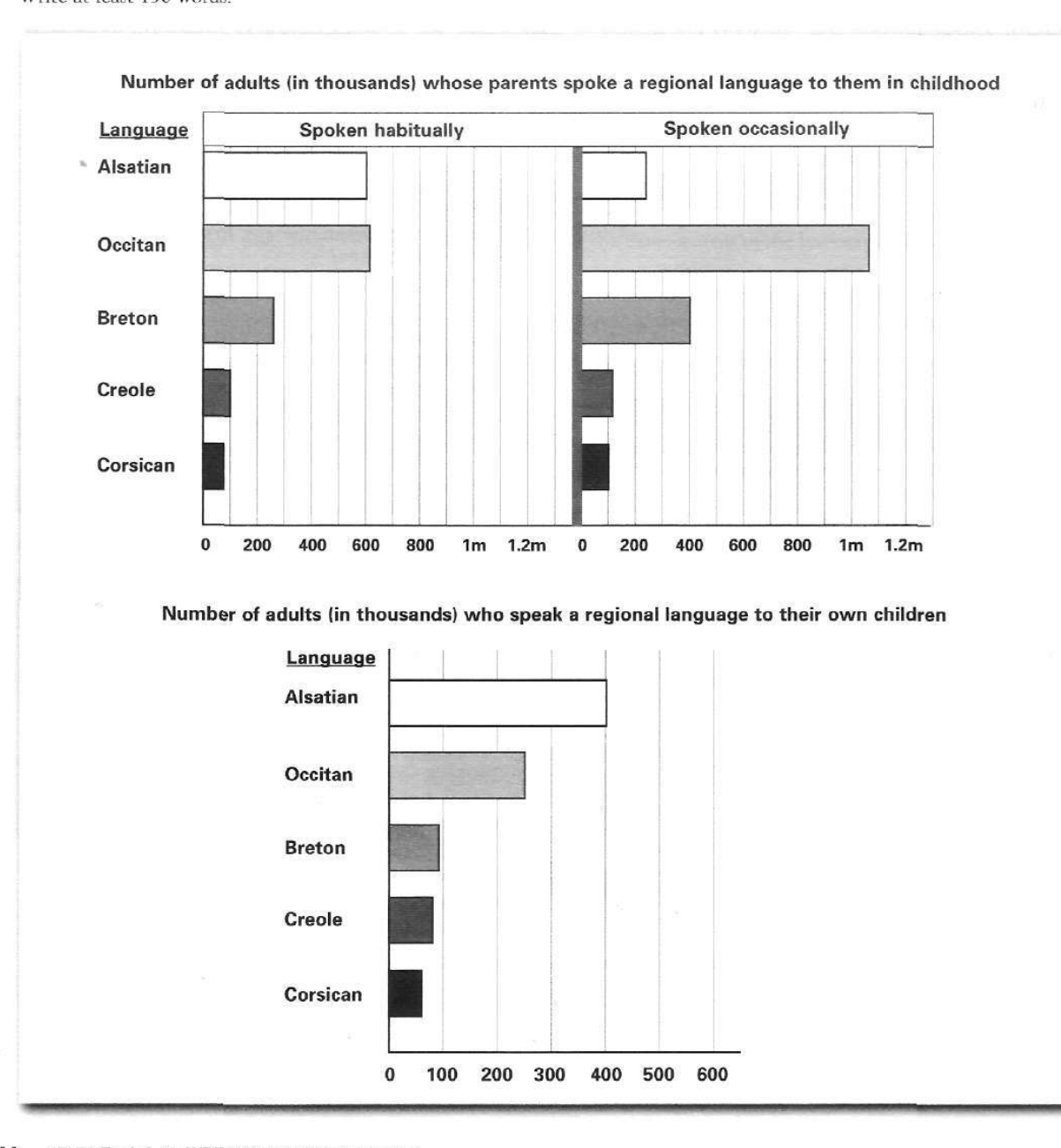
The charts below show the number of French adults whose parents spoke a French regional language to them when they were children and the number who speak a French regional language to their own children.
Write a report for a university lecturer describing the information below.
Number of adults (in thousands) whose parents spoke a regional language to them in childhood
Student answer (Band 4.5)
the charts illustrate the number of french adults whose parents spoke a french regional language to them when they were children and also the number of who speak a French regional to thier own cildren.
Overall it is clear that Occitan language recorded highest figures in both category spoken habitually and occasionally who speak languages around 630 and 1.75 million and Corsican recorded lowest figures . It is also noticable that thier were the significant difference between the figure.
First of all the number of Alsatian language whose spoke a regional language to them are 630 spoken habitually and 250 in occasionally . Follwed by the occitan are 630 and 1.75 m also Breton languager are 260 and respectively in occasionally 400 adults. creole and Corsican recored lowest figure , that are 100 in habitually and 110 are occasionally also
AI examiner evaluation
| Criterion | Band |
|---|---|
| Task Achievement / Task Response | 3.5 |
| Coherence and Cohesion | 4.5 |
| Lexical Resource | 5.0 |
| Grammatical Range and Accuracy | 5.0 |
| Overall | 4.5 |
Task Achievement / Task Response: Band 3.5
The response identifies the chart’s general subject and attempts an overview, noting that Occitan is highest and Corsican lowest. However, the overview misreports Occitan’s figures: the chart shows about 620,000 adults speaking it habitually and 1.065 million occasionally, not 630,000 and 1.75 million. The report also omits the second chart’s key comparison—how many adults speak each language to their own children—and ends before describing all the data. The figures for Alsatian and the smaller languages are also incomplete or inaccurate. The response is 121 words, below the required 150, which limits its coverage. To improve, include both charts, select the main comparisons, and check each figure against the visual.
Coherence and Cohesion: Band 4.5
There is a basic attempt to organise the report: an opening, an overview, and a paragraph beginning “First of all” to present details. This gives the reader some sense of progression, and language names provide occasional links between points. However, the report stops abruptly, so the information is not developed into a complete, balanced account. Connections between comparisons are often unclear, particularly in the final sentence, which trails off after “also”. The repeated use of “also” and the lack of clear grouping make the sequence difficult to follow. Use separate, purposeful paragraphs for the overview and the two charts, and connect figures with explicit comparisons such as “by contrast” or “whereas”.
Lexical Resource: Band 5.0
The response uses some relevant chart vocabulary, including “number,” “figures,” “highest,” “lowest,” and “spoken habitually and occasionally.” These terms show an attempt to describe quantities and categories. However, the range is limited and several word-choice, form, and spelling errors make parts difficult to interpret: “the number of who speak,” “regional to thier own cildren,” “languager,” and “recored.” Phrases such as “the significant difference between the figure” are also imprecise and do not clearly state what is being compared. Aim for accurate, varied expressions for quantities and comparisons, such as “the figure for,” “approximately,” and “compared with,” and proofread spelling and word forms.
Grammatical Range and Accuracy: Band 5.0
The response attempts both simple statements and longer sentences, for example, “Overall it is clear that…” and “First of all the number of Alsatian language…” However, sentence structures are often faulty, and errors frequently make relationships between ideas unclear. Examples include “the number of who speak,” “whose spoke,” and “also Breton languager are 260 and respectively in occasionally 400 adults.” There are also problems with articles, agreement, plurals, and sentence boundaries; the final sentence is incomplete. Use straightforward, complete sentences with a clear subject and verb, for example, “About 600,000 adults spoke Alsatian habitually, while 240,000 did so occasionally.” Then check agreement and punctuation before adding more complex structures.
See this exact question answered at other band scores. The same prompt compared across bands.
Browse more IELTS Writing model answers or get your own writing scored by the same AI examiner.