Band 4.5 IELTS Writing Task 1 Model Answer
Overall Band Score: 4.5 · IELTS Complete Catalyst · 2026-11-20
IELTS Writing Task 1 question
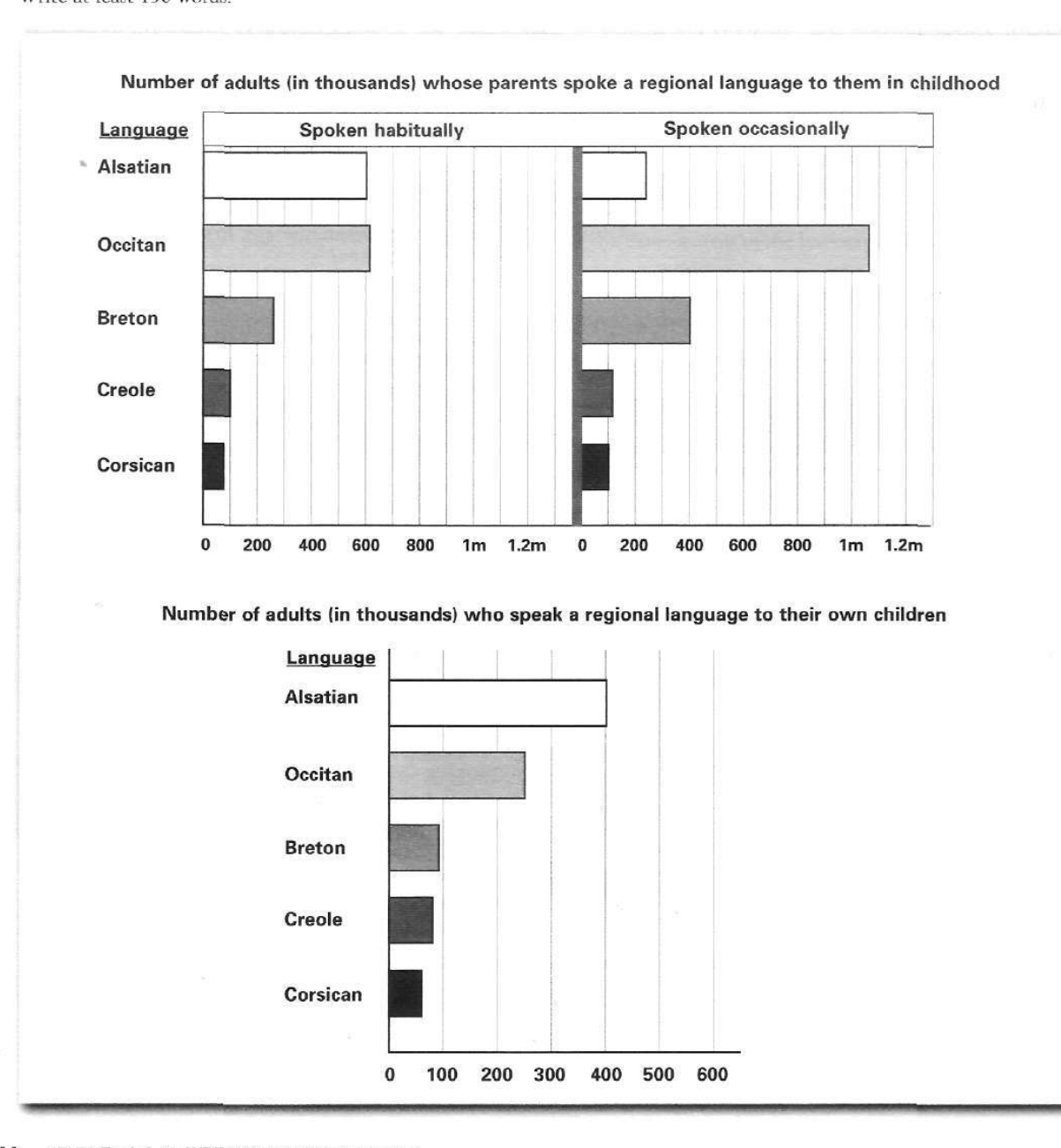
The charts below show the number of French adults whose parents spoke a French regional language to them when they were children and the number who speak a French regional language to their own children.
Write a report for a university lecturer describing the information below.
Number of adults (in thousands) whose parents spoke a regional language to them in childhood
Student answer (Band 4.5)
In this chart they illustrates the information about the number of french adults whose parents spoke a french regional language to them when they were children and the number who speak a french regional language to their own children. The name of these languages are Alsatian, Occitan, Breton, Creole, Corsican.
There are many French regional languages whicgh are spoken habitually or occasionally we have to summarise the information of these languages.
Alsatian language is spoken by 600,000 people habitually and by 250,000 people occasionally. Occitan is also spoken by 600,000 people habitually or occasionally by 1.1 million people. Breton is spoken by 280 thousand individuals habitually and occasionally by 400,000 individuals. Creole is spoken habitually by very few people which is about 100,000 and occasionally by 110,000. Corsican is spoke habitually by 90,000 people and occasionally by 100 people.
I think Alsatian is the most common regional language which is habitually spoken by 600,000 people but very few people speak in this language occasionally. Occitan is the language which is spoken by most people occasionally.Creole and Corsican is spoken by very few people and there is a possibility that these languages can be finished soon.
AI examiner evaluation
| Criterion | Band |
|---|---|
| Task Achievement / Task Response | 3.5 |
| Coherence and Cohesion | 4.5 |
| Lexical Resource | 5.5 |
| Grammatical Range and Accuracy | 5.0 |
| Overall | 4.5 |
Task Achievement / Task Response: Band 3.5
The response identifies the chart’s subject and names all five languages, and it reports several relevant figures, including Occitan’s high occasional-use total and Alsatian’s habitual-use figure. However, it does not adequately describe the second chart, which compares adults speaking each language to their own children; this is a major part of the task. Some figures are also inaccurate: Alsatian occasional use is about 240,000, not 250,000; Breton habitual use is about 260,000, not 280,000; and Corsican occasional use is about 105,000, not 100 people. The claim that Alsatian is the most common habitual language is also incorrect, as Occitan is slightly higher. The unsupported prediction that languages may disappear should be replaced with a clear overview of the main comparisons.
Coherence and Cohesion: Band 4.5
The response has a basic sequence: it introduces the subject, lists figures for the languages, and then offers a concluding comment. This gives the reader some sense of organisation. However, the progression is limited because the figures are presented one language at a time without grouping the main patterns, and the second chart is not integrated into the report. The opening repeats information from the task, while phrases such as “we have to summarise” do not help connect the data. The final paragraph repeats earlier points rather than drawing together the key comparisons. Use separate paragraphs for an overview and for selected details, and connect comparisons explicitly—for example, contrast the high number speaking Occitan occasionally with the lower number passing it on to children.
Lexical Resource: Band 5.5
The response uses enough topic vocabulary to communicate the general subject, including “habitually,” “occasionally,” “regional language,” and “individuals.” It also attempts some variation in describing the figures. However, wording is often repetitive, especially repeated forms of “spoken,” and some choices are inaccurate or unnatural: “the name of these languages,” “spoken by very few people,” and “there is a possibility that these languages can be finished soon.” The spelling error “whicgh” and the phrase “100 people” where the chart indicates roughly 105,000 also reduce precision. Aim for concise data-reporting language such as “the figure stood at,” “by contrast,” and “passed on to their children,” while avoiding unsupported claims about languages disappearing.
Grammatical Range and Accuracy: Band 5.0
The response communicates its basic meaning through mostly simple sentences and makes some attempts to combine ideas, but grammatical control is inconsistent. Errors include subject–verb agreement in “this chart they illustrates,” “Creole and Corsican is spoken,” and “the name … are.” There are also problems with verb forms and articles, such as “Corsican is spoke” and “Alsatian language,” where an article is needed. The sentence beginning “There are many … we have to summarise” joins two independent ideas without suitable punctuation or a conjunction. These errors sometimes make the reader pause, although the intended meaning is generally recoverable. Practise accurate agreement and verb forms, and use a wider range of correctly punctuated sentence patterns.
See this exact question answered at other band scores. The same prompt compared across bands.
Browse more IELTS Writing model answers or get your own writing scored by the same AI examiner.