Band 4.5 IELTS Writing Task 1 Model Answer
Overall Band Score: 4.5 · IELTS Complete Catalyst · 2026-11-22
IELTS Writing Task 1 question
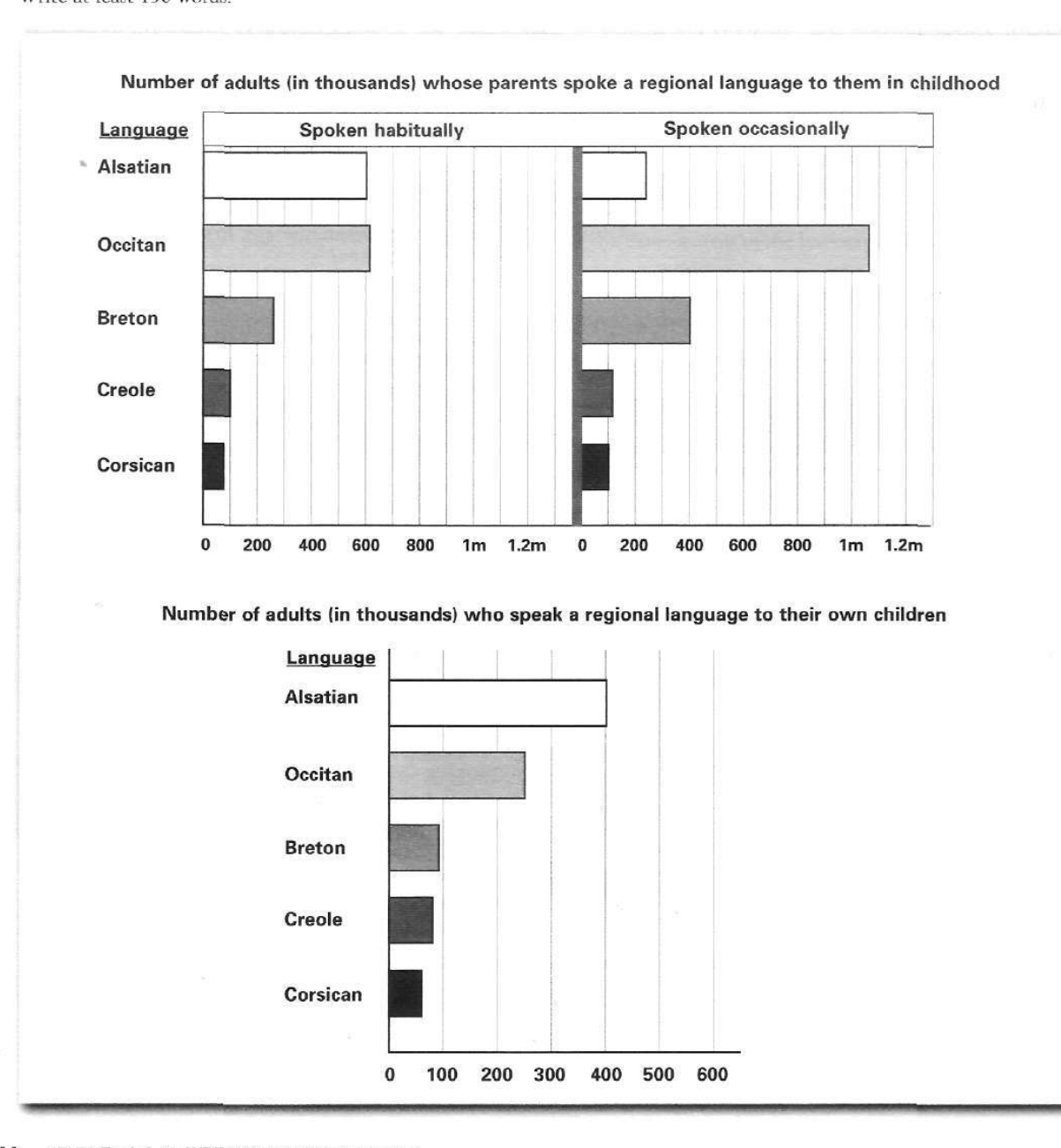
The charts below show the number of French adults whose parents spoke a French regional language to them when they were children and the number who speak a French regional language to their own children.
Write a report for a university lecturer describing the information below.
Number of adults (in thousands) whose parents spoke a regional language to them in childhood
Student answer (Band 4.5)
These charts illustrate the number of french teenagers whose parents used French regional language with them when they were kids and the number who speak french regional language to their own children.
Overall, the Occitan language was most favourite language throughout the whole time period, while Corsican was least spoken.
As can be seen in the chart, the Alastian had 600 people who spoken habitually, while when it spoken occasionally it had just over 200 users. The Occitan proceeded with 600 users habitually and 1m with occasionally speakes. Further, Breton had adults with the number of 250 habitually and 400 occasionally rspectively. Cerole and Corsican had very fewer users.
On the other hand, number of ad
AI examiner evaluation
| Criterion | Band |
|---|---|
| Task Achievement / Task Response | 3.5 |
| Coherence and Cohesion | 4.0 |
| Lexical Resource | 5.0 |
| Grammatical Range and Accuracy | 5.0 |
| Overall | 4.5 |
Task Achievement / Task Response: Band 3.5
The response identifies the charts’ general subject and gives a brief overview, but it misstates the population as “French teenagers” rather than adults and says Occitan was the most popular “throughout,” although it was not the leading language in the chart of adults speaking to their own children. Some figures are reported approximately correctly, such as Alsatian at 600 habitual speakers and Breton at 400 occasional speakers, but the second chart is not described: the response ends with “On the other hand, number of ad” and gives no comparisons for transmission to children. The report is therefore only a partial account, with key information omitted and some inaccurate interpretation. It is also below the required 150 words. A complete response should compare both charts and highlight the sharp decline between generations.
Coherence and Cohesion: Band 4.0
There is a basic attempt to organise the report: an opening, an overview, and a paragraph describing figures, followed by a transition to the second chart. However, the progression is incomplete because the final sentence breaks off at “On the other hand, number of ad,” leaving the comparison unfinished. The overview’s claim that Occitan was most popular “throughout” also does not clearly distinguish the two charts, which weakens the relationship between the summary and the details. Linking phrases such as “Overall,” “As can be seen,” and “On the other hand” show awareness of cohesion, but they cannot compensate for the missing development. Use separate, complete paragraphs for the overview and each chart, and connect comparisons explicitly.
Lexical Resource: Band 5.0
The response uses some relevant vocabulary, including “habitually,” “occasionally,” and “users,” so the topic is generally recognisable. However, the range is limited and several choices are inaccurate or unnatural: “most favourite language” is redundant, “proceeded with 600 users” does not express a chart comparison, and “very fewer users” is not idiomatic. There are also spelling errors in “Alastian,” “speakes,” “rspectively,” and “Cerole,” alongside inconsistent capitalisation of “French.” These errors make parts of the report harder to follow. Aim for precise chart language such as “recorded,” “stood at,” “approximately,” and “the figure for,” and check spelling and collocations before submitting.
Grammatical Range and Accuracy: Band 5.0
The response attempts both simple and more developed sentence forms, for example, “As can be seen in the chart, the Alastian had 600 people who spoken habitually.” However, verb forms and sentence construction are often inaccurate: “who spoken” needs a correctly formed verb, and “while when it spoken occasionally” lacks a clear grammatical structure. The opening also has problems with articles and number, as in “used French regional language” and “the number … and the number.” The final clause is incomplete, ending with “number of ad,” so it does not form a complete sentence. These errors sometimes obscure the intended meaning. Practise complete comparative sentences and check verb forms, articles, and sentence endings.
See this exact question answered at other band scores. The same prompt compared across bands.
Browse more IELTS Writing model answers or get your own writing scored by the same AI examiner.