Band 6.0 IELTS Writing Task 1 Model Answer
Overall Band Score: 6.0 · IELTS Complete Catalyst · 2026-11-23
IELTS Writing Task 1 question
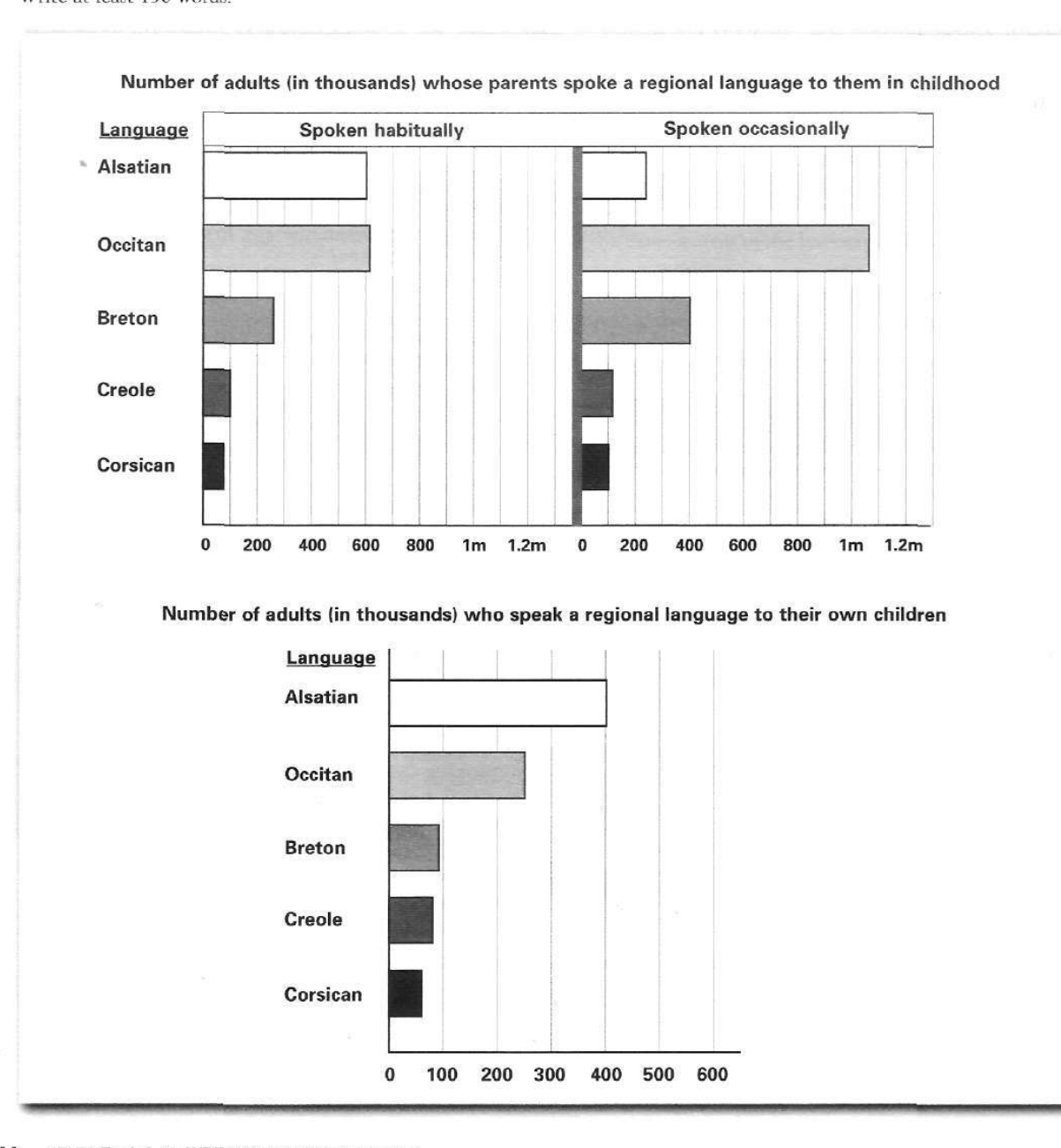
The charts below show the number of French adults whose parents spoke a French regional language to them when they were children and the number who speak a French regional language to their own children.
Write a report for a university lecturer describing the information below.
Number of adults (in thousands) whose parents spoke a regional language to them in childhood
Student answer (Band 6.0)
The bar chart gives us information about the number of french adults who were spoken to in french regional language by their parents when they were children and the number who speak it to their own little ones.
Overall, the number of people who spoke these regional languages decreased overtime. Occitan was the most spoken language back then which is now replaced by Alsatian.
The most popular language back then was Occitan with more than 1 million adults who spoke it occasionally with about 600,000 people who spoke it everday. This language's popularity was closely followed by Alsatian when it came to be spoken habitually with just under 600,000 people although it was rarely spoken occasionally. Breton was spoken more occasionally than Alsatian with a figure of 400,000 people. The other two languages were rarely spoken.
Nowadays, Alsatian has become the most popular language with about 400,000 speakers.
Even though, the number of people who spoke Occitan dropped to around 250,000 people, its still the 2nd most popular language in the region. Breton's number fell even more to just under 100,000 speakers. The other two languages's use also became even less overtime.
AI examiner evaluation
| Criterion | Band |
|---|---|
| Task Achievement / Task Response | 6.0 |
| Coherence and Cohesion | 6.0 |
| Lexical Resource | 6.0 |
| Grammatical Range and Accuracy | 5.5 |
| Overall | 6.0 |
Task Achievement / Task Response: Band 6.0
You cover both parts of the chart and give a clear overview: Occitan leads in the childhood figures, while Alsatian is highest among adults speaking to their own children. Several key comparisons are accurate, including Occitan’s occasional figure of just over one million and the later figures of about 400,000 for Alsatian and 250,000 for Occitan. However, the overview that regional-language use “decreased overtime” is too broad: the charts show a comparison between generations, and the decline varies by language. Some details are also imprecise or misleading; for example, Alsatian was not “rarely spoken occasionally” (about 240,000), and the final figures for Creole and Corsican are not specified. Distinguish habitual from occasional childhood use more consistently and report the remaining comparisons accurately.
Coherence and Cohesion: Band 6.0
The report has a clear overall structure, moving from an introduction and overview to childhood figures and then current use with children. This makes the main comparison easy to follow. Paragraphing is appropriate, and transitions such as “Overall” and “Nowadays” help signal shifts. However, some links between ideas are loose: “This language’s popularity was closely followed by Alsatian” is followed by a comparison specifically about habitual speech, so the basis of comparison is not immediately clear. The repeated use of “The other two languages” also leaves the reader to infer which languages and figures are meant. Make comparisons explicit and use clearer references, for example naming Creole and Corsican together and stating their values.
Lexical Resource: Band 6.0
You use an adequate range of vocabulary to describe the charts, including “closely followed,” “dropped,” “figure,” and “most popular.” These choices generally communicate the comparisons, and you attempt to vary your wording rather than simply repeat “number.” Some expressions are imprecise or informal for an academic report: “their own little ones” is conversational, while “spoken everday” and “rarely spoken” do not accurately express the chart categories. “Popularity” also suggests preference rather than the number of speakers. Spelling errors such as “french,” “overtime,” and “everday” reduce accuracy. Use the chart’s terms—“habitually” and “occasionally”—and prefer neutral descriptions such as “the number of speakers” or “use among the next generation.”
Grammatical Range and Accuracy: Band 5.5
You use a mix of simple sentences and more complex forms, including the relative clause in “adults who were spoken to” and the concessive structure beginning “Even though.” Most sentences remain understandable, but some grammatical errors and awkward constructions are present. In the opening, “the number of french adults who were spoken to in french regional language” has an unclear passive construction and is missing an article; a clearer form would be “adults whose parents spoke a regional language to them.” In “Even though, the number … dropped,” the comma after the introductory clause is misplaced, and “its still” needs an apostrophe in “it’s.” The phrase “the other two languages’s use” also has incorrect plural possessive marking. Check articles, apostrophes, and clause punctuation while retaining your varied sentence structures.
See this exact question answered at other band scores. The same prompt compared across bands.
Browse more IELTS Writing model answers or get your own writing scored by the same AI examiner.