Band 4.5 IELTS Writing Task 1 Model Answer
Overall Band Score: 4.5 · IELTS Complete Catalyst · 2026-11-23
IELTS Writing Task 1 question
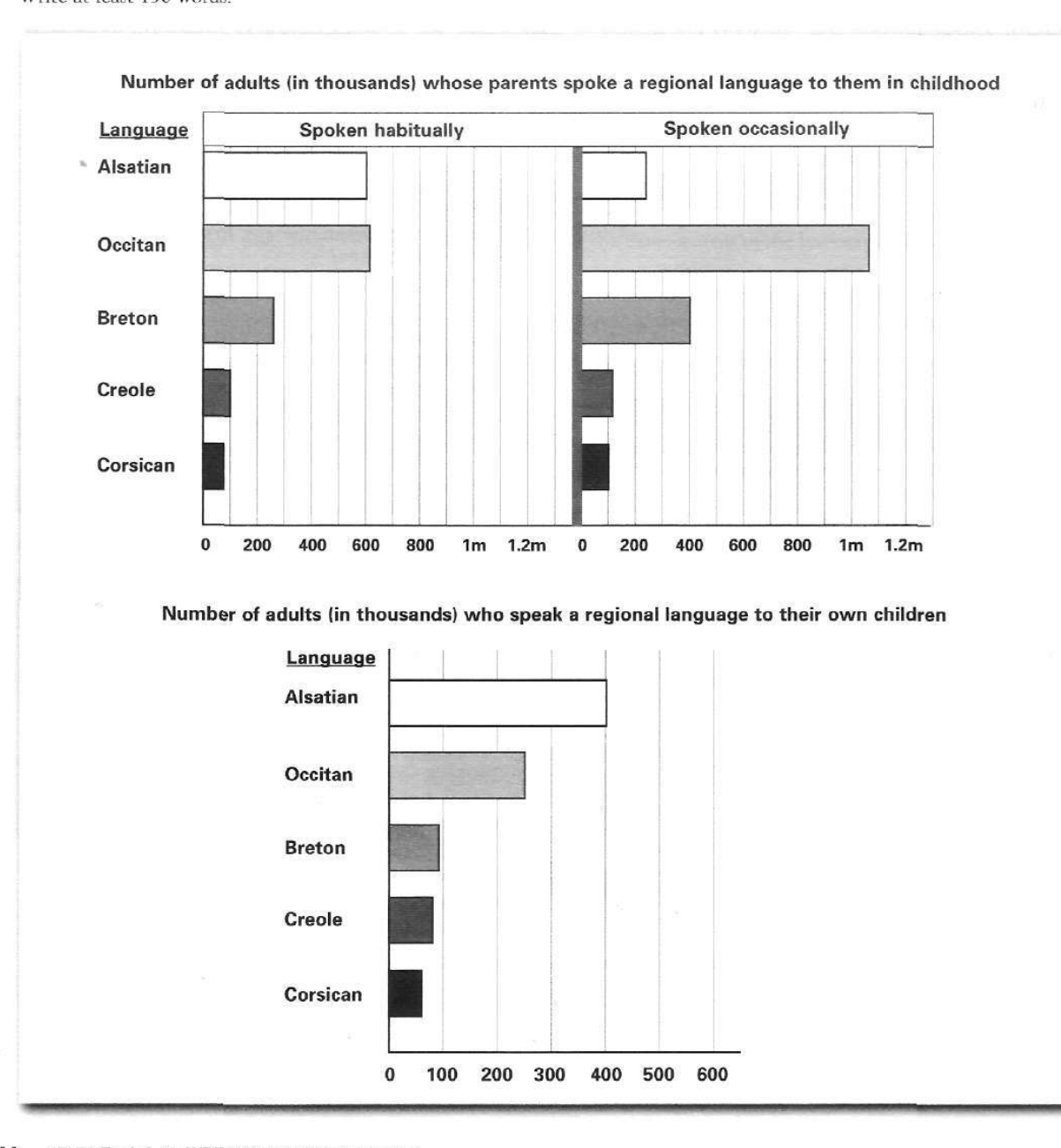
The charts below show the number of French adults whose parents spoke a French regional language to them when they were children and the number who speak a French regional language to their own children.
Write a report for a university lecturer describing the information below.
Number of adults (in thousands) whose parents spoke a regional language to them in childhood
Student answer (Band 4.5)
The bar graph chart illustrates a report of a university describing about the number of french adults whose parents spoke a french regional language to them when they were children and the number who speaks a french regional language to their own children.
The first bar graph shows the number of adults whose parents spoke a regional language to them in childhood mentioned in thousand in numbers. The Spoken habitually were Alsatian with 600 and occitan same with alsatian and breton was at 250 and creole and corsican were under 100. The spoken occasionally were occitan as higgest with 1.5 million followed by alsatian at 250 and then breton at 400 and creole and corsican were at same at 100.
The second bar graph shows the number of adults who speak a regional language to their own children in different languages were alsatian was at higest at 400 and follwed by occitan at 250 and then breton, creocle and corsican were under 100. This all mentioned numbers were in thousands.
Overall, It shows about french adults who spoke a regional language to them in childhood and who speak a regional language to their own children.
AI examiner evaluation
| Criterion | Band |
|---|---|
| Task Achievement / Task Response | 4.0 |
| Coherence and Cohesion | 5.0 |
| Lexical Resource | 5.0 |
| Grammatical Range and Accuracy | 4.5 |
| Overall | 4.5 |
Task Achievement / Task Response: Band 4.0
You identify both charts and report several relevant comparisons, including Alsatian at about 600, Occitan as the largest occasional-use figure, and Alsatian at 400 for speaking to children. However, important figures are inaccurate: Occitan spoken occasionally is about 1,065 thousand, not 1.5 million, and Occitan spoken habitually is about 620 thousand rather than the same as Alsatian. The overview merely repeats the topic and does not summarise the main pattern, such as the much higher childhood figures compared with transmission to children. The response also contains 147 words, below the required 150, with 48 prompt words excluded from the count. These omissions and inaccuracies leave the task only minimally addressed.
Coherence and Cohesion: Band 5.0
The response has a basic three-part structure: an introduction, a paragraph about the childhood figures, and one about speaking to children, followed by a brief overall statement. This makes the two charts distinguishable. However, there is little overall progression, and the final paragraph does not provide a useful summary of the key trends. Connections between details are often mechanical, especially the repeated use of “and then” and “followed by.” Some comparisons are also difficult to follow, as in “occitan same with alsatian,” because the relationship between the figures is not clearly expressed. Grouping the figures by the most and least common languages, and using clearer comparison phrases, would improve the organisation.
Lexical Resource: Band 5.0
You use some relevant chart vocabulary, including “bar graph,” “spoken habitually,” “spoken occasionally,” and “followed by,” so the reader can recognise the subject and categories. However, the range is limited and several expressions are repetitive or imprecise. “The bar graph chart illustrates a report” is an awkward description, while “higgest” and “follwed” show spelling problems; “creocle” also misspells a language name. Repeated phrases such as “were under 100” give little precision when describing data. Use standard chart-report collocations and accurate language names, and vary expressions for ranking and approximate quantities. These changes would make the information easier to interpret.
Grammatical Range and Accuracy: Band 4.5
Most sentences use simple structures, and the reader can generally identify which chart or language is being discussed. However, grammatical errors are frequent and sometimes make relationships unclear. For example, “the number of adults who speaks” has subject–verb disagreement, and “The Spoken habitually were Alsatian with 600” lacks a clear grammatical structure. The opening sentence is also difficult to parse because it combines “illustrates a report” with an unclear description of what is being counted. Capitalisation and punctuation are inconsistent, including “Overall, It.” Practise forming complete sentences with a clear subject and verb, and check agreement and sentence boundaries when listing comparisons.
See this exact question answered at other band scores. The same prompt compared across bands.
Browse more IELTS Writing model answers or get your own writing scored by the same AI examiner.