Band 5.0 IELTS Writing Task 1 Model Answer
Overall Band Score: 5.0 · IELTS Complete Catalyst · 2026-11-23
IELTS Writing Task 1 question
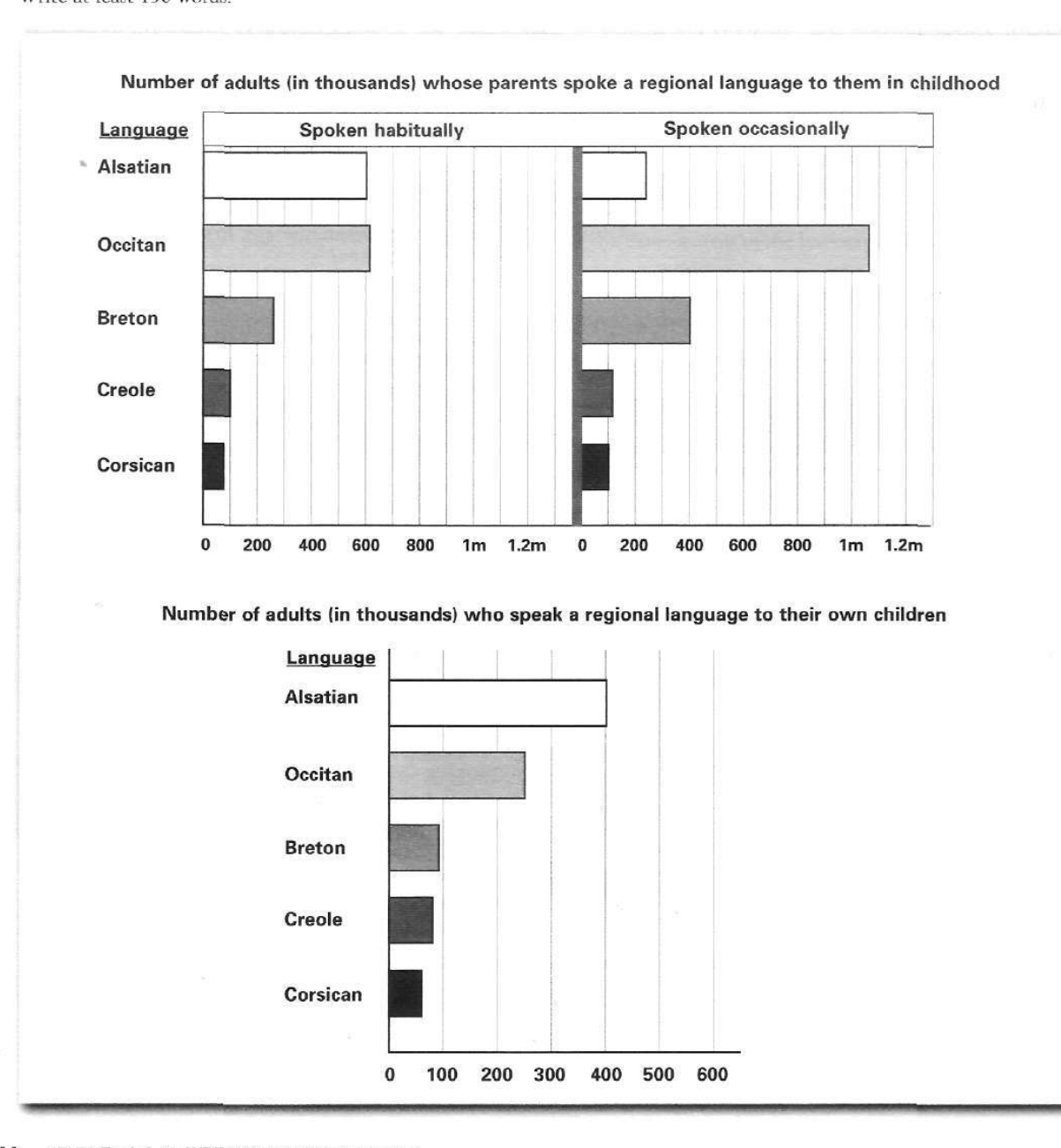
The charts below show the number of French adults whose parents spoke a French regional language to them when they were children and the number who speak a French regional language to their own children.
Write a report for a university lecturer describing the information below.
Number of adults (in thousands) whose parents spoke a regional language to them in childhood
Student answer (Band 5.0)
the bar chart represent how a group of French adults practice French reginal betwen then and their parents and their children. the first chart bar shows two types of spoken language one is Habitually and the second one is occasionally as we noticed this two types afftected how this group react to their children where the highst in this two group is Occitan it crosses 1m thousnds in occasionaly Spoken from the parents as result this affect how this group practice freonce with thir children where Occitan was ranked second in the number of adults who speak regioanl languae to their children , it is also noteceable that Alsatian ranked first In the spoken languge with the parents as well as with their childern , the last three ranking is also represtend in the same order in two charts where Berton, Creole and Corsican where in the last ranking in both chart with less than approximatly 100 thousands of this group of adults doesn't speak with their children the regional languae which might be result of how the language was practice with them from their parent .
AI examiner evaluation
| Criterion | Band |
|---|---|
| Task Achievement / Task Response | 5.0 |
| Coherence and Cohesion | 4.5 |
| Lexical Resource | 5.0 |
| Grammatical Range and Accuracy | 5.0 |
| Overall | 5.0 |
Task Achievement / Task Response: Band 5.0
You identify the chart’s main subject and make several relevant comparisons, including that Occitan is highest in occasional parental speech and Alsatian has the largest figure for speaking to children. However, the report only partially covers the data: it gives no clear overview of the overall contrast between parental use and transmission to children, and several figures or rankings are missing. The claim that Alsatian ranks first in both charts is inaccurate: Occitan is slightly higher than Alsatian for habitual parental speech, and Occitan is clearly highest for occasional speech. The final comparison of the lower-ranked languages is also imprecise. Select the main patterns, report the figures accurately, and avoid explaining causes that the charts do not establish.
Coherence and Cohesion: Band 4.5
There is some organisation: the response moves from describing the parental-language chart to comparing it with language use among children, and phrases such as “as a result” and “where” attempt to connect ideas. However, the whole report is presented as one long, loosely connected sequence, so the reader has difficulty distinguishing an overview from supporting details. Several links are unclear or repetitive, particularly the repeated use of “where” and the shift from chart rankings to a possible explanation at the end. Use separate paragraphs for an overview and key comparisons, and organise the details by the two chart measures. Clearer sentence boundaries and more precise referencing would make the progression easier to follow.
Lexical Resource: Band 5.0
The response uses some task-relevant vocabulary, including “habitually,” “occasionally,” “ranked,” and “regional language,” which helps communicate the topic. However, the range is limited and several word-choice, spelling, and collocation errors make parts difficult to read, such as “practice French reginal,” “the last three ranking,” and “less than approximatly 100 thousands.” Some expressions are also imprecise: “this group react to their children” does not clearly describe language transmission, and “crosses 1m” is not a natural way to report a chart value. Aim for accurate phrases such as “the number of adults,” “spoke the language occasionally,” and “passed the language on to their children,” while checking spelling and plural forms.
Grammatical Range and Accuracy: Band 5.0
You attempt to combine ideas in longer sentences, for example by using “as we noticed” and “as a result,” but these structures are often faulty or difficult to follow. The opening, “the bar chart represent,” has subject–verb disagreement, while “how a group of French adults practice … betwen then and their parents and their children” lacks a clear grammatical structure. Articles, plurals, and sentence boundaries are also inconsistently controlled, and the response relies heavily on one extended sentence joined by commas. These errors can make relationships between ideas unclear. Practise writing shorter, complete sentences first, then add controlled complex structures, checking agreement, verb forms, articles, and punctuation.
See this exact question answered at other band scores. The same prompt compared across bands.
Browse more IELTS Writing model answers or get your own writing scored by the same AI examiner.