Band 5.0 IELTS Writing Task 1 Model Answer
Overall Band Score: 5.0 · IELTS Complete Catalyst · 2026-11-24
IELTS Writing Task 1 question
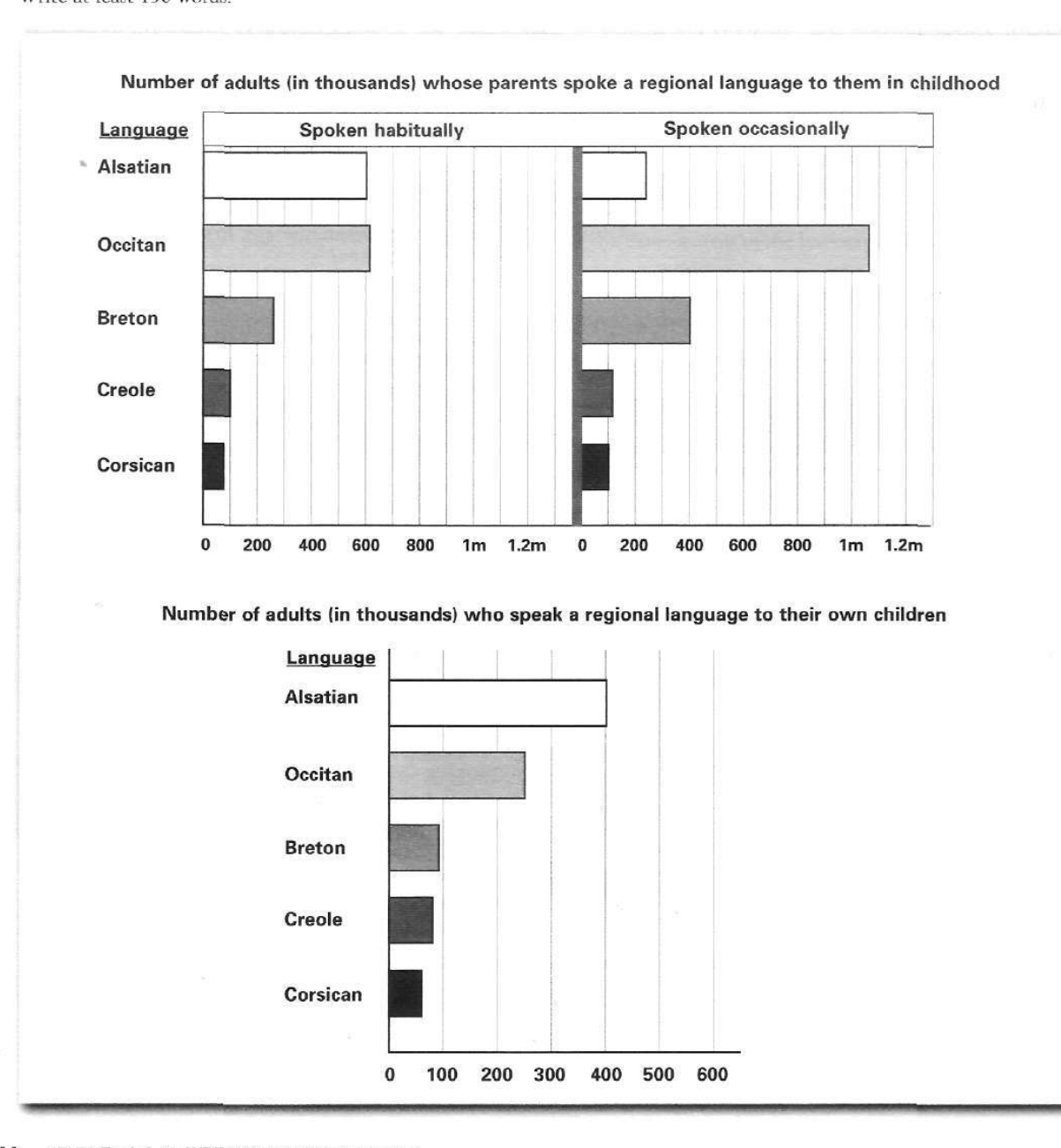
The charts below show the number of French adults whose parents spoke a French regional language to them when they were children and the number who speak a French regional language to their own children.
Write a report for a university lecturer describing the information below.
Number of adults (in thousands) whose parents spoke a regional language to them in childhood
Student answer (Band 5.0)
From the given chart above we can see that it provides the information about the number of French adults whose parents spoke a French regional language to them when they were children and the number who speak a French regional language to their own children.
We can see that there are in total 5 language spoken, in which it includes Alsatian, Occitan, Breton, Creole, Corsican. In the chart mentioned about the parents childhood we can see that there are two sections divided being spoken habitually and spoken occasionally. We can see that the habitually spoken language in parents childhood has two language with similar uses (600), but in terms of speaking it occasionally Occitan language surpasses Alsatian by almost 1.2 million speakers . Looking at the remaining three language we can on see that they are not spoken quite often and they have low uses in both habitually and occasionally spoken with just a slight change.
Looking at the new data where how often does the parent use the language, the data has significant changes. Looking at the changes we can see that the rate of use of Alsatian language by the parent to their children has the most increase which reached up to 400. Then there's Occitan reaching 250. We can see that the other three language still doesn't have significant increase being lower than 100 speakers.
AI examiner evaluation
| Criterion | Band |
|---|---|
| Task Achievement / Task Response | 5.0 |
| Coherence and Cohesion | 5.0 |
| Lexical Resource | 5.0 |
| Grammatical Range and Accuracy | 5.0 |
| Overall | 5.0 |
Task Achievement / Task Response: Band 5.0
You identify the two chart topics and mention all five languages, and you correctly note that Occitan has the largest occasional-use figure and that Alsatian leads the figures for speaking to children. However, the report only partly selects and reports the key information. The claim that two languages have similar habitual use at 600 is inaccurate: Alsatian is about 600, while Occitan is about 620. Also, saying Occitan exceeds Alsatian by “almost 1.2 million” confuses Occitan’s value with the difference; the gap is about 825,000. The overview is not clearly stated, and “increase” suggests a change over time rather than a comparison between separate measures. Give a concise overview and compare the main figures accurately.
Coherence and Cohesion: Band 5.0
The response has a basic sequence: it introduces the charts, discusses the childhood figures, and then turns to speaking to children. This gives the reader some sense of the report’s organisation. However, progression within the paragraphs is limited, and repeated openings such as “We can see” and “Looking at” make the links mechanical. The second paragraph also moves between the two childhood categories without clearly distinguishing their rankings, while the final paragraph calls the figures “changes” without explaining that these are separate comparisons. Use a clear overview paragraph followed by grouped comparisons, and connect ideas through precise references such as “By contrast” or “For the second chart.”
Lexical Resource: Band 5.0
You use some relevant chart vocabulary, including “habitually,” “occasionally,” “surpasses,” and “reached,” so the reader can generally understand the subject. However, the range is limited and several phrases are imprecise or repetitive, including “low uses,” “significant changes,” and “rate of use.” “Increase” is also not an accurate choice for comparing the two charts, since they do not show change over time. Repeated use of “language” and “we can see” further restricts variety. Aim for precise terms for quantities and comparisons, such as “figure,” “number,” “was higher than,” and “declined to,” while ensuring that the wording matches what the charts actually show.
Grammatical Range and Accuracy: Band 5.0
You attempt some longer sentences using clauses such as “in which it includes…” and “Looking at the remaining three language…,” but these structures are often faulty, and the overall range remains limited. Errors include “there are in total 5 language spoken,” where the plural form and sentence construction are incorrect, and “the other three language still doesn’t have,” which has both a plural-agreement problem and an unsuitable verb form. The question-like construction “where how often does the parent use the language” also disrupts the sentence. These errors sometimes make the relationships between ideas harder to follow. Practise accurate plural forms, subject–verb agreement, and straightforward declarative sentences before adding more complex clauses.
See this exact question answered at other band scores. The same prompt compared across bands.
Browse more IELTS Writing model answers or get your own writing scored by the same AI examiner.