Band 6.0 IELTS Writing Task 1 Model Answer
Overall Band Score: 6.0 · IELTS Complete Catalyst · 2026-11-24
IELTS Writing Task 1 question
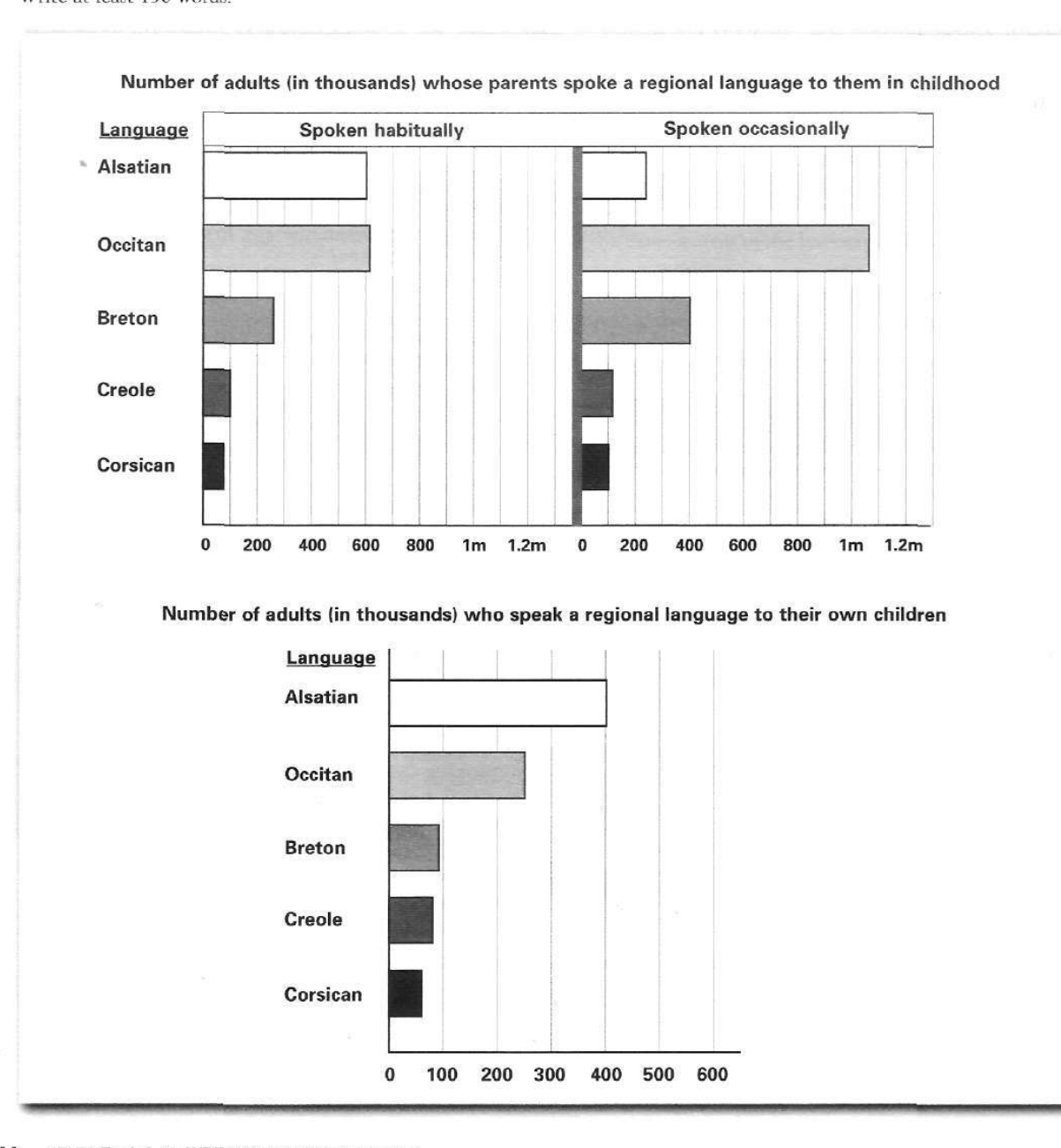
The charts below show the number of French adults whose parents spoke a French regional language to them when they were children and the number who speak a French regional language to their own children.
Write a report for a university lecturer describing the information below.
Number of adults (in thousands) whose parents spoke a regional language to them in childhood
Student answer (Band 6.0)
The bar graphs illustrates the number(in thousands) of french adults whose parents spoke regional language to them in their childhood habitually and occasionally and the number who speaks regional language to their own children.
Overall, it is clear that Alastian and Occitan languages are almost same that are spoken habitually while Occitan is the highest language used ocassionally. And the Alsatian is the most used language in the third chart.
Firstly, the number of adults who speak Alsatian and Occitan habitually both are same around 600,000 then Breton is 300,000, Creole language about 200,000 and lastly Corsican language about 70,000 which marked the lowest figure. And the number of adults who speak Occitan occasionally stood at 1.1 million, which marked the highest figure. Followed by Breton at 400,000 and 300,000 by Alsatian.Furthermore, the Creole and Corsican both languages were same 100,000.
On the other hand, the number of adults who speaks a Alastian to their own children stood at 400,000, which marked the highest figure. Followed by Occitan at 250,000 and around 100,000 by Breton. Moreover, then it decrease gradually 80,000 of Creole language while, the Corsican approximately 50,000, which marked the lowest figure.
AI examiner evaluation
| Criterion | Band |
|---|---|
| Task Achievement / Task Response | 5.5 |
| Coherence and Cohesion | 6.5 |
| Lexical Resource | 6.0 |
| Grammatical Range and Accuracy | 5.5 |
| Overall | 6.0 |
Task Achievement / Task Response: Band 5.5
You cover both charts and identify several important comparisons, including Occitan as the leading language spoken occasionally and Alsatian as the most common language passed on to children. However, some figures and comparisons are inaccurate: habitual Breton is about 260,000, not 300,000; occasional Alsatian is about 240,000, not 300,000; and occasional Creole and Corsican are about 120,000 and 105,000, rather than both being 100,000. The overview also says Alsatian and Occitan are “almost same” habitually, although Occitan is slightly higher, and it would be more informative to highlight the broad contrast between the large childhood totals and the much lower figures for speaking to children. More precise reporting and a clearer overview would make the response more complete.
Coherence and Cohesion: Band 6.5
The report has a clear overall arrangement: an introduction, an overview, a paragraph comparing childhood language use, and a final paragraph about speaking to children. This gives the reader a logical route through the two charts, and signposts such as “Overall,” “Firstly,” and “On the other hand” help show the stages of the report. The sequence within the childhood paragraph is mostly understandable, although the comparison becomes less smooth in “Followed by Breton … and 300,000 by Alsatian,” where the relationship between figures could be stated more explicitly. The final paragraph also relies on a list-like sequence of “Followed by” and “Moreover.” Use more varied linking and clearer sentence connections to make progression less mechanical.
Lexical Resource: Band 6.0
You use a reasonable range of task-related vocabulary, including “habitually,” “occasionally,” “stood at,” “highest figure,” and “lowest figure.” These choices help communicate comparisons, and the meaning is generally clear. However, some wording is repetitive or imprecise: “number of adults who speak” is repeated, while “the most used language” is less natural for describing the chart. There are also spelling errors in “french,” “Alastian,” and “ocassionally,” and “both languages were same” is an awkward expression. Aim for accurate spelling and more natural collocations, such as “the number of adults speaking” and “the figure for.” This would improve precision while retaining the useful range already shown.
Grammatical Range and Accuracy: Band 5.5
You attempt both simple and more extended sentence forms, and the main comparisons can usually be understood. However, errors in agreement, articles, and sentence construction recur. For example, “The bar graphs illustrates” should use a plural verb, while “the number who speaks” and “the number of adults who speaks” require “speak.” The opening also needs articles and clearer structure: “whose parents spoke a regional language to them during childhood.” Some fragments, including “Followed by Occitan at 250,000,” are not complete sentences, and “Moreover, then it decrease gradually” has faulty word order and verb form. Work on producing complete sentences and checking subject–verb agreement; more accurate control of these patterns would make the report easier to read.
See this exact question answered at other band scores. The same prompt compared across bands.
Browse more IELTS Writing model answers or get your own writing scored by the same AI examiner.