Band 5.0 IELTS Writing Task 1 Model Answer
Overall Band Score: 5.0 · IELTS Complete Catalyst · 2026-11-25
IELTS Writing Task 1 question
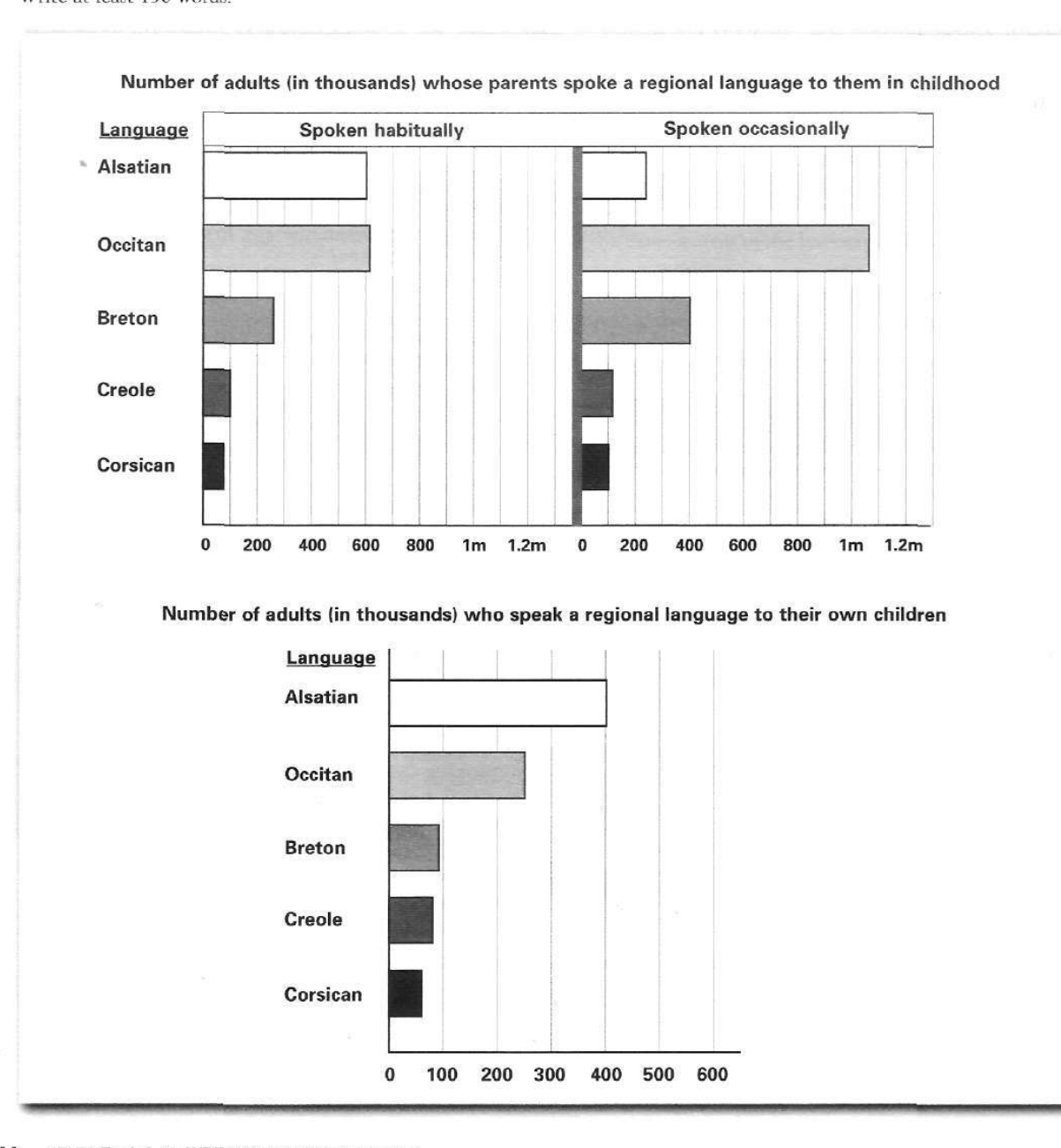
The charts below show the number of French adults whose parents spoke a French regional language to them when they were children and the number who speak a French regional language to their own children.
Write a report for a university lecturer describing the information below.
Number of adults (in thousands) whose parents spoke a regional language to them in childhood
Student answer (Band 5.0)
These bar graph demonstrate the no of french citizen that communicate with their parents in french when they were in childhood occasionally and mostly, another graph shows the proportion of parents who spoke french with their offsprings according to their region.
Mostly spoken language was Occitian, whereas Alsatian accent was almost equilent to the no of Occitian. while corsican was the least spoken accent of french. On special event mostly Occaitan laguage was used, Breton was second largest most spoken accent on an event whereas Corcican is least spoken accent.
Alsatian is now the most spoken language as compare to Occitan. The number of Corsican is still at least while the ratio of breton and creole is high.
it conclude that majority of childern who spoke Occitan in their childhood speaks alsatan with their own offsprings and the ratio of Occitan falls down while th numbers of Alsatian speaking individuals increase
AI examiner evaluation
| Criterion | Band |
|---|---|
| Task Achievement / Task Response | 4.5 |
| Coherence and Cohesion | 5.0 |
| Lexical Resource | 5.0 |
| Grammatical Range and Accuracy | 5.0 |
| Overall | 5.0 |
Task Achievement / Task Response: Band 4.5
The response identifies the two charts and makes some relevant comparisons, including that Corsican has the lowest figures and that Alsatian is highest among languages spoken to children. However, the report only partially describes the data and includes important inaccuracies. Occitan, not Alsatian, has the largest total for parents speaking a language to their children in childhood, especially when it was spoken occasionally; the claim that children who spoke Occitan mostly use Alsatian with their own offspring is not supported by the charts. The overview also refers to “special event” use, which is not shown. To improve, summarise the main contrast accurately and support it with selected figures, such as Occitan’s high childhood totals versus its lower figure for speaking to the next generation.
Coherence and Cohesion: Band 5.0
There is some organisation: the opening introduces the charts, and later sentences compare childhood use with language spoken to children. Basic linking words such as “whereas” and “while” help signal contrasts. However, the ideas do not progress clearly from an overview to well-organised details, and the second paragraph’s reference to “special event” use is confusing because the chart distinguishes habitual and occasional speech. The final sentence introduces an unsupported conclusion rather than drawing together the reported comparisons. Use separate paragraphs for an accurate overview and key data, and connect each comparison explicitly to the relevant chart category.
Lexical Resource: Band 5.0
The response uses some task-related vocabulary, including “proportion,” “ratio,” “least,” and “most spoken,” so the reader can recognise the general topic. However, the range is limited and several word choices or spellings make the report difficult to interpret: “accent” is used where “language” is intended, “special event” does not match “spoken occasionally,” and names such as “Occitian” and “Corcican” are misspelled. Phrases such as “the ratio of breton and creole is high” are also vague and do not specify what is being compared. Use the chart’s terminology consistently and choose precise comparison language, such as “figure,” “total,” “higher,” and “declined.”
Grammatical Range and Accuracy: Band 5.0
The response attempts a few longer sentences, including the final sentence beginning “it conclude that,” and uses comparison structures such as “whereas” and “as compare to.” However, the range is limited, and frequent errors in sentence formation and agreement sometimes make the meaning unclear. For example, “These bar graph demonstrate” has a plural subject with a singular verb, while “the number of Corsican is still at least” does not form a clear grammatical comparison. The final sentence also shifts between singular and plural forms (“it conclude” and “individuals increase”). Practise accurate simple sentences first, then build comparisons with correct subjects and verbs, for example, “Occitan had the highest childhood figures, but fewer adults spoke it to their children.”
See this exact question answered at other band scores. The same prompt compared across bands.
Browse more IELTS Writing model answers or get your own writing scored by the same AI examiner.