Band 6.0 IELTS Writing Task 1 Model Answer
Overall Band Score: 6.0 · IELTS Complete Catalyst · 2026-11-25
IELTS Writing Task 1 question
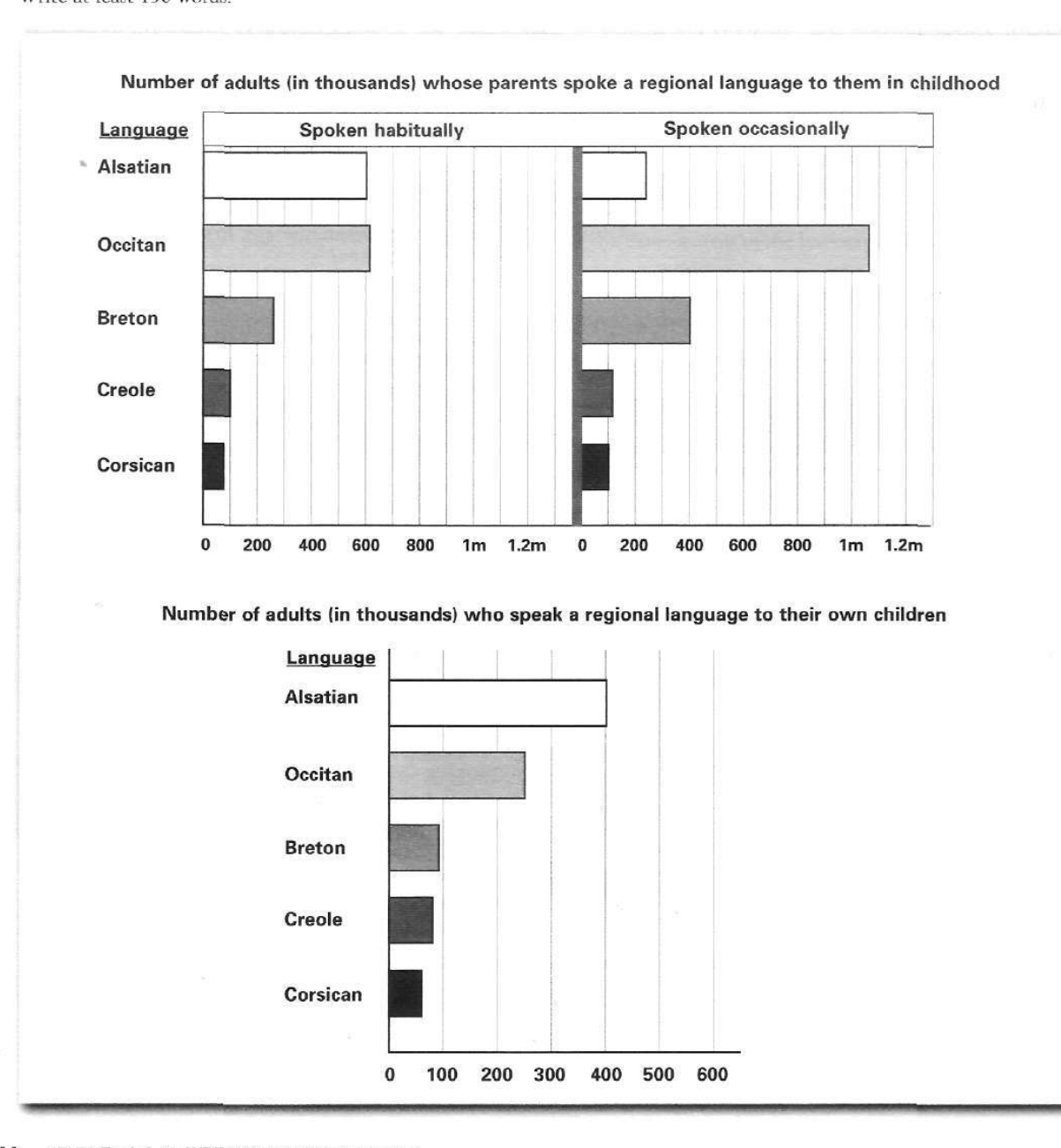
The charts below show the number of French adults whose parents spoke a French regional language to them when they were children and the number who speak a French regional language to their own children.
Write a report for a university lecturer describing the information below.
Number of adults (in thousands) whose parents spoke a regional language to them in childhood
Student answer (Band 6.0)
The first chart illustrates the number of adults whose parents spoke a regional language both habitually and occasionally to them in their childhood while the second chart shows the number of grown ups who speak a regional language to their own kids.
It seems clear that when spoken out of habit, Alsatian and Occitan languages take the lead with 600 thousands of adults, Breton surpasses 200 of people, while Creole only reaches 100 of adults and Corsican is the least amount of spoken language habitually with almost 100.
On the other hand, when spoken occasionally, Occitan language is way ahead of its competitors with more than a million. Breton and Alsatian is in the middle, and the least spoken are Creole and Corsican. Occitan language takes the lead in both spoken habitually and occasionally.
Even though most children's parents spoke to them in Occitan language in the first graph, it seems like adults in the second chart speak to their children in Alsatian the most with 400, Occitan comes second with 250 and Creole and Corsican are the least spoken out of five, not even reaching 100.
AI examiner evaluation
| Criterion | Band |
|---|---|
| Task Achievement / Task Response | 6.0 |
| Coherence and Cohesion | 6.5 |
| Lexical Resource | 6.0 |
| Grammatical Range and Accuracy | 6.0 |
| Overall | 6.0 |
Task Achievement / Task Response: Band 6.0
You cover both charts and make relevant comparisons, including the key contrast that Occitan is highest for occasional parental speech while Alsatian leads in speech to children. Several figures are broadly accurate: you report about 600,000 for habitual Alsatian, over a million for occasional Occitan, and 400,000 and 250,000 for the two leading languages in the second chart. However, the overview is not fully reliable: Occitan does not lead habitual speech; it is slightly above Alsatian at about 620,000, and the final claim that most parents spoke Occitan is too broad because the charts distinguish habitual and occasional use. Some middle and lower values are described only generally. A clearer overview and more precise comparisons across both charts would strengthen coverage.
Coherence and Cohesion: Band 6.5
The response has a coherent overall arrangement: it introduces the charts, discusses habitual and occasional speech, then compares these figures with language use by adults speaking to their own children. Transitions such as “On the other hand” and “Even though” help signal shifts, and the main comparisons are generally easy to follow. This already shows some progression, but cohesion is not consistently controlled. The repeated phrase “takes the lead” and the return to Occitan in the final paragraph make the comparison feel somewhat repetitive, while “it seems like” leaves the final point less direct. Grouping the figures into clearer comparisons—for example, the two leading languages and then the lower figures—would make the progression more deliberate and the links between charts clearer.
Lexical Resource: Band 6.0
You use an adequate range of task-related vocabulary, including “habitually,” “occasionally,” “surpasses,” “competitors,” and “least spoken,” so the reader can understand the main comparisons. There are also attempts to vary wording, such as “grown ups” and “kids,” but these are too informal for a university report; “adults” and “children” would be more appropriate. Some collocations and expressions are imprecise, including “600 thousands of adults,” “the least amount of spoken language habitually,” and “way ahead.” Repeated use of “takes the lead” also limits variety. Choose more precise reporting language such as “approximately,” “recorded,” and “was the highest,” and use standard forms for quantities and categories.
Grammatical Range and Accuracy: Band 6.0
You use both simple and complex sentence forms, including a clear introductory sentence with “while” and a contrast introduced by “Even though.” Most meanings remain understandable, and the response is not limited to short, basic statements. Some grammatical errors persist, however. In “Breton and Alsatian is in the middle,” the plural subject requires “are”; “600 thousands” should be “600 thousand”; and “Corsican is the least amount” does not form a grammatical comparison. There are also spacing and punctuation issues, such as the extra space before “adults” in the final paragraph, and some long sentences would benefit from clearer punctuation. Check subject–verb agreement, quantity forms, and sentence boundaries when editing.
See this exact question answered at other band scores. The same prompt compared across bands.
Browse more IELTS Writing model answers or get your own writing scored by the same AI examiner.