Band 6.0 IELTS Writing Task 1 Model Answer
Overall Band Score: 6.0 · IELTS Complete Catalyst · 2026-11-26
IELTS Writing Task 1 question
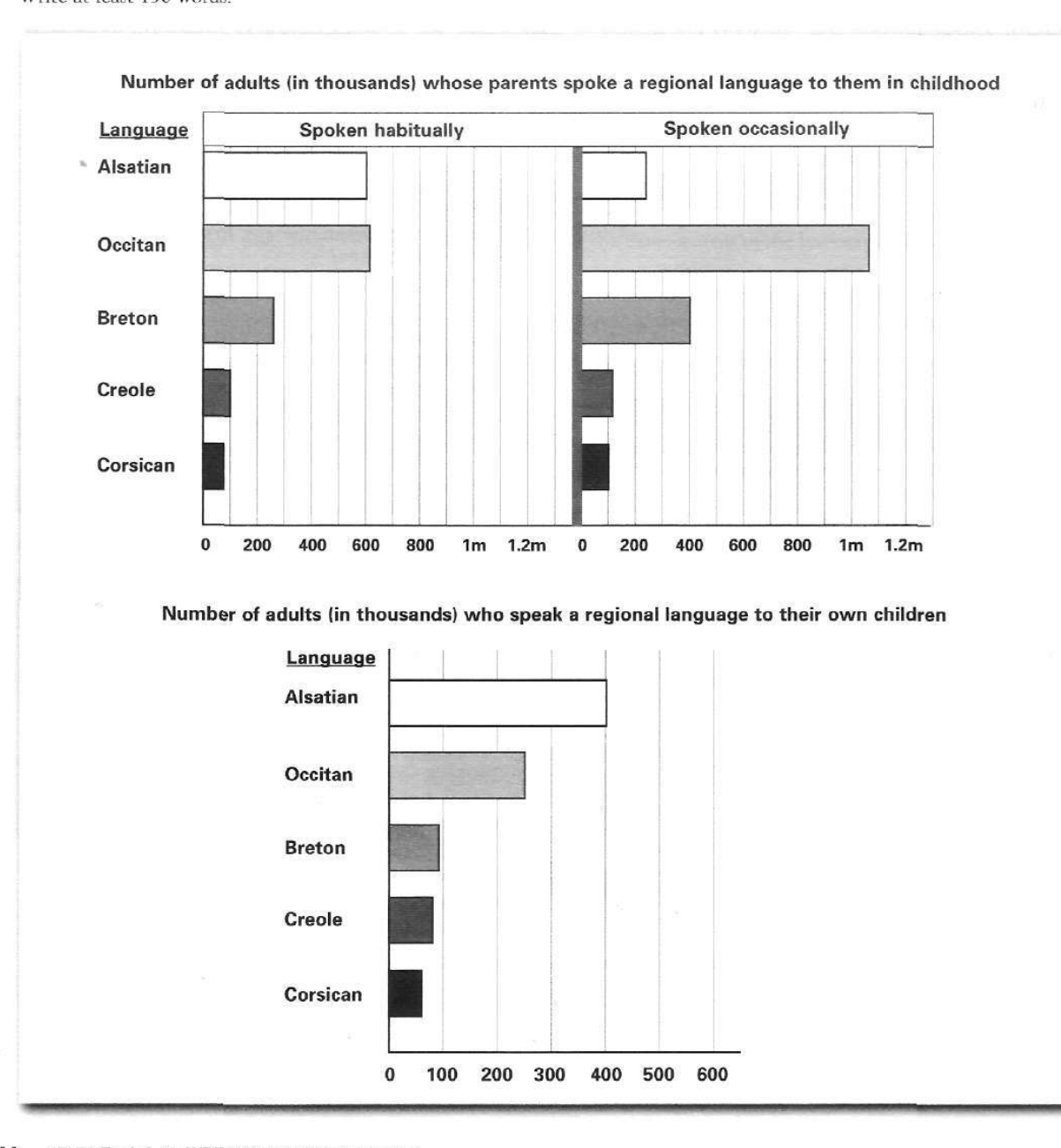
The charts below show the number of French adults whose parents spoke a French regional language to them when they were children and the number who speak a French regional language to their own children.
Write a report for a university lecturer describing the information below.
Number of adults (in thousands) whose parents spoke a regional language to them in childhood
Student answer (Band 6.0)
The charts illustrate the number of French people whose parents spoke a French regional language to them when they were little and who speak regional languages to their children.
Overall, Breton, Creole and Corsican were spoken by relatively small number of people. Most of the parents spoke Occitan when they were children, while highest number of adults speak Alsatian to their own children.
Alsatian and Occitan were spoken habitually by almost similar number of people, that was 600,000. Occitan was spoken occasionally by approximately 1.15 million adults' parents while only 250,000 adults' parents spoke Alsatian occasionally. However, Breton was spoken habitually by 250,000 adults' parents and occasionally by 400,000 parents. Number of adults whose parents spoke Creole habitually and occasionally were 100,000 and 120,000 respectively, and for Corsican the numbers were 80,000 and 100,000 respectively.
In contrast, most of the adults speak Alsatian that is 400,000 speak Alsatian to their children while Occitan dropped its popularity where only 250,000 people speak that language. Breton, Creole, and Corsican record values below than 100,000 whereas the lowest number of adults 50,000 people speak Corsican
AI examiner evaluation
| Criterion | Band |
|---|---|
| Task Achievement / Task Response | 6.5 |
| Coherence and Cohesion | 6.5 |
| Lexical Resource | 6.0 |
| Grammatical Range and Accuracy | 5.5 |
| Overall | 6.0 |
Task Achievement / Task Response: Band 6.5
The report covers both charts and gives a clear overview, identifying the small figures for Breton, Creole and Corsican and the prominence of Alsatian among adults speaking to their children. Several comparisons are relevant, including the large occasional Occitan figure and the fall from childhood exposure to speaking Occitan with the next generation. However, the overview is not fully accurate: Occitan, not Alsatian, has the highest total parental exposure when habitual and occasional figures are considered, and the claim that most parents spoke Occitan is too broad. The final comparison also says all three smaller languages are below 100,000, although Creole is about 100,000. More precise synthesis of the two parental categories and careful checking of the figures would make the coverage more complete.
Coherence and Cohesion: Band 6.5
The response has a recognisable four-paragraph structure: introduction, overview, details of childhood exposure, and comparison with language use by adults’ children. This gives the reader a generally coherent route through the information, and transitions such as “Overall” and “In contrast” help signal the report’s stages. Some links and references are less clear, however. In “Alsatian and Occitan were spoken habitually by almost similar number of people, that was 600,000,” the reference to the figure is awkward and does not clearly distinguish the two values. The final paragraph also combines several comparisons in a long sentence and ends abruptly, weakening progression. Grouping the figures by larger and smaller languages, and using clearer references to each chart, would make cohesion more flexible and precise.
Lexical Resource: Band 6.0
The vocabulary is adequate for describing the charts, with useful terms such as “habitually,” “occasionally,” “approximately,” and “dropped its popularity.” The writer also varies the repeated chart language to some extent. However, several choices are imprecise or unnatural: “when they were little” is informal for an academic report, “most of the parents spoke Occitan” overstates the data, and “record values below than 100,000” is not a natural collocation. Repetition of “spoken” and “number of adults” also limits flexibility. Aim for accurate, neutral reporting verbs and phrases such as “the figures stood at,” “was transmitted to,” and “declined to.” This would improve precision while retaining the clear, task-appropriate vocabulary already present.
Grammatical Range and Accuracy: Band 5.5
The response uses a mix of simple statements and some more developed structures, and the main comparisons are generally understandable. There are nevertheless several grammatical errors, including missing articles and agreement problems: “by relatively small number” should be “by a relatively small number,” and “Number of adults … were” needs an article and a singular verb (“The number … was”). The construction “that was 600,000” is also poorly attached to the preceding clause, while the final sentence lacks clear punctuation and a complete ending. These errors do not usually prevent understanding, but they reduce accuracy and control. Check articles, singular/plural agreement, and sentence boundaries, and divide the final comparison into shorter, complete sentences.
See this exact question answered at other band scores. The same prompt compared across bands.
Browse more IELTS Writing model answers or get your own writing scored by the same AI examiner.