Band 6.0 IELTS Writing Task 1 Model Answer
Overall Band Score: 6.0 · IELTS Complete Catalyst · 2026-11-27
IELTS Writing Task 1 question
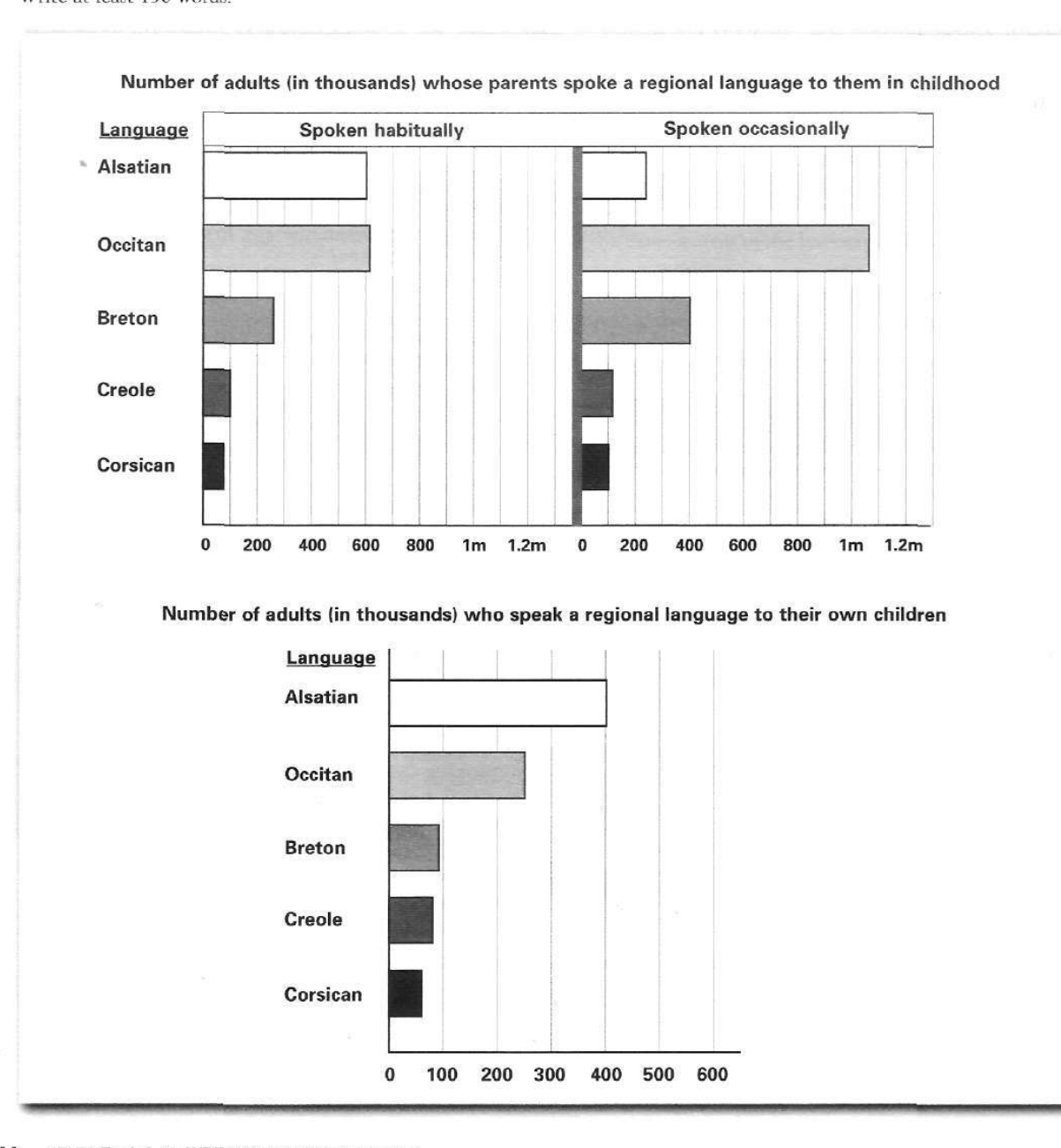
The charts below show the number of French adults whose parents spoke a French regional language to them when they were children and the number who speak a French regional language to their own children.
Write a report for a university lecturer describing the information below.
Number of adults (in thousands) whose parents spoke a regional language to them in childhood
Student answer (Band 6.0)
The bar charts illustrate that number of people whose parents spoke them a French regional language when they were a child and also the number who speak afrench regional language to their own chldren.
Overall, Occitan and Alsatian were the most widely spoken languages during childhood wheras Creole and Corsican were the least common.
In terms of spoken habitually during childhood, also Occotan and Alsatian were identical at approximatelly 600,000 each followed by Breton at around 260,000. Regarding languages spoken accasionally Occitan ranked first over one milion, compared with 400,000 for Breton and 250,000 for Alsatian. The figure for Creole and Corsican were considerable lower in both categories, spoken habiitually and occasionally, around at 105,000 and 100,000, respectively.
Turning to second chart Alsatian was spoken by around 400,000 adults to their own children, followed by Occitian at 250,000. By contrast the corresponding figure for Breton, Creole and Corsican were all below 100,000
AI examiner evaluation
| Criterion | Band |
|---|---|
| Task Achievement / Task Response | 6.0 |
| Coherence and Cohesion | 6.5 |
| Lexical Resource | 6.0 |
| Grammatical Range and Accuracy | 5.5 |
| Overall | 6.0 |
Task Achievement / Task Response: Band 6.0
You cover both charts and provide a relevant overview, identifying Occitan and Alsatian as the leading childhood languages and Creole and Corsican as the least common. Several key comparisons are also accurate: Occitan was spoken occasionally by just over one million adults, while Alsatian was the most common language passed on to children, at about 400,000. However, the overview could describe the contrast between childhood use and transmission to the next generation more clearly. There are also some imprecise or incomplete details: Alsatian and Occitan were not identical in habitual childhood use (about 600,000 and 620,000), and the final figures for the three smallest groups are not specified. A clearer summary of the main patterns and more precise comparisons would strengthen coverage.
Coherence and Cohesion: Band 6.5
The report has a clear overall arrangement: an introduction, an overview, a paragraph on childhood use, and a final paragraph on speaking to children. Sequencing phrases such as “Overall,” “Regarding,” and “Turning to” help the reader follow the shift between categories, and the comparisons are generally grouped sensibly. This meets the lower-band expectations securely and shows some effective progression. To make the organisation more polished, avoid awkward or unclear links such as “also Occotan and Alsatian” and “compared with 400,000 for Breton and 250,000 for Alsatian,” where the comparison takes effort to interpret. Use more precise references and connect the two charts explicitly, rather than relying mainly on formulaic transitions.
Lexical Resource: Band 6.0
You use an adequate range of task-related vocabulary, including “widely spoken,” “ranked first,” “corresponding figure,” and “considerable lower.” These choices show an attempt to describe rankings and comparisons, and the meaning is generally understandable. However, some word choices and collocations are inaccurate or awkward, such as “spoken them a French regional language,” “spoken habitually during childhood,” and “considerable lower.” Spelling errors—including “Occotan,” “approximatelly,” “accasionally,” and “habiitually”—also reduce precision. Aim for accurate, natural chart-reporting phrases and check spelling carefully; this would make your descriptions more fluent and exact without needing unnecessarily complex vocabulary.
Grammatical Range and Accuracy: Band 5.5
You attempt a mix of simple and more developed sentence forms, including the contrast introduced by “By contrast” and the longer comparison beginning “Regarding languages spoken occasionally.” Most of the intended meaning can be followed, but some grammatical errors remain. For example, the opening sentence lacks an article in “illustrate that number,” and “whose parents spoke them a French regional language” has an incorrect sentence pattern. There are also agreement and article problems in “The figure for Creole and Corsican were” and “the corresponding figure for Breton, Creole and Corsican were.” Some sentences are also incomplete or awkwardly punctuated, particularly the sentence listing the lower figures. Review articles, subject–verb agreement, and sentence boundaries to improve control.
See this exact question answered at other band scores. The same prompt compared across bands.
Browse more IELTS Writing model answers or get your own writing scored by the same AI examiner.