Band 4.5 IELTS Writing Task 1 Model Answer
Overall Band Score: 4.5 · IELTS Complete Catalyst · 2026-11-28
IELTS Writing Task 1 question
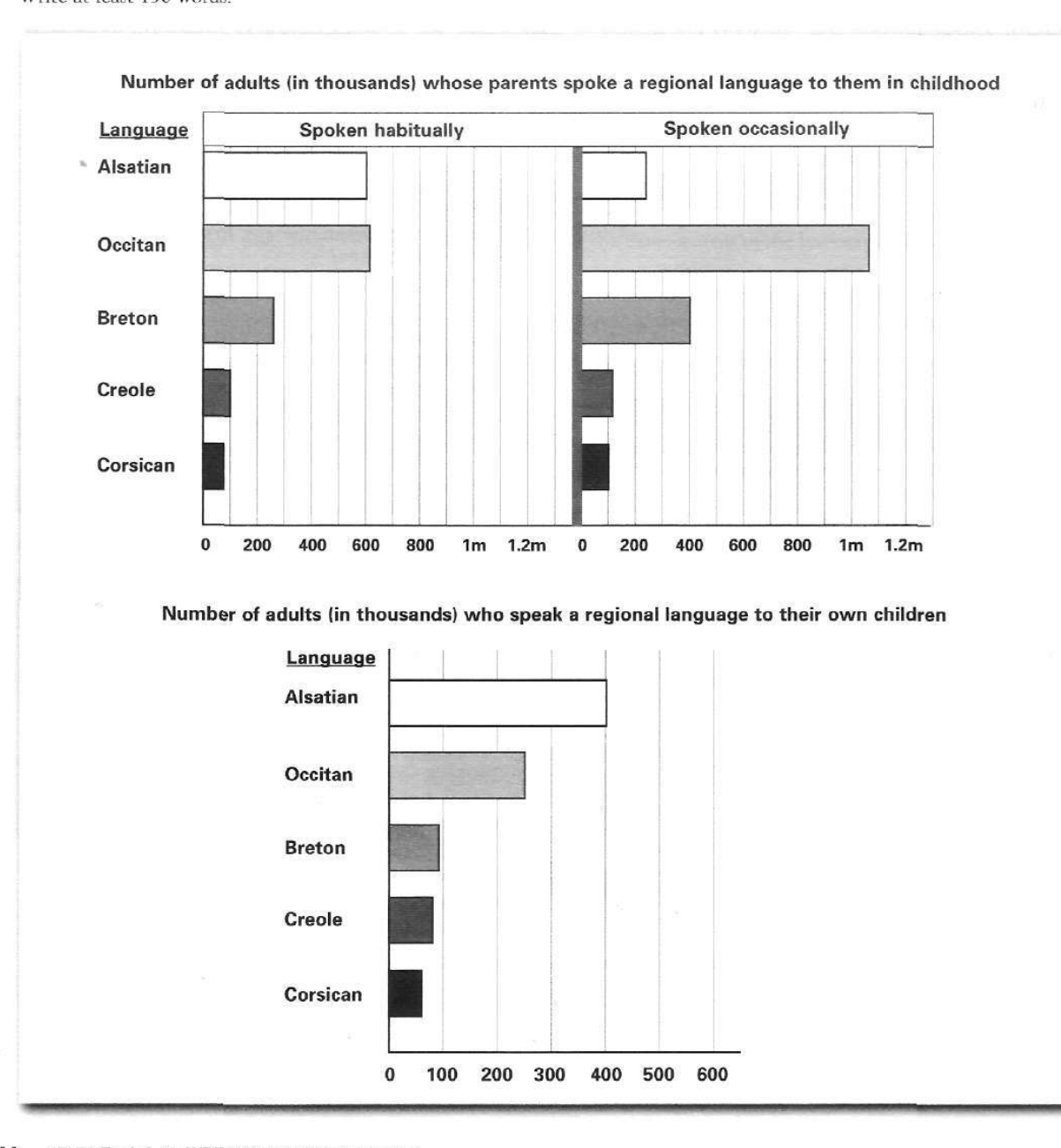
The charts below show the number of French adults whose parents spoke a French regional language to them when they were children and the number who speak a French regional language to their own children.
Write a report for a university lecturer describing the information below.
Number of adults (in thousands) whose parents spoke a regional language to them in childhood
Student answer (Band 4.5)
Number of French adults whose parents spoke a French regional language to them when they were children and the number who speak a French regional language to their own children.
In my opinion as I saw in the both graphs Alsation speak french habitually more than occasionally. on the other hand Occitan speaks more french occasionally than habitually. But as i see Occitan and Alsation speak almost same french habitually. Breton speak less french habitually than occasionally. Creole and Corsican speak almost same french habitually and occasionally.
On The other hand as i see in graph second. In Recent times Alsation adults speak More English than occitan. This big change have been seen In one generation. while breton adults speak less french then their parents. Adults of Corsican and Creole Speak More French Than Their Parents
In Conclusion, The No Of Adults who speaks french Increases In Alsatian. while The No Of young decreases in occatin In One Generation Gap.
AI examiner evaluation
| Criterion | Band |
|---|---|
| Task Achievement / Task Response | 3.5 |
| Coherence and Cohesion | 5.0 |
| Lexical Resource | 5.0 |
| Grammatical Range and Accuracy | 5.0 |
| Overall | 4.5 |
Task Achievement / Task Response: Band 3.5
The response identifies some relevant contrasts, such as Occitan being spoken more occasionally than habitually and Alsatian having the largest figure for speaking a language to children. However, several claims misread the chart: Alsatian is not higher than Occitan for habitual use (about 600,000 versus 620,000), and the second chart concerns regional languages, not English. The conclusion that numbers increase for Alsatian and decrease for Occitan is also unclear and does not accurately summarise the figures. A clear overview and accurate comparisons across both charts are missing, and the report is under the 150-word minimum: 130 words were counted, with 30 prompt words excluded. Describe the data directly and support the overview with key figures.
Coherence and Cohesion: Band 5.0
There is some basic organisation: an opening line, a paragraph comparing the first chart, a paragraph about the second, and a conclusion. Connectors such as “On the other hand” and “In Conclusion” signal relationships between sections. However, progression is difficult to follow because the comparisons are not consistently organised by chart or by language, and the same contrastive phrase is repeated. References such as “this big change” and “the No of young” are unclear, while the conclusion introduces a claim that is not clearly linked to the preceding details. Group the figures into a logical sequence, use clear references, and reserve contrast markers for genuine contrasts.
Lexical Resource: Band 5.0
The response uses some task-related vocabulary, including “habitually,” “occasionally,” “adults,” and “one generation,” so the reader can recognise the general subject. However, the range is limited and several choices are inaccurate or unsuitable for a chart report. “Speak more English” misidentifies the languages shown, while “No of young” and “speak French” do not precisely describe the data. There are also spelling and form problems in names such as “Alsation” and “occatin,” and repeated capitalisation distracts from the report. Use precise terms such as “regional language,” “number of adults,” “higher/lower,” and “approximately,” and check the spelling of each language name.
Grammatical Range and Accuracy: Band 5.0
The response communicates some simple comparisons, for example, “Occitan speaks more french occasionally than habitually,” and attempts longer sentences using contrast clauses. However, the range remains limited, and errors in sentence construction and agreement occur frequently enough to make some statements difficult to interpret. Examples include “Alsation speak,” “This big change have been seen,” and “the No Of Adults who speaks.” Capitalisation and punctuation are also inconsistent, including sentence openings such as “on the other hand” and unnecessary capitals within sentences. Practise accurate subject–verb agreement and complete sentence patterns, such as “Alsatian adults spoke the language habitually,” before adding more complex comparisons.
See this exact question answered at other band scores. The same prompt compared across bands.
Browse more IELTS Writing model answers or get your own writing scored by the same AI examiner.