Band 5.5 IELTS Writing Task 1 Model Answer
Overall Band Score: 5.5 · IELTS Complete Catalyst · 2026-11-05
IELTS Writing Task 1 question
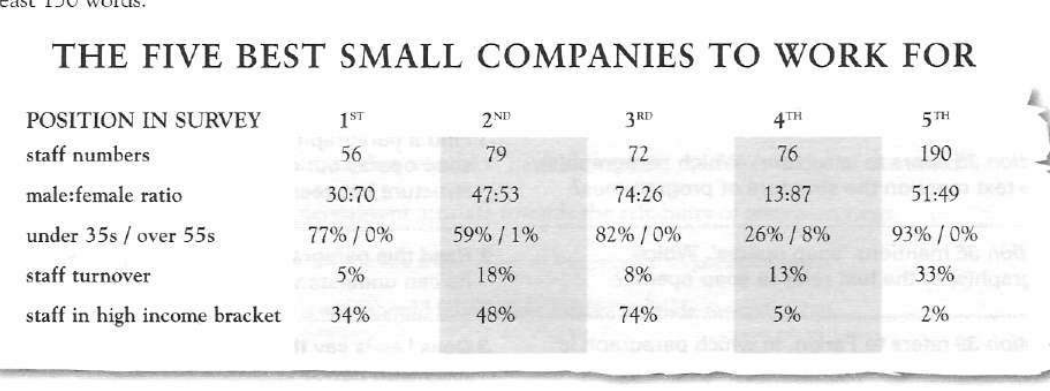
The table below gives information about the five small companies in Britain that came top in a survey of staff conducted by a national newspaper to find out which companies are the best to work for.
Summarise the information by selecting and reporting the main features, and make comparisons where relevant.
THE FIVE BEST SMALL COMPANIES TO WORK FOR
Student answer (Band 5.5)
The table illustrates a survey of five of the best small companies to work for in the UK, conducted by a national newspaper.
Overall, there are five different categories (Staff numbers, male-to-female ratio, age factors, staff turnover, staff in high income); these are the measurable factors of those
e companies as the best categories.
The 3rd company has the highest staff-to-high-income ratio, at almost 74%,with 8% staff turnover; the 5th company's staff-to-high-income ratio is the opposite, at only 2% and in this company has the highest number of staff, with almost equal gender of workers(51:49), 35% workers are under 35, staff turnover ratio is almost 33%.
The 2nd company has the 2nd highest staff in the high-income bracket at 48%, with 18% staff turnover ratio; 59% of workers are under 35 years, and 1% are over 55 years; the male: female ratio is 47:53, with 79 workers. According to the table, the 2nd-lowest staff with high income is the 4th company, with 76 workers and a 13% staff turnover rate; its female workers are the highest among the 5 companies(male: female 13:87); 26% of staff are under 35 and 8% are over 55.
Lastly, the first company has 56 staff members with a 34% income bracket; 77% are under 35 years and 0% are over 55 years; the staff gender ratio is male: female 77%/0%; the staff turnover ratio is almost 5%.
AI examiner evaluation
| Criterion | Band |
|---|---|
| Task Achievement / Task Response | 5.0 |
| Coherence and Cohesion | 5.5 |
| Lexical Resource | 5.5 |
| Grammatical Range and Accuracy | 5.5 |
| Overall | 5.5 |
Task Achievement / Task Response: Band 5.0
You identify the table’s subject and report several relevant comparisons, including the third-placed company’s 74% high-income figure and the fifth-placed company’s 33% turnover. However, the overview does not clearly summarise the main patterns: it mainly lists the categories and then discusses individual companies. Some figures are also misreported. For the fifth company, 93% of staff are under 35, not 35%; for the first company, 30:70 is the male-to-female ratio, not 77%/0%. The first company’s 34% refers to staff in the high-income bracket, rather than an “income bracket” generally. Select the strongest overall contrasts and check each figure against the table to make the summary more accurate and complete.
Coherence and Cohesion: Band 5.5
The response has a recognisable structure: an introduction, an overview-like paragraph, and further comparisons grouped by company. Phrases such as “The 2nd company” and “Lastly” help signal movement between points. However, the overview does not establish a clear organising pattern, and the body reads largely as a sequence of company-by-company details rather than a progression built around key comparisons. The phrase “these are the measurable factors” repeats information from the introduction without summarising the results. Grouping companies by shared contrasts—for example, turnover or age profile—and using clearer links between those comparisons would make the organisation more coherent and cohesion less repetitive.
Lexical Resource: Band 5.5
You use relevant task vocabulary, including “staff turnover,” “male-to-female ratio,” and “high-income bracket,” and these terms help communicate the table’s categories. There is some attempt to vary phrasing, such as “workers” and “staff members.” However, several expressions are imprecise or unnatural, including “staff-to-high-income ratio,” “age factors,” and “the opposite,” which make comparisons less clear. “Almost” is also used for exact figures such as 74% and 5%, where it adds little precision. Aim for standard collocations such as “proportion of employees in the high-income bracket” and “turnover rate,” and use direct comparative language to describe the figures.
Grammatical Range and Accuracy: Band 5.5
The response includes both simple statements and longer sentences with clauses, as in “The 2nd company has the 2nd highest staff in the high-income bracket at 48%, with 18% staff turnover ratio.” Meaning is generally recoverable, but control becomes less secure in longer constructions. For example, “with almost equal gender of workers(51:49), 35% workers are under 35” joins details without clear grammatical links, while “and in this company has the highest number of staff” lacks a clear subject. There are also punctuation and spacing problems, such as the missing space before “with” after “74%,” and inconsistent punctuation around ratios. Use shorter, complete clauses and check articles, sentence boundaries, and punctuation when combining several statistics.
See this exact question answered at other band scores. The same prompt compared across bands.
Browse more IELTS Writing model answers or get your own writing scored by the same AI examiner.