Band 4.5 IELTS Writing Task 1 Model Answer
Overall Band Score: 4.5 · IELTS Complete Catalyst · 2026-11-07
IELTS Writing Task 1 question
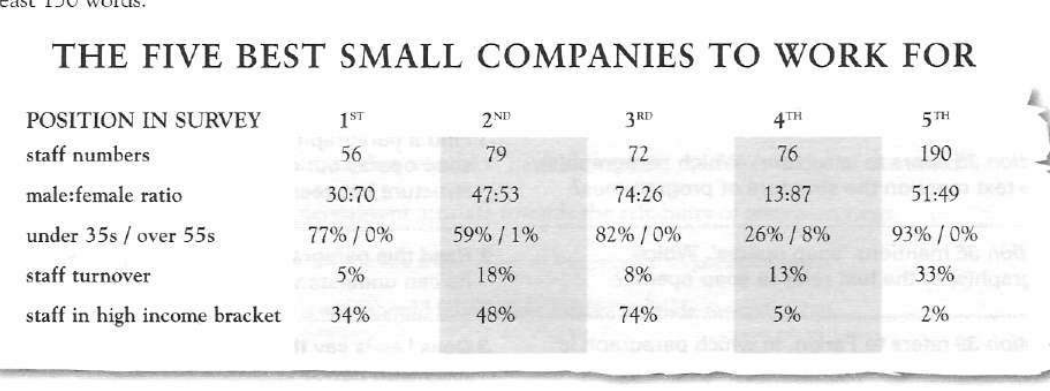
The table below gives information about the five small companies in Britain that came top in a survey of staff conducted by a national newspaper to find out which companies are the best to work for.
Summarise the information by selecting and reporting the main features, and make comparisons where relevant.
THE FIVE BEST SMALL COMPANIES TO WORK FOR
Student answer (Band 4.5)
The table below demonstrate the five small best companies in Britain for working.
overall, there are five position mention in the table are mention as staff numbers,male:female ratio, under 35s\over 55,staff turnover ,and staff in high income bracket repectively.
furthermore, the largest number of staff are in 5th company with 190 people and there male female ratio i 51:49 and they have all the staff under 35 age and no staff over 55 and staff turnover is 33% and staff in high income i only 2 %.the firt company and 56 number of staff with male female ratio of 30:70 and under 35 age 77% and no over 55 age staff and 5% staff turnover and staff in high income in 34%.
The second company have 79 staff and male :female ratio is 47:53 and 1 % over 55 age and 59% under 35,and staff turnover is 18 % and staff in high income i 48%.the third company have 7 staff with 74:26 male female ratio an under 35 82% and over 55 0%staff and staff turnover of 8% and 74% staff in high income,the forth company have 76 staff and 13:87 ra
AI examiner evaluation
| Criterion | Band |
|---|---|
| Task Achievement / Task Response | 4.5 |
| Coherence and Cohesion | 4.5 |
| Lexical Resource | 5.0 |
| Grammatical Range and Accuracy | 4.5 |
| Overall | 4.5 |
Task Achievement / Task Response: Band 4.5
You identify several relevant features, including the largest workforce (190 in fifth place), the first company’s 5% turnover, and the high-income figures for the second and third companies. However, the response does not provide a clear, accurate overview of the main comparisons, and the final discussion of the fourth company is cut off. Some data are misreported: the third company has 72 staff, not 7, and the fifth company has 93% under 35, rather than all staff being under 35. The opening mainly lists the table categories instead of summarising its key patterns. To make the report more complete, give a concise overview of notable contrasts, then accurately compare the companies across selected measures.
Coherence and Cohesion: Band 4.5
The response follows a potentially useful order by discussing the companies one by one, and words such as “furthermore” and “the second company” help signal movement between points. However, the information is presented in long, crowded sentences, with little paragraphing or clear separation between the overview and supporting details. The opening sentence about the table’s categories does not establish a meaningful progression, and the final sentence stops partway through the fourth company’s description. This makes the report feel incomplete and difficult to follow. Organise it into an overview followed by grouped comparisons, and use shorter sentences so each company’s figures and contrasts are easy to track.
Lexical Resource: Band 5.0
You use relevant topic vocabulary, including “staff turnover,” “male female ratio,” and “high income bracket,” so the reader can recognise the measures being described. However, the range is limited and several phrases are awkward or imprecise, such as “five position mention,” “largest number of staff are in 5th company,” and “staff in high income i only 2%.” Spelling errors, including “repectively” and “firt,” also reduce accuracy and polish. Aim for standard report language and more precise collocations, for example, “ranked fifth,” “employed 190 people,” and “the proportion of staff in the high-income bracket.” These changes would make the comparisons clearer and more natural.
Grammatical Range and Accuracy: Band 4.5
The response attempts to connect several pieces of information in sentences, but sentence structures are mostly simple or run together, and frequent errors make the relationships between figures harder to understand. Examples include “The table below demonstrate,” “The second company have 79 staff,” and “the third company have 7 staff,” where subject–verb agreement is incorrect. Articles and sentence boundaries are also problematic, as in “the largest number of staff are in 5th company,” while the final sentence ends unfinished. Use complete sentences with consistent present-tense verbs, check singular and plural agreement, and punctuate each company’s description separately. A few accurate comparative or complex structures would also help show relationships between the data.
See this exact question answered at other band scores. The same prompt compared across bands.
Browse more IELTS Writing model answers or get your own writing scored by the same AI examiner.