Band 5.5 IELTS Writing Task 1 Model Answer
Overall Band Score: 5.5 · IELTS Complete Catalyst · 2026-11-10
IELTS Writing Task 1 question
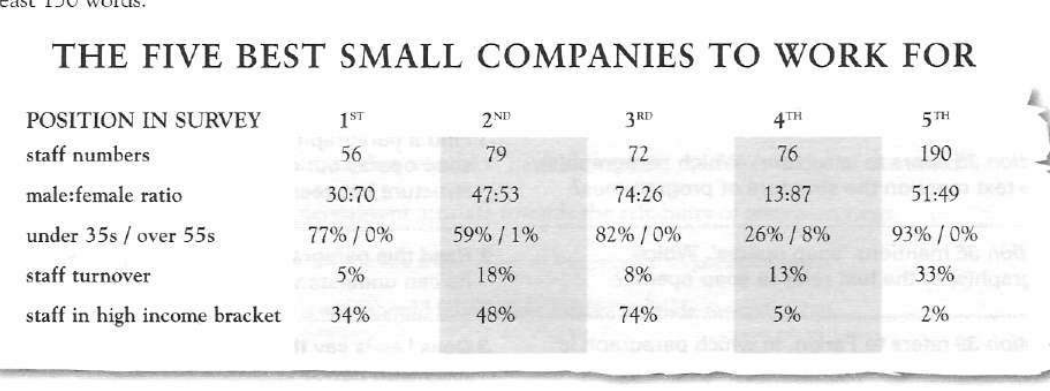
The table below gives information about the five small companies in Britain that came top in a survey of staff conducted by a national newspaper to find out which companies are the best to work for.
Summarise the information by selecting and reporting the main features, and make comparisons where relevant.
THE FIVE BEST SMALL COMPANIES TO WORK FOR
Student answer (Band 5.5)
The tables describes five small countries in Britain that came top in a survey of staff conducted by a national newspaper to find the best working company. Overall, staff numbers varies inproportional to the ranking of the company such as number one ranked has the best staff number 56 and it increases as the rank decreases, so for fifth ranked the number stands at 190. As for as male to female ratio is concerned, first ranked has more female employees as compare to male with 30:70 ratio,whereas highest male workers are with third ranked and highest female with fourth ranked small company. It is prminent from the table that ranked first, third and fifth have zero staff over 55 years of age whereas fouth rank has the highest with 8 percent and second has just one percent of the employees over 55 years. However, for under 35 years, highest percentage of employes are with fifth rankes which is 93 percent, and least with second ranked that is 59 percent. First ranked company has the least staff turnover 5 percent, and fifth ranked has the highest 33 percent. Lastly, the staff in high income bracket, third rankes has the highest number of employees with 74% and fifth one has the least with 2%.
AI examiner evaluation
| Criterion | Band |
|---|---|
| Task Achievement / Task Response | 6.0 |
| Coherence and Cohesion | 5.5 |
| Lexical Resource | 5.5 |
| Grammatical Range and Accuracy | 5.5 |
| Overall | 5.5 |
Task Achievement / Task Response: Band 6.0
You cover the main categories in the table and make several relevant comparisons, including the smallest and largest workforces, the age profile, turnover, and high-income staff. Most figures are reported accurately, such as the 5% turnover at the top-ranked company and the 33% at the fifth-ranked company. However, the opening says staff numbers increase as ranking decreases, which is not a clear or fully accurate summary of the pattern: the figures fluctuate before reaching 190 in fifth place. There is also no concise overview of the most notable contrasts, such as the third-ranked company having the highest high-income share while the fifth has the highest turnover. Some comparisons are less fully developed, so select and summarise the key patterns more clearly.
Coherence and Cohesion: Band 5.5
The response follows a generally understandable order, moving from workforce size and gender to age, turnover, and income. Linking expressions such as “Overall,” “However,” and “Lastly” help signal these shifts. However, the information is presented as one long paragraph, so the overview and supporting details are not clearly separated. Some transitions also feel mechanical, and the sentence beginning “As for as male to female ratio is concerned” combines several comparisons without a clear progression. Group related figures into paragraphs and use a brief overview before the detailed comparisons. This would make the organisation easier to follow and reduce the need for repeated ranking-based phrasing.
Lexical Resource: Band 5.5
You use relevant vocabulary for describing the table, including “staff turnover,” “high income bracket,” “percentage,” and “ratio,” so the topic is generally clear. There is some attempt at more formal reporting language, for example “It is prominent from the table,” but several choices are inaccurate or unnatural and weaken precision. “Small countries” is not the correct term for the businesses, and phrases such as “best staff number” and “highest number of employees” are not always suitable when the data are percentages. Spelling errors, including “prminent,” “employes,” and “rankes,” are also noticeable. Aim for accurate collocations such as “workforce,” “proportion of staff,” and “ranked first,” and proofread spelling.
Grammatical Range and Accuracy: Band 5.5
You attempt a mixture of simple and more complex sentences, including comparisons introduced by “whereas” and “as … is concerned.” The main information is usually understandable, but some grammatical errors recur. For example, “The tables describes” has a subject–verb agreement error, while “staff numbers varies” should use a plural verb. The sentence “first ranked has more female employees as compare to male” also has problems with articles and comparative structure. Punctuation is sometimes missing, as in “30:70 ratio,whereas,” and several sentences are long enough to make relationships between ideas less clear. Check agreement, articles, and comparative forms, and divide longer sentences where needed.
See this exact question answered at other band scores. The same prompt compared across bands.
Browse more IELTS Writing model answers or get your own writing scored by the same AI examiner.