Band 5.5 IELTS Writing Task 1 Model Answer
Overall Band Score: 5.5 · IELTS Complete Catalyst · 2026-11-10
IELTS Writing Task 1 question
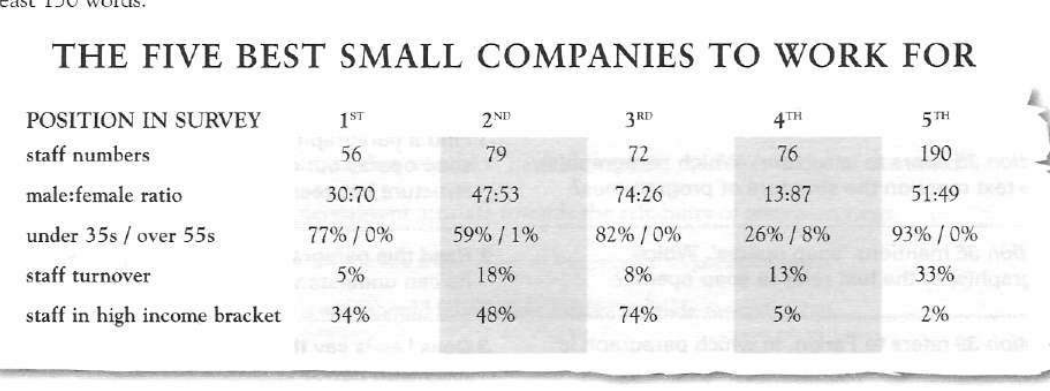
The table below gives information about the five small companies in Britain that came top in a survey of staff conducted by a national newspaper to find out which companies are the best to work for.
Summarise the information by selecting and reporting the main features, and make comparisons where relevant.
THE FIVE BEST SMALL COMPANIES TO WORK FOR
Student answer (Band 5.5)
The table given above illustrates the information about the five small companies in Britain that came top in a survey of staff.If we look at the staff numbers; the 5th company has most members and 1st company has least members.The number of employees are almost same in rest of 3 companies.The male :female ratio is mostly indifferent in 1st,3rd and 4th companies and almost same in 2nd and 5th company.
If we glance at age of employees there is no any staff above 55 in companies 1st ,3rd and 5th.But in 4th company there are 8% of staff whoc are above 55 and 1% in 2nd company.
The other aspect is staff turnover which is maximum in 5th and minimum in 1st company.On the other hand,staff with high income brackets are in 3rd company about 74% and least in 4th and 5th company which are 5% and 2%.
AI examiner evaluation
| Criterion | Band |
|---|---|
| Task Achievement / Task Response | 5.0 |
| Coherence and Cohesion | 5.5 |
| Lexical Resource | 5.5 |
| Grammatical Range and Accuracy | 5.0 |
| Overall | 5.5 |
Task Achievement / Task Response: Band 5.0
You identify several relevant comparisons, including the largest and smallest workforces, the age profile, turnover, and the highest and lowest high-income shares. Most figures you mention are accurate: for example, fifth place has the most staff, first place the fewest, and third place has the largest high-income group at 74%. However, the response is only a partial summary: it gives no clear overall overview of the companies’ main patterns, and the male-to-female comparison is vague (“mostly indifferent”). It also omits useful contrasts, such as the wide range in turnover and the differing age profiles. The response is 133 words, below the required 150; develop the overview and comparisons to meet the minimum.
Coherence and Cohesion: Band 5.5
The information is grouped into a broadly sensible sequence: workforce size and gender, then age, followed by turnover and income. Linking phrases such as “If we look at” and “On the other hand” help signal movement between points. However, the response has no paragraph breaks, so the different comparison areas run together, and the progression is not fully clear. Some links are mechanical or imprecise, particularly “The other aspect is staff turnover,” while the opening sentence largely repeats the task rather than establishing an overview. Use a brief introduction and overview, then separate related comparisons into paragraphs and connect them with clear references to the companies and figures.
Lexical Resource: Band 5.5
You use enough topic vocabulary to communicate the main categories, including “staff numbers,” “male:female ratio,” “staff turnover,” and “high income brackets.” Terms such as “maximum” and “minimum” also help express comparisons. However, the range is limited and several choices are unnatural or unclear: “mostly indifferent” does not accurately describe the gender ratios, and “most members” is less suitable than a term referring to employees or staff. There are also noticeable spelling and word-form errors, including “whoc” and “employees” where the sentence requires a singular form. Aim for precise comparison language and check spelling and collocations so the reader can interpret each point immediately.
Grammatical Range and Accuracy: Band 5.0
The response includes some attempts at complex sentences, such as “But in 4th company there are 8% of staff who are above 55 and 1% in 2nd company,” and most ideas remain understandable. However, the range is limited, and errors recur in sentence structure, agreement, articles, and punctuation. For example, “The number of employees are almost same” has a subject–verb agreement error and is missing an article; “there is no any staff” is not a correct negative construction. Several sentences also lack spaces after full stops or commas, and company references need clearer grammatical framing. Practise accurate comparative sentence patterns and proofread each sentence for agreement, articles, and punctuation.
See this exact question answered at other band scores. The same prompt compared across bands.
Browse more IELTS Writing model answers or get your own writing scored by the same AI examiner.