Band 6.0 IELTS Writing Task 1 Model Answer
Overall Band Score: 6.0 · IELTS Complete Catalyst · 2026-11-11
IELTS Writing Task 1 question
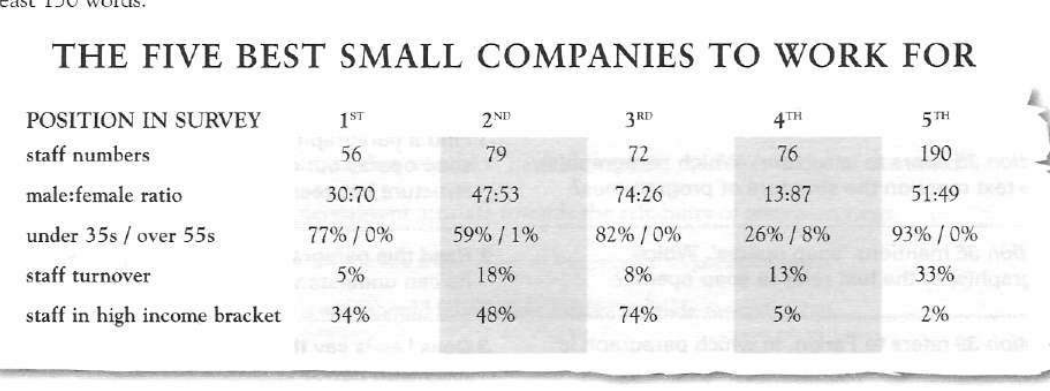
The table below gives information about the five small companies in Britain that came top in a survey of staff conducted by a national newspaper to find out which companies are the best to work for.
Summarise the information by selecting and reporting the main features, and make comparisons where relevant.
THE FIVE BEST SMALL COMPANIES TO WORK FOR
Student answer (Band 6.0)
The table illustrates about a survey of staff conducted by a national newspaper for top five small companies in Britain which are good to work for.
Overall, the fifth company has the highest staff numbers of male and female ratio but a high staff turnover too. The third company has a highest percentage of high income individuals while the fifth has the least. Three companies have no employ over 55s while the two have a minimal proportion.
The fifth company has a biggest staff of 190 individuals while the second to forth has in between 70 to 80. Male and female ratio is almost equal with a difference of two in fifth company which is 51:49 while the forth company has the highest difference which is 13:87. The first, third and fifth comapny has zero staff over 55s while the second has 1% and the forth 8%.
The fifth company accounted for a highest staff turnover at 33% while the first company shows least at 5%. The third company provides 74% of their employes with a high income while the forth and fifth have just 5% and 2%.
AI examiner evaluation
| Criterion | Band |
|---|---|
| Task Achievement / Task Response | 6.5 |
| Coherence and Cohesion | 6.0 |
| Lexical Resource | 5.5 |
| Grammatical Range and Accuracy | 5.5 |
| Overall | 6.0 |
Task Achievement / Task Response: Band 6.5
You identify the table’s subject and give a relevant overview, noting that the fifth-ranked company has the most staff and the highest turnover, while the third has the largest high-income share. Most figures you report are accurate, including the staff totals, age proportions, turnover extremes and income percentages. This covers the main features well and shows some comparison. However, the overview’s claim that the fifth company has the highest “male and female ratio” is unclear: its ratio is nearly balanced, whereas the fourth company has the strongest female majority. The first company’s 34% high-income figure and the second company’s 18% turnover are also omitted, leaving some comparisons less fully developed. A more precise overview and a few additional contrasts would make the account more complete.
Coherence and Cohesion: Band 6.0
The response has a clear overall arrangement: an introduction, an overview, and two paragraphs grouping staff and demographic details before turnover and income. This makes the information reasonably easy to follow, and comparisons such as the fifth company’s 33% turnover against the first company’s 5% help connect the data. However, progression within the overview is sometimes unclear, particularly in “highest staff numbers of male and female ratio,” which combines separate categories. Linking is also limited, with repeated use of “while” and “the fifth company,” and some references such as “the two” require the reader to infer which companies are meant. Use clearer category-based transitions and explicit references to each ranking to make cohesion less mechanical.
Lexical Resource: Band 5.5
You use relevant vocabulary for describing a table, including “staff turnover,” “percentage,” “proportion,” and “high income,” so the meaning is generally clear. There are also attempts at more formal reporting language, such as “accounted for” and “conducted.” However, several word choices and collocations are inaccurate or awkward: “illustrates about a survey,” “has a highest percentage,” and “provides … with a high income” do not express the intended relationships naturally. Spelling errors such as “comapny” and “employes” also reduce accuracy. Build a more reliable set of data-reporting phrases, and check spelling and word forms; for example, say that a company “ranked first” or that a percentage of staff “were in the high-income bracket.”
Grammatical Range and Accuracy: Band 5.5
You attempt both simple statements and more developed comparisons, and the reader can usually understand the data. Some sentence patterns are controlled, such as “The fifth company accounted for a highest staff turnover at 33% while the first company shows least at 5%.” However, errors in articles, agreement and sentence construction remain noticeable. Examples include “the top five small companies … which are good to work for,” “the second to forth has,” and “Three companies have no employ over 55s.” The overview sentence about the fifth company’s staff numbers and ratio is also difficult to parse because the grammatical relationship between the two measures is unclear. Practise accurate plural forms and article use, and separate distinct comparisons into clear clauses. This will improve control while retaining your attempts at complex sentences.
See this exact question answered at other band scores. The same prompt compared across bands.
Browse more IELTS Writing model answers or get your own writing scored by the same AI examiner.